 Getting More Matches
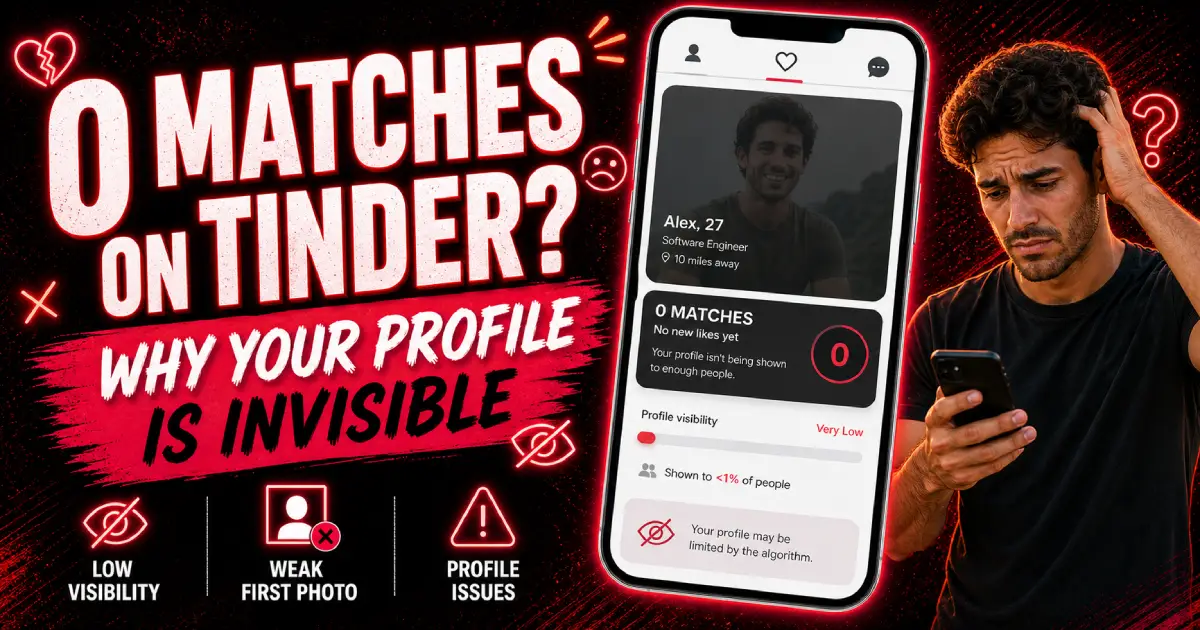
0 Matches on Tinder? Why Your Profile is Invisible
Zero matches on Tinder isn't bad luck — your profile is being suppressed by the algorithm. Here's exactly why it happens and how to become visible again.
In this article5 sections
You've been on Tinder for weeks. You're swiping right on profiles you're genuinely interested in. Your photos are fine — at least you think so. But the match notification never comes, or it comes so rarely it might as well not exist. Your profile feels like it's shouting into a void.
Here's what most people in this situation don't understand: zero matches on Tinder is almost never about your looks. It's about your profile's position in the algorithm. Tinder doesn't show everyone's profile to everyone. It makes decisions about who sees you based on a score — and if that score is low, you're being shown to fewer people, less often, in worse positions. You're not unattractive. You're invisible.
🔎 Are You Making These Invisibility Mistakes?
| Factor | Hurts your visibility | Helps your visibility |
|---|---|---|
| Profile completeness | Empty bio, fewer than 4 photos | Full profile, 6 photos, connected Spotify |
| Activity score | Logging in once a week | Daily engagement, fast replies |
| Photo quality | Blurry, dark, or group photos | Clear, well-lit solo headshot first |
| Swipe behavior | Swiping right on everything | Selective swiping signals higher standards |
| Recency | Account months old with no activity | Fresh engagement triggers recency boost |
If three or more rows in the left column describe you, algorithm suppression is your primary problem — not your face.
📸 Start With Your Photos
SharpScan gives you a free AI analysis of your Tinder photos — the fastest way to see what the algorithm and her first impression are both working against.
🤔 How Tinder's Desirability Score Actually Works
Tinder has used various versions of an internal ranking system — originally called the Elo score, later evolved into what they call a desirability score or activity-based ranking. Here's the honest simplified version of how it functions:
When you join Tinder, you're given an initial position in the queue. Your profile gets shown to a test audience. How that audience responds — do people swipe right or left, do they message after matching, do matches expire — all of this feeds back into your score. Your score determines who sees you and how prominently.
Key factors that influence it:
- Swipe ratio on your profile — what percentage of people who see you swipe right
- Match response rate — do your matches lead to conversations
- Account recency — fresh accounts and recently active accounts get a temporary visibility boost
- Selectivity signal — accounts that swipe right on everything are penalized; the algorithm interprets this as low-quality or spam behavior
This is why a new account sometimes gets a burst of matches, then slows down dramatically — the initial boost expires once your real engagement data comes in.
🚫 Why Your Profile Score Is Low: The 4 Real Reasons
Reason 1: Your First Photo Is Tanking Your Swipe Ratio
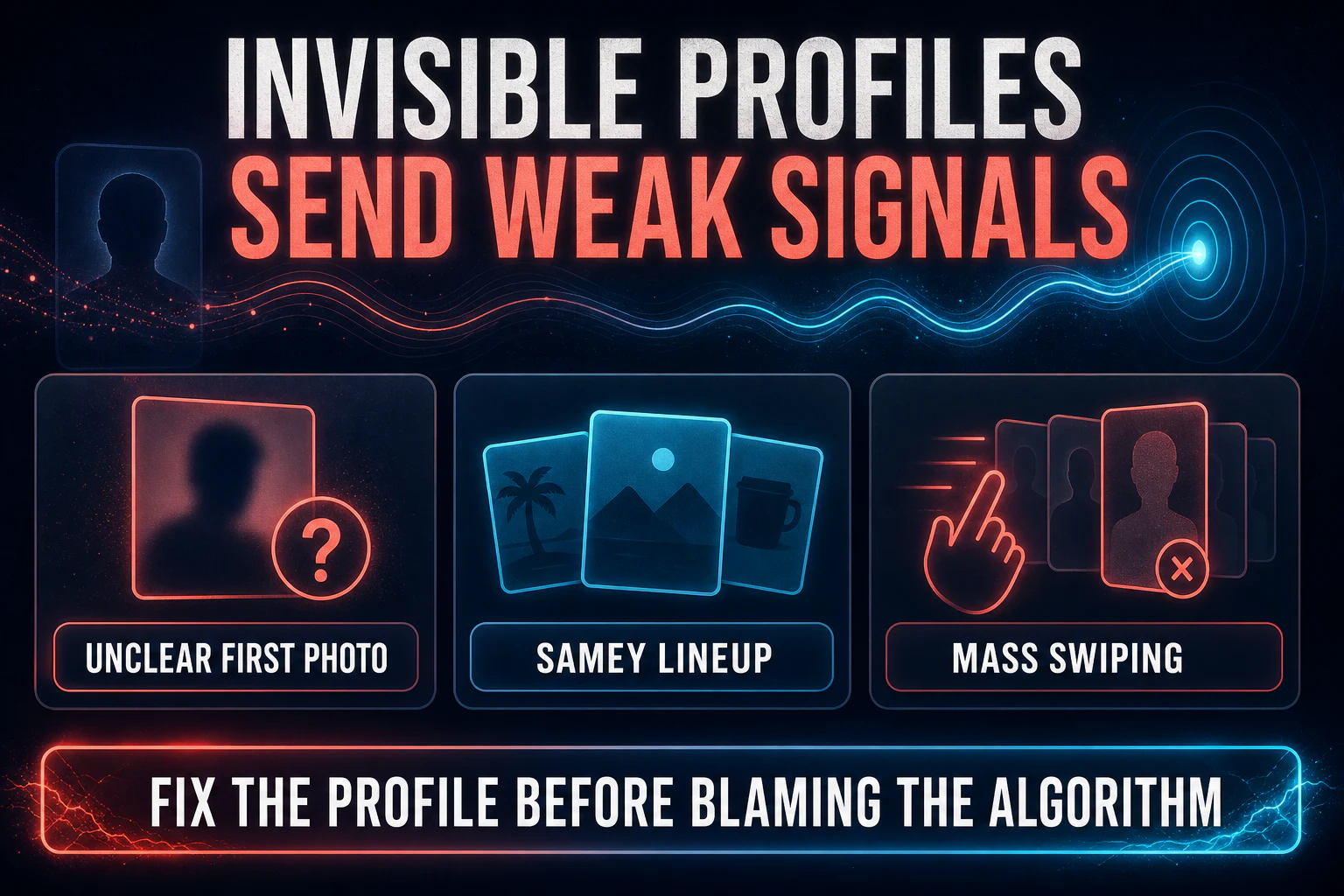
If people are seeing your profile but swiping left, your desirability score drops. And the first photo is responsible for the majority of those left swipes. Sunglasses, group shots, bad lighting, no smile — each of these is a first-impression kill switch.
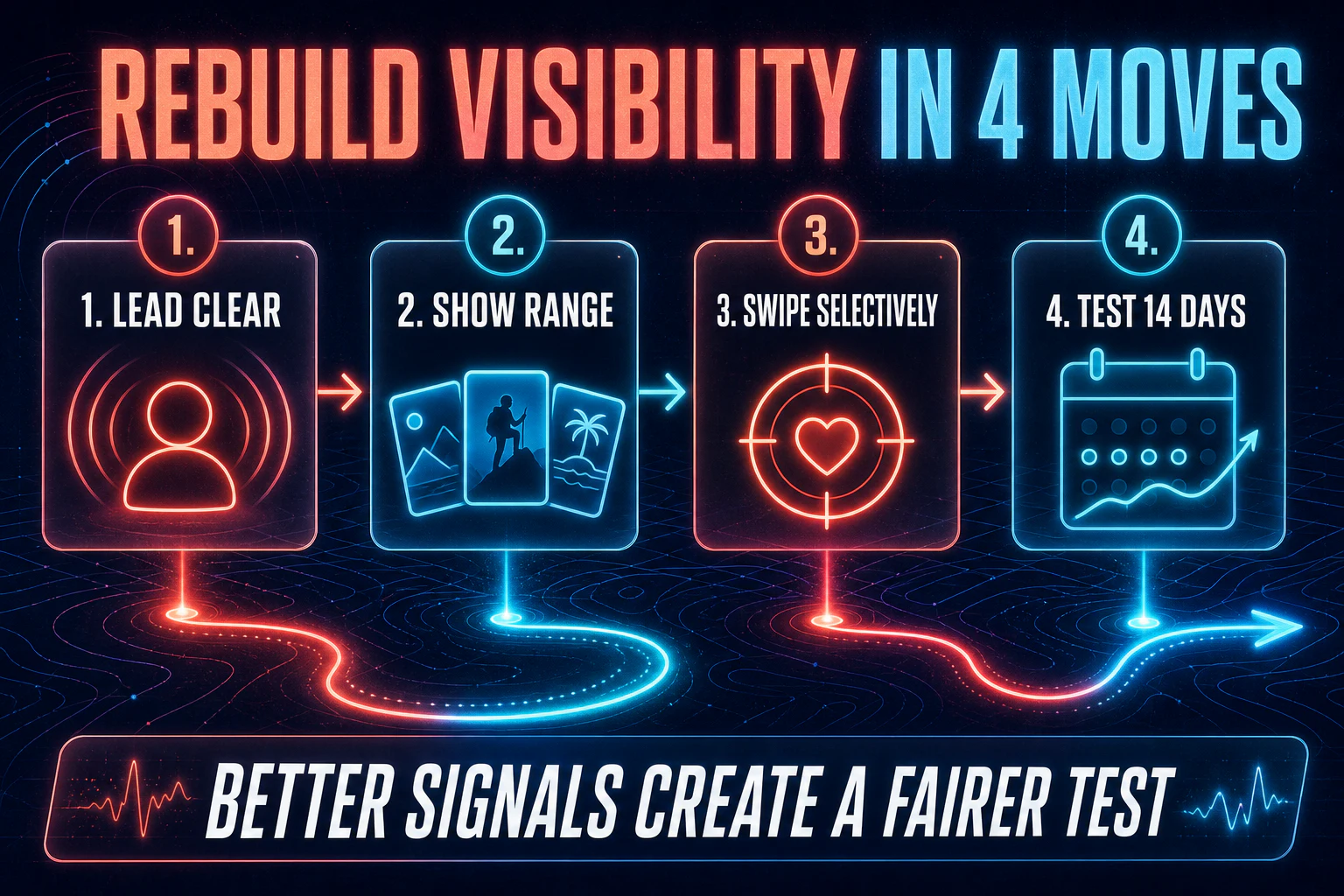
The fix: Replace your first photo with a clear, well-lit, solo headshot where your face is fully visible and you're smiling or at least neutral-positive. This single change has the highest impact of any profile tweak. See our primary photo guide for the exact standards.
Reason 2: You're Swiping Right on Everything
Tinder's algorithm penalizes indiscriminate swiping. If your swipe-right rate is above 70–80%, it signals to the system that you're either a bot, very desperate, or not exercising the judgment of a real quality account. The algorithm responds by reducing your profile's exposure.
The fix: Be selective. Only swipe right on profiles you're genuinely interested in. A 30–50% right-swipe rate is a healthier signal.
Reason 3: Your Account Has Gone Stale
Dating app algorithms reward recency. An account that hasn't had meaningful activity in 30+ days is treated differently than an active one. Your profile gets pushed down in favor of recently active users. The algorithm assumes an inactive account is less likely to lead to the engaged conversations Tinder's business model depends on.
The fix: Log in and actively use the app every day during your active period. Swipe, reply to messages, keep the activity clock ticking. The recency boost is a real, documented phenomenon — new engagement resets your position.
Reason 4: Your Profile Has Friction Points
Even if you're being shown to people, friction in your photos or bio can cause left swipes that compound the problem. Empty bio, inconsistent photo vibe, or the wrong first photo all contribute to a low swipe-right rate — which feeds back into algorithm suppression.
The fix: Audit your profile end-to-end. Check every photo for clarity, context, and consistency. Check your bio for personality and hooks. See the 7 Tinder photo mistakes guide for the most common offenders.
📸 The Algorithm Reset: How to Rebuild Visibility
If your account has been underperforming for a while, you have two options:
Option 1: Optimize and engage aggressively. Update your photos (new photos signal fresh activity), refresh your bio, and commit to daily engagement for 2–3 weeks. This is slower but preserves your match history.
Option 2: Delete and restart. A new account gets the full new-user visibility boost. If your current account has a deep performance history working against it, a clean slate can legitimately outperform optimization.
Wait, Really? Tinder Gold's "Boost" feature temporarily forces your profile to the top of the queue — which works, but only if your photos and bio are good enough to convert that extra visibility into right swipes. A Boost on a weak profile is expensive and ineffective.
For a complete breakdown of how Tinder's ranking system works, see our Tinder desirability score explained guide.
📸 Diagnose the Real Problem
Is it your algorithm score or your photos? SharpScan's free analysis tells you what's actually working against you.
✅ Quick Self-Check: Your Visibility Audit
- First photo: clear, solo, well-lit, face visible, no sunglasses?
- At least 5–6 photos uploaded, showing different sides of your life?
- Bio filled in — shows personality, not a list of adjectives?
- Logged in and engaged with the app in the last 24 hours?
- Swiping selectively (not right on everything)?
- Profile updated in the last 30 days?
Zero matches on Tinder is a solvable problem. It usually comes down to photo quality, account activity, or algorithm positioning — none of which are fixed. Work through this checklist and give it two weeks. The visibility is there. You just need to earn it back.