 Safety, Privacy & Wellbeing
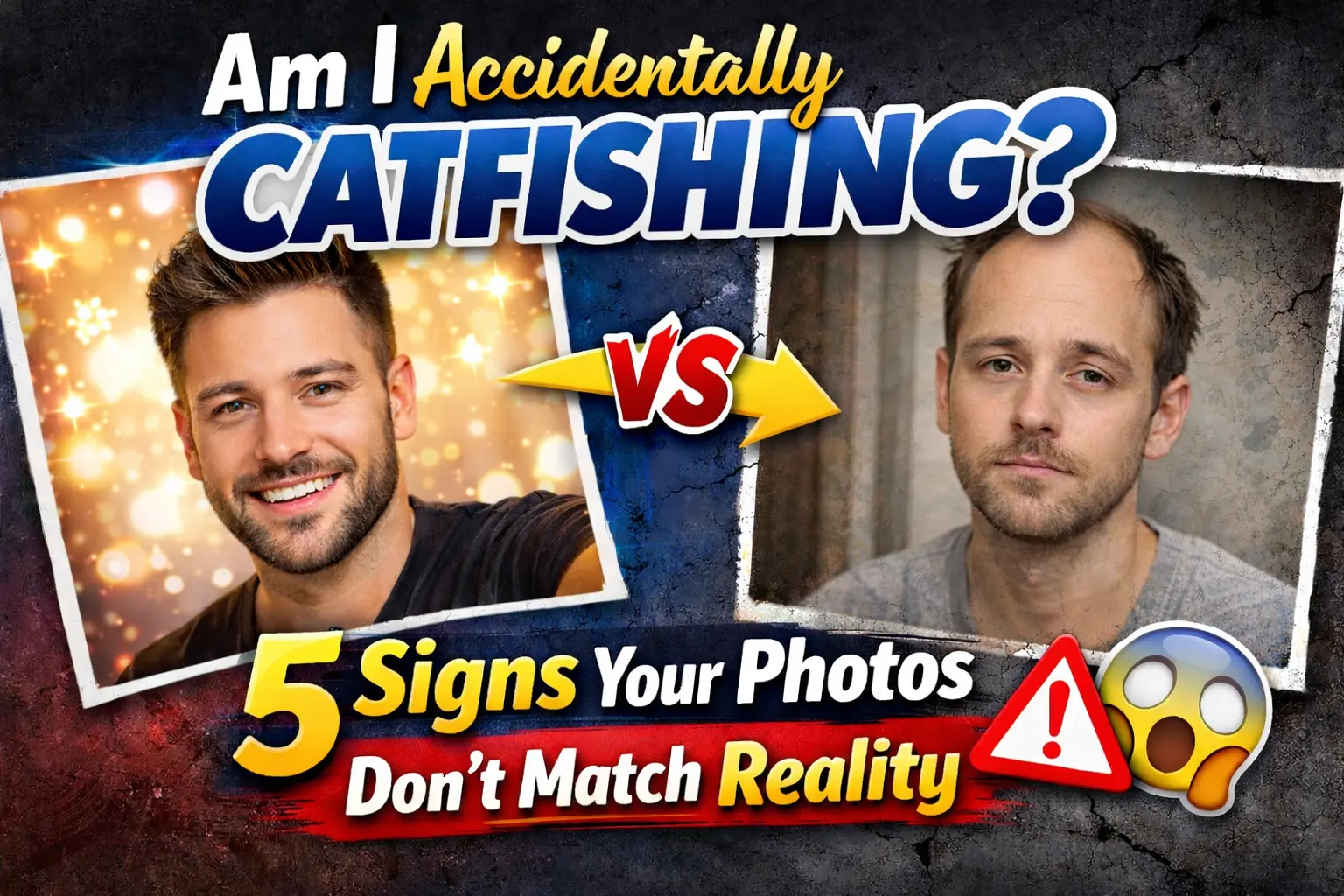
Are You Catfishing? 5 Signs Your Photos Look Misleading
Worried your dating photos set the wrong expectations? Here are 5 warning signs your profile feels misleading — and how to fix it without underselling yourself.
In this article16 sections
- 5 Signs at a Glance
- What Is "Accidental Catfishing" Exactly?
- Sign #1: Your Photos Are More Than 18 Months Old
- Sign #2: You've Changed Significantly Since Your Photos Were Taken
- Sign #3: You're Using Heavily Filtered or Edited Photos
- Sign #4: All Your Photos Are From Perfect Angles and Lighting
- Sign #5: People Seem Disappointed When They Meet You
- The Psychology Behind Accidental Catfishing
- How to Fix Accidental Catfishing: The Honest Photo Audit
- The Upside of Authentic Photos
- The "Best Foot Forward" vs. "Catfishing" Line
- Common Objections (And Why They Don't Hold Up)
- How to Take Honest Photos That Still Look Great
- What to Do If You're Already Experiencing This Problem
- The Bottom Line: Authenticity Gets Better Results
- Frequently Asked Questions
The match was great. Texts were funny. The first date was awful — not because of conversation, but because the second she walked in, you saw her face do the look. The little flicker that says "oh."
That's accidental catfishing. Not the malicious kind — you didn't fake anything. You just leaned on your six best photos from the past three years, golden-hour-lit, perfectly angled, and now your matches are meeting a stranger.
The gap doesn't have to be big to kill attraction. It just has to exist. Here are the five signs you're doing it right now — and the fix is way easier than the problem feels.
5 Signs at a Glance
| # | Sign | Quick fix |
|---|---|---|
| 1 | Newest photo > 18 months old | Take fresh photos this week |
| 2 | Major change since photos (weight, hair, glasses, beard) | Reshoot post-change |
| 3 | Heavy filter / FaceTune / smoothing | Drop the editing, keep texture |
| 4 | Every photo is the same angle + golden hour | Add varied angles, expressions, lighting |
| 5 | Dates ghost or seem disappointed on arrival | Update lineup based on signs 1–4 |
If any one of these is true, fix it. If two or more are true, your match-to-second-date rate is bleeding out and you don't know it.
What Is "Accidental Catfishing" Exactly?
Traditional catfishing involves deliberately pretending to be someone else - fake photos, stolen identities, complete fabrication.
Accidental catfishing is different. It's when:
- All your photos are genuinely you
- You haven't intentionally tried to deceive anyone
- But the overall impression your profile creates doesn't match current reality
Think of it this way: If someone met you in person first, would they recognize you from your dating profile? If there's a significant gap between expectation and reality, you've got a problem.
Why This Matters
When your photos don't match reality, every first date starts with disappointment. Your match is comparing Real You to Photo You, and Real You is coming up short - even if you're perfectly attractive.
The typical sequence:
- They see your photos and get excited
- They meet you and feel let down
- The date feels off because they're processing the disconnect
- They ghost afterward or politely decline a second date
It's not that you're unattractive. It's that you weren't what they expected. And in dating, unmet expectations kill attraction faster than almost anything else.
Sign #1: Your Photos Are More Than 18 Months Old
If your newest photo is over a year and a half old, you're probably accidentally catfishing.
People change more than they realize. Weight fluctuates. Hairlines shift. Faces mature. Skin changes. Style evolves. Eighteen months is enough time for noticeable differences to emerge.
The Common Rationalizations
"But I basically look the same!"
You don't. You think you do because you see yourself every day, so the changes are gradual and invisible to you. But someone seeing you for the first time in person versus your 2-year-old photo? They'll notice.
"That photo is so good though, I can't waste it."
A "good photo" that doesn't represent current reality is a liability, not an asset. It gets matches who won't stick around after meeting you.
"I looked better back then."
Maybe. But would you rather get matches based on how you looked 2 years ago and disappoint them in person, or get fewer but more compatible matches who are attracted to actual current you?
The Reality Check
Pull up your dating profile photos right now. Check the dates. If any photo is older than 18 months, it needs to go - no matter how good it is.
Here's why: Matches aren't swiping right on Past You. They expect to meet Photo You. If Photo You is from 2023 and it's now 2026, you're setting yourself up for failure.
📸 Keep Your Profile Current
Not sure if your photos are recent enough?
ProfileSharp's analysis includes a recency check and highlights when your photos might be creating unrealistic expectations. Get personalized guidance on which photos to update first.
Sign #2: You've Changed Significantly Since Your Photos Were Taken
Even if your photos are technically recent, major life changes create a mismatch between Photo You and Real You.
Common Significant Changes
Weight changes (15+ pounds in either direction)
If you've lost or gained noticeable weight since your photos were taken, your body shape doesn't match your profile. Full-body photos become especially misleading.
Different hairstyle or hairline
Grew a beard? Shaved a beard? Cut your hair short? Grew it long? Going through visible hair loss? These are major visual changes that photos don't capture if they're pre-transformation.
New glasses or stopped wearing glasses
Seems minor, but glasses significantly change face shape and overall appearance. If you now wear glasses daily but your photos show you without them (or vice versa), that's a disconnect.
Tattoos or removed tattoos
Visible tattoos (or their absence) are immediately noticeable in person.
Skin changes
Significant acne that developed, acne that cleared up, new scars, or skin conditions that emerged all create visible differences.
Age-related changes
If you're in your late 20s or beyond, faces change noticeably year over year. Crow's feet, forehead lines, changes in facial volume - these aren't flaws, but they are visible.
The Self-Perception Problem
We adjust to our own changes gradually, so we don't notice them. But someone meeting you for the first time absolutely will notice the difference between your photos and reality.
The test: Show your dating profile to a brutally honest friend who sees you regularly. Ask: "If you met me for a first date based on these photos, would you be surprised by anything about how I actually look?"
If the answer is anything other than "No, the photos are accurate," you need newer photos.
Sign #3: You're Using Heavily Filtered or Edited Photos
Filters and editing apps have gotten so sophisticated that people often don't realize how much they're changing their appearance.
The Filter Creep
You start with subtle smoothing. Then you brighten the eyes a bit. Maybe slim the face slightly. Whiten the teeth. Sharpen the image. Before you know it, you've created a version of yourself that doesn't exist in real life.
Common filtering issues:
- Skin smoothing that erases texture, pores, and fine lines
- Face reshaping that subtly slims, elongates, or changes proportions
- Eye enlargement that creates an uncanny valley effect
- Teeth whitening beyond natural levels
- Color correction that changes your actual skin tone
- Beautification filters that subtly "fix" features you didn't realize needed fixing
The Instagram Reality Gap
Instagram filters, FaceTune, and built-in phone beautification modes create photos that technically look like you, but an idealized version that doesn't match reality.
The problem: Your brain adapts to seeing filtered versions of yourself and starts believing that's how you look. Meanwhile, your dates are meeting unfiltered you.
How to Tell If You're Over-Editing
The comparison test: Take a fresh, unedited selfie right now in natural light. Put it side by side with your dating profile photos. If there's a noticeable difference in skin texture, face shape, or overall appearance, your profile photos are too edited.
The reverse search test: Would someone be able to pick you out of a lineup based on your photos? Or have you edited yourself into a generic, smoothed-out version that barely resembles your actual face?
🎯 Authenticity Over Perfection
Worried your unedited photos aren't good enough?
The truth is, authentic photos get better dates than perfect-but-fake photos. ProfileSharp helps you find your best natural photos - the ones that show you at your actual best without filters or heavy editing.
Sign #4: All Your Photos Are From Perfect Angles and Lighting
You know your good angles. You know your lighting. You've mastered the slight upward tilt that defines your jawline and the soft window light that erases imperfections.
But if every single photo shows you in perfect conditions from the exact same flattering angle, your profile creates an unrealistic impression.
The Perfect Photo Problem
In real life, people see you from all angles, in all lighting conditions, making all kinds of expressions. If your photos only show your one perfect angle in ideal conditions, there's a massive gap between Photo You and Real Life You.
Signs you're doing this:
- All photos from the same side of your face
- All photos with the same head tilt
- All photos in golden hour or perfect window light
- All photos from the exact same distance
- No photos where you're mid-laugh or making natural expressions
The MySpace Angle Evolution
Remember the MySpace angle (camera high and angled down)? People used it because it was universally flattering. Modern dating profile curation is the same thing - people learn their angles and stick to them religiously.
The issue: While this makes for aesthetically pleasing individual photos, it creates a cohesive profile that doesn't represent how you actually look in varied, real-world situations.
The Fix: Photo Diversity
Include photos that show:
- Different angles (front-facing, slight side profile, three-quarter view)
- Different lighting (outdoor, indoor, natural, artificial)
- Different expressions (smiling, laughing, neutral, mid-conversation)
- Different distances (headshot, mid-range, full-body)
Why this works: Variety builds trust. It shows you're comfortable with how you look from multiple perspectives, which signals confidence and authenticity.
Sign #5: People Seem Disappointed When They Meet You
This is the most important sign - and the hardest one to face honestly.
The Pattern Recognition
If you're experiencing any of these patterns, your photos likely don't match reality:
The immediate vibe shift
They seem excited while messaging, but their energy drops noticeably when they first see you in person. The enthusiasm doesn't match their texts.
The quick scan
They do a subtle but visible once-over when you first meet, as if confirming or checking something. This is them comparing Real You to Photo You.
The short first dates
Dates consistently end after one drink or coffee, even when the conversation seemed fine. They're not rude, but they're clearly not interested in extending the time together.
The post-date ghost
Everything seemed to go well, but they go silent afterward. No second date, no real explanation, just a polite brush-off or complete disappearance.
The "you look different" comment
Sometimes they'll say it directly: "You look different than your photos" or "Your photos don't do you justice" (which can be code for the opposite). Any comment about the photo-to-reality match is a red flag.
The comparison questions
"When was this photo taken?" or "Do you still have the same hairstyle?" or similar questions that suggest they're trying to reconcile your photos with the person in front of them.
The Honest Assessment
This requires brutal self-honesty: Do your dates seem consistently less interested after meeting you than they were while messaging?
If yes, one of two things is happening:
- Your photos are creating unrealistic expectations
- Your in-person social skills need work
Usually, it's #1. And #1 is much easier to fix than #2.
The Solution
Ask a trusted, honest friend to review your dating profile, then meet you somewhere as if it's a first date. Have them tell you honestly: "Based on my photos, were you expecting me to look different in any way?"
Their answer will tell you everything you need to know.
The Psychology Behind Accidental Catfishing
Understanding why people accidentally catfish helps you avoid it.
The Peak Selection Bias
Humans naturally curate the best versions of themselves. You're not going to post your worst photo - you'll post your best. This is normal and healthy.
The problem emerges when your "best" photos are actually your "best ever" photos - the top 0.1% of how you look on your absolute peak days with perfect lighting, perfect angle, perfect everything.
If your entire profile is peak-you from 2-3 years ago, you've created an avatar that doesn't represent typical-you today.
The Gradual Change Blindness
You see yourself in the mirror every day, so you don't notice gradual changes. Your brain fills in the gaps and maintains a consistent self-image even as your actual appearance shifts.
This means: You genuinely believe you still look like your 18-month-old photos because the changes have been too gradual for you to notice. But someone seeing you for the first time has no such blindness.
The Sunk Cost Fallacy
You spent time finding or taking those perfect photos. You got matches with them. You don't want to "waste" them by replacing them with more recent, less polished photos.
The reality: A less polished but accurate photo gets you better dates with people who are genuinely attracted to actual you. A polished but outdated photo gets you more matches but worse dates.
How to Fix Accidental Catfishing: The Honest Photo Audit
Ready to make sure your profile matches reality? Here's your action plan:
Step 1: The 18-Month Rule
Delete any photo older than 18 months. No exceptions, no matter how good it is.
Why 18 months? It's long enough that you've likely changed in noticeable ways, but short enough that most people don't think their photos are "old" yet.
Step 2: The Major Change Check
Compare your current appearance to your photos:
- Same weight range (within 10-15 pounds)?
- Same hairstyle/facial hair?
- Same general fitness level?
- Same visible features (glasses, tattoos, etc.)?
If anything has changed significantly, you need new photos that reflect current reality.
Step 3: The Filter Audit
Open your photos in a photo editor. Check the metadata. Were filters applied? Was editing done?
The test: If you can't show up to a date looking exactly like your photos with normal makeup/grooming, your photos are too edited.
Step 4: The Angle Diversity Check
Look at all your photos together. Do they show you from multiple angles and lighting conditions, or is it the same angle over and over?
Add variety. Real life is three-dimensional.
Step 5: The Friend Test
Show your profile to 2-3 friends who see you regularly. Ask:
- "Do these photos look like how I actually look right now?"
- "If you were meeting me for a first date based on these photos, would you be surprised by anything?"
- "Which photos are least accurate?"
Listen to their answers without defending your photo choices.
Step 6: The Gut Check
Deep down, do you worry that you look better in your photos than in real life? That people might be disappointed when they meet you?
If the answer is yes, your instincts are probably right. Fix the photos.
The Upside of Authentic Photos
Here's what most people don't realize: Accurate photos get you better dates, not fewer dates.
Why Authenticity Wins
Better match quality
People who swipe right on accurate photos are attracted to actual you, not idealized you. This means better chemistry, more second dates, and higher relationship potential.
No first-date disappointment
When your photos match reality, dates start with relief and comfort instead of disappointment and disconnect. The vibe is better from minute one.
Confidence boost
When you know your photos are honest, you show up to dates without the anxiety of "Will they be disappointed?" This confidence is attractive and improves date quality.
Fewer awkward moments
No more subtle once-overs, no more "you look different" comments, no more wondering if they're mentally comparing you to your photos.
Higher conversion to second dates
Studies show that dates where expectations match reality have significantly higher second-date conversion rates.
The Counterintuitive Truth
You might get fewer matches with honest photos. But the matches you get will be dramatically better quality.
Would you rather:
- 100 matches where 90 ghost after meeting you because you don't look like your photos?
- 40 matches where 30 lead to genuine second dates because they're attracted to real you?
The second option results in more actual dates and more relationship potential.
🚀 Build an Authentic, Attractive Profile
Want photos that are both authentic AND attractive?
ProfileSharp analyzes your photos for accuracy, appeal, and authenticity. Get specific recommendations on which current photos work best and what types of new photos to take.
The "Best Foot Forward" vs. "Catfishing" Line
There's a difference between presenting yourself well and misrepresenting yourself. Here's where the line is:
Totally Fine ✅
- Choosing your best photos from recent months
- Good lighting and flattering angles
- Light color correction and cropping
- Showing yourself in attractive settings
- Picking photos where you're smiling and look happy
- Strategic photo selection that highlights your strengths
Crossing the Line ❌
- Using photos older than 18 months
- Heavily filtering or editing your face/body
- Showing a version of yourself that no longer exists
- Hiding significant features (weight, hair loss, etc.)
- Creating unrealistic expectations about your appearance
The rule of thumb: If a date's first reaction would be "You look different than your photos," you've crossed the line.
Common Objections (And Why They Don't Hold Up)
"But I don't have any good recent photos!"
Then take new ones. Seriously. Set aside one afternoon, grab a friend or a tripod, go to 3-4 different locations with good lighting, and take 100-200 photos. You'll get 6-8 usable ones.
Not having recent photos isn't an excuse - it's a solvable problem that takes a few hours to fix.
"I looked better before [weight gain/hair loss/aging/etc.]"
Maybe. But would you rather:
- Match with people attracted to how you looked before, who will be disappointed in person?
- Match with people attracted to how you look now, who will be excited to meet you?
The second option leads to actual relationships. The first leads to rejections and ghosting.
"Everyone else is doing it!"
Probably true. And everyone else is experiencing the same disappointing first dates, ghosting, and frustration. Don't race to the bottom.
Being authentic makes you stand out in a sea of overly curated, filtered profiles.
"If I use honest photos, I won't get any matches."
If you genuinely believe this, there are two possibilities:
Your photos are terrible quality (lighting, composition, etc.) but you're actually attractive. Solution: Take better quality photos.
You don't find yourself attractive. Solution: This is a self-esteem issue, not a photo issue, and it won't be solved by misleading people.
In either case, dishonest photos aren't the answer.
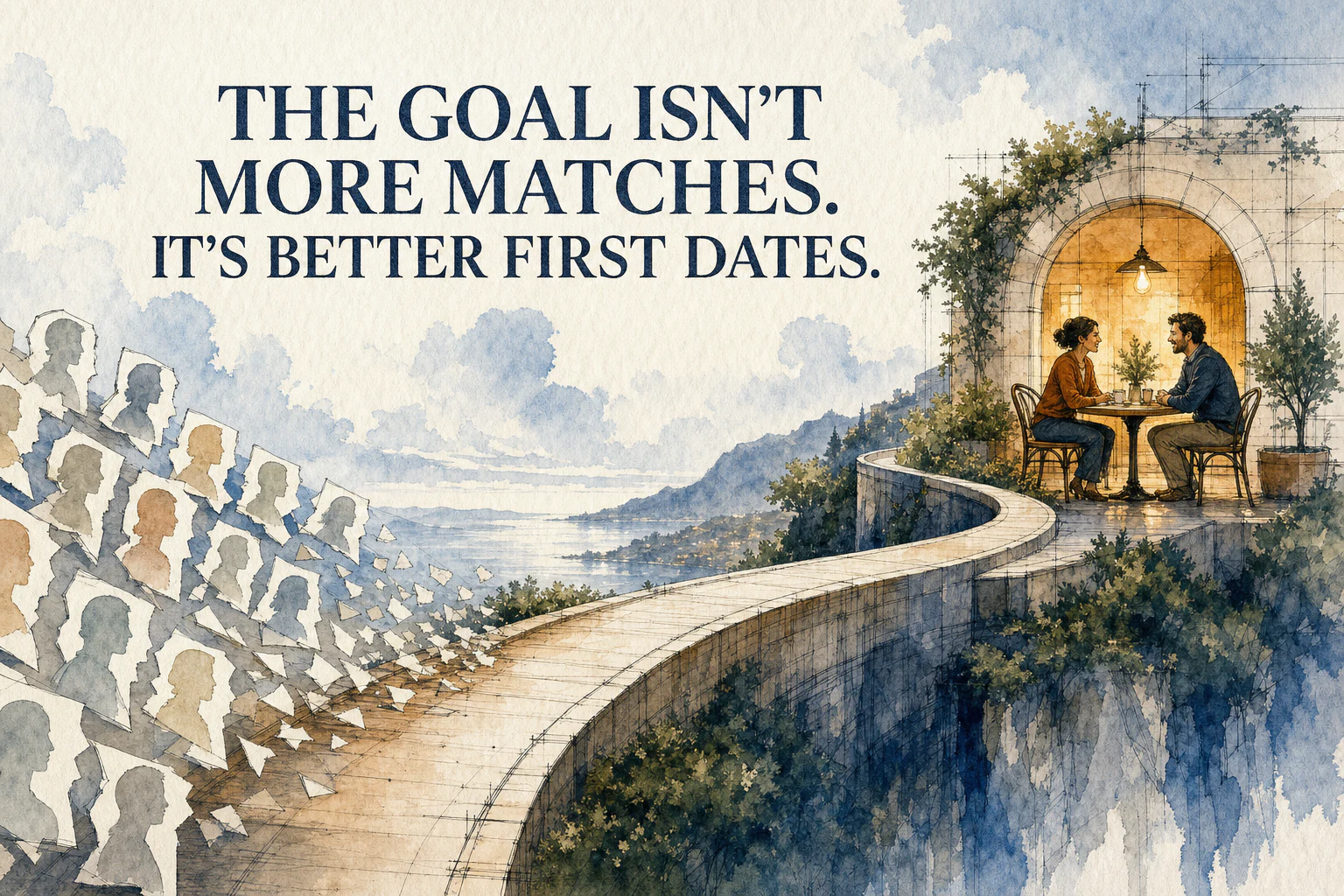
How to Take Honest Photos That Still Look Great
Authentic doesn't mean unflattering. Here's how to get photos that represent reality while still looking attractive:
Natural Lighting Is Your Friend
Shoot during golden hour (hour before sunset) or near windows with indirect sunlight. This is universally flattering but still accurate.
Slight Angles, Not Extreme Ones
A slight angle is more interesting than straight-on, but don't go extreme. If you wouldn't naturally stand at that angle in conversation, it's too much.
Genuine Expressions
Mid-laugh photos, natural smiles, and candid expressions photograph better than posed, forced smiles. Ask a friend to take photos while you're actually talking and joking.
Show Your Actual Life
Photos from actual activities you do regularly are automatically authentic. If you hike, get hiking photos. If you cook, get cooking photos. If you read in coffee shops, get coffee shop photos.
Variety in Every Dimension
Different outfits, different locations, different times of day, different activities. Variety inherently creates a more accurate overall impression.
Skip the Filters
Use the native camera app, not Instagram or Snapchat. Basic cropping and brightness adjustment is fine. Face-altering filters are not.
What to Do If You're Already Experiencing This Problem
Already have dates scheduled based on potentially misleading photos? Here's your damage control plan:
Option 1: Update Your Photos Immediately
Swap out misleading photos for current, accurate ones. Yes, some existing matches might unmatch. But better that than awkward in-person disappointment.
Option 2: Set Expectations Via Messaging
If you can't update photos quickly but have dates scheduled, mention changes in conversation:
- "Fair warning, I've grown a beard since that photo"
- "I should update my photos, I've lost weight since those were taken"
- "My hair is shorter now than in my pics"
This prevents first-date shock.
Option 3: Post Current Photos to Instagram
If your dating profile links to Instagram, post very recent, unfiltered photos. Matches who check your Instagram will get a current impression.
The Bottom Line: Authenticity Gets Better Results
Accidental catfishing feels like a victimless shortcut - you're just using your best photos, right? But it's actually sabotaging your dating success.
The reality:
- Misleading photos get more matches but worse dates
- Authentic photos get fewer matches but better dates
- First-date chemistry depends heavily on met expectations
- Disappointment kills attraction faster than almost anything
If you want actual relationships (not just validation from matches), your photos need to accurately represent current you.
The action steps:
- Delete photos older than 18 months
- Remove heavily edited or filtered photos
- Take new photos that show current you in varied, flattering but honest conditions
- Get honest feedback from friends
- Update your profile with authentic photos
You might see your match count dip initially. But your date quality will skyrocket, and that's what actually matters.
💡 Get Your Honest Profile Assessment
Not sure if your photos are authentic or accidentally misleading?
ProfileSharp provides an honest analysis of your photo accuracy and helps you build a profile that's both attractive and authentic. Stop accidentally catfishing and start getting better dates.
Frequently Asked Questions
How old is too old for dating profile photos?
18 months maximum. After that, you've likely changed enough that photos don't represent current reality. Ideally, your newest photos should be from the past 3-6 months.
Is it okay to use light filters or editing?
Basic adjustments (brightness, contrast, cropping) are fine. Anything that changes your face shape, skin texture, or body proportions crosses the line into misleading.
What if I genuinely think my old photos look more like me than recent ones?
This is often self-perception distortion. Ask friends whose opinion you trust. If they say your old photos look dated, believe them over your own perception.
Do I need to include "bad angle" photos to be honest?
No. You can choose flattering photos while still being honest. The key is that your flattering photos should be recent and represent your current appearance across multiple angles and conditions.
What if I'm currently losing weight / growing my hair / making a change?
Use photos from your current state, then update when the change is complete. Don't use aspirational photos of future you or nostalgic photos of past you.
How do I know if my photos are too edited?
If there's any doubt in your mind whether you can show up to a date looking like your photos, they're too edited.
Will honest photos get me fewer matches?
Possibly, but the matches will be higher quality. Would you rather have 100 matches who ghost after meeting you or 30 matches who are genuinely attracted to real you?
Is everyone else catfishing too?
Many people use outdated or heavily edited photos, yes. But "everyone else does it" isn't a good strategy for actual dating success. Being authentic makes you stand out positively.
What if I just don't photograph well?
This usually means you need better quality photos, not misleading photos. Invest time in proper lighting, settings, and taking enough photos to get good ones that still look like you.
Last updated: January 16, 2026