 Messaging & Conversations
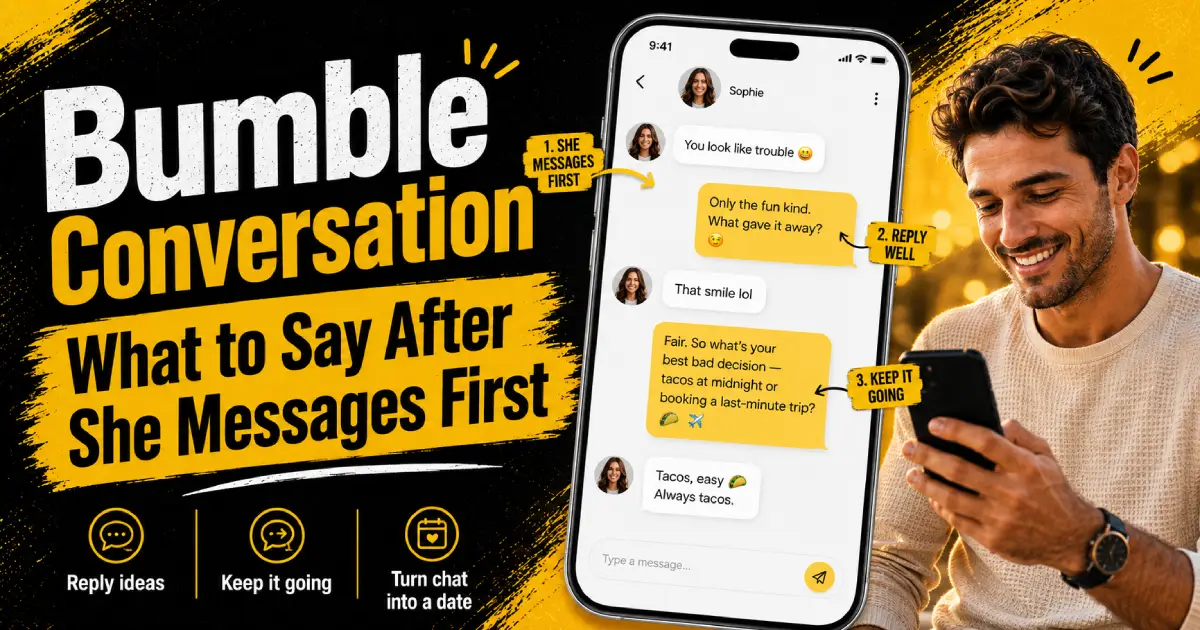
Bumble Conversation: What to Say After She Messages First
She sent the first message on Bumble. Now it's your turn — and what you say next determines whether this match goes anywhere. Here's exactly what works.
In this article6 sections
She sent the first message. That's a signal — she's interested enough to break the ice in an app that explicitly requires it. What you do with that opening in the next 24 hours will define whether this match leads somewhere or disappears into the match graveyard.
Most men misread this moment. They either over-respond (too eager, too much) or under-respond (too cool, too little). The move is to match her energy, escalate slightly, and keep the momentum going.
⚡ Bumble vs. Other Apps: What's Different
| Dynamic | Tinder/Hinge | Bumble |
|---|---|---|
| Who opens | Either person | Women must open |
| Qualification signal | Both matched = mild mutual interest | She opened = active interest |
| Your response job | Open strong | Continue and escalate |
| Pressure dynamic | You carry more early | More balanced — she started it |
| Time pressure | Relatively low | 24-hour expiry on your reply |
The key difference: on Bumble, she's already done the hard part. Your job isn't to make a great first impression with an opener — your job is to respond in a way that rewards her for reaching out and makes continuing the conversation feel natural.
For the profile side of this equation — what makes her want to message in the first place — see how to get more matches on Bumble.
💬 Get Real-Time Help With Bumble Replies
Wingman analyzes your Bumble conversation and gives you 4 reply options — Flirty, Funny, Confident, Chill — tuned to her specific opening and your conversation vibe. 3 free analyses per day.
🎯 How to Respond to Common Bumble Openers
She says "Hey!" or "Hi 😊" This is the most common opener — and the least helpful, because it gives you nothing to work with. The temptation is to match it with another one-liner. Don't.
🔴 "Hey! How are you?"
🟢 "Hey! Okay — you opened, now you're on the hook to pick the conversation topic. I'll give you a pass on 'how are you' though 😄"
This is playful, acknowledges the dynamic, and puts a gentle pressure on her to be interesting — which she likely will be.
She asks a real question: This is the ideal opener. She's invested. Answer genuinely, add something interesting about yourself, and ask something back.
She references your profile: Gold. She read it. Match that energy with a response that shows you're equally observant about hers.
She uses a clever line or joke: Match the energy. Go funnier or equally playful. This is not the moment for a serious, earnest response.
📝 The Escalation Framework
After her opener, your job is to move the conversation toward something real. Here's the arc:
Exchange 1–2: Respond well, add something about yourself, ask one question back. Low stakes. Keep it light.
Exchange 3–5: Create a conversational thread — something that builds. Reference what she said, develop a bit of banter or shared interest. This is where the connection either starts forming or doesn't.
Exchange 6–8: If the conversation is going well, introduce the idea of meeting. Doesn't need to be a formal ask — it can be a reference to something you'd both do: "That's the exact kind of restaurant I'd want to find. We should scope one out."
Exchange 10+: If you're still in question-and-answer mode with no progress toward an actual plan, the conversation is becoming a pen-pal dynamic. Start steering.
For the full playbook on breaking out of that dynamic and landing an actual date, see how to get a date from a dating app.
Wait, Really? Research on dating app conversion (match → date) consistently shows that longer conversations don't produce better first dates. In fact, the longer a match sits in "just chatting" mode, the lower the likelihood it ever converts. Men who move toward a date-ask within 7–10 exchanges convert at significantly higher rates than those who wait for a "perfect moment."
🚫 Bumble Conversation Mistakes
Responding with another "hey." She already did the work. If you match her low-effort opener with your own low-effort response, you've both wasted a match.
Being too formal or stiff. A professional tone with "I see you enjoy hiking, I also enjoy outdoor activities" is not a conversation. It's a LinkedIn connection request.
Waiting too long to respond. The 24-hour window is literal. And beyond the technical deadline, waiting days to respond to a woman who made the first move sends a confusing signal about your interest.
Turning it into an interview. Five questions in a row. No statements about yourself. No shared momentum. Just her answering your questionnaire.
Ignoring what she actually said. If she referenced your profile or asked a specific question and you respond with something generic, she'll notice that you didn't actually read her message.
🔎 Reading Her Message for Cues
Every opening message tells you something about what she's looking for in the conversation:
- Casual and warm (Hey! How's your week?): She wants light, friendly conversation. Match with warmth.
- Curious about you (Saw you're into X, tell me more): She's interested. Give her a real answer, be enthusiastic.
- Funny/witty opener: She's testing your humor. Be funny back.
- Straight to a question (What are you looking for on here?): She's direct. Be honest and direct back.
- Prompt response (responding to your Hinge-style prompts): Engage with what she engaged with.
Wingman's analysis reads the specific tone and content of her opening message and calibrates your reply options to match. Try it for your conversation →
✅ Quick Self-Check
- I responded within 24 hours
- I didn't just mirror her opener with an equally low-effort response
- I answered any question she asked and added something about myself
- I asked one question back — not five
- I'm not already in interview mode (all questions, no statements)
- If the conversation is going well after 7+ exchanges, I'm starting to steer toward an actual plan