 Messaging & Conversations
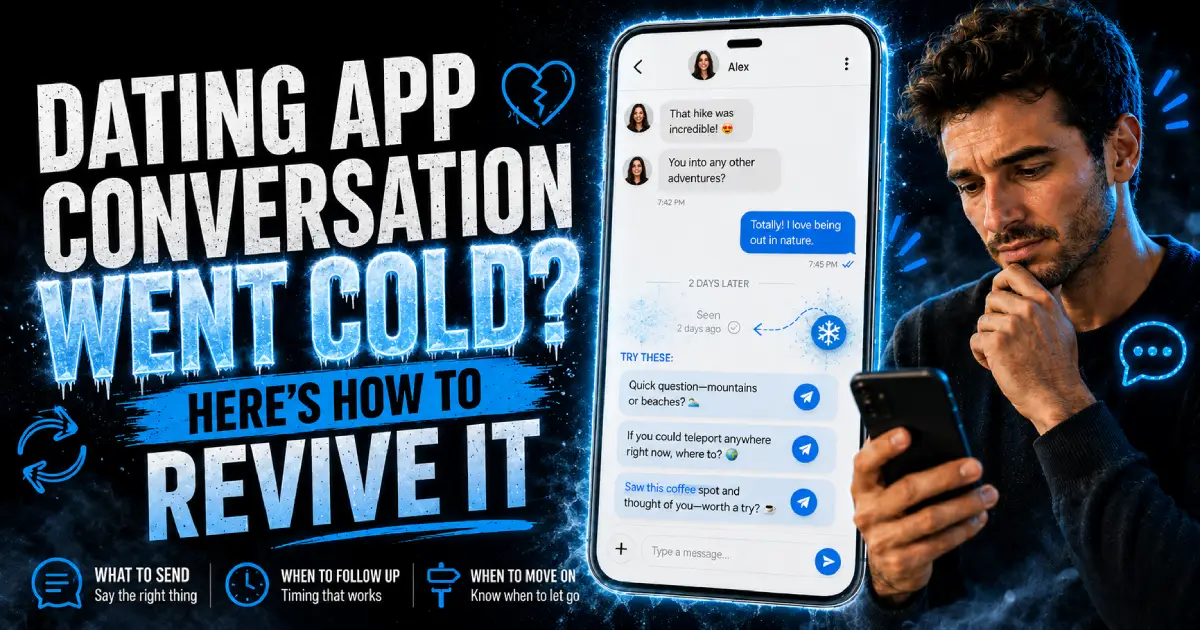
Dating App Conversation Went Cold? Here's How to Revive It
A dating app conversation went cold and you're not sure if it's worth saving. Here's how to read the situation, what to send, and when to just move on.
In this article6 sections
She was responding. Then she wasn't. It's been three days since your last message went unanswered and you're staring at the thread trying to decide if sending something now makes you look desperate, or if not sending something means you're giving up on a match that might have been worth something.
The good news: cold conversations are recoverable more often than most men assume. The bad news: the way most men try to revive them is exactly wrong. Here's the playbook that actually works.

⚡ Why Conversations Go Cold
| Cold Trigger | What Happened | Recovery Potential |
|---|---|---|
| Life interrupted her | Busy, distracted, forgot | High |
| Conversation ran out of energy | No hooks, no momentum | Medium — needs restart |
| You asked too much too soon | She felt pressure | Medium — reset tone |
| Generic conversation | Nothing memorable | Medium |
| She matched with someone else | Higher interest match | Low |
| Conversation peaked early | Nothing left to say | Low-medium |
| She's just not that interested | Initial match ≠ real interest | Low |
Most cold conversations fall into the first three categories — which means most cold conversations are worth one revival attempt. The key word is one.
Most of these situations are preventable before they reach the cold stage — see how to keep a conversation going on dating apps for the proactive playbook.
💬 Read Her Interest Level Before You Send Anything
Wingman analyzes the conversation and tells you whether she's likely still interested — then gives you a re-engagement message that fits the situation. 3 free analyses per day.
🎯 The Re-Engagement Framework
A re-engagement message has to accomplish three things:
- Not feel like a "hey, why haven't you responded?" guilt trip
- Not feel like you've been thinking about it for three days
- Give her a natural, easy reason to respond
The best re-engagement messages are low-pressure, forward-moving, and slightly funny or interesting. They don't acknowledge the gap unless you have a genuinely good reason.
Template structure: [Relevant hook or observation] + [easy question or reaction]. That's it.
🔴 "Hey, haven't heard from you in a while. Everything okay?"
🔴 "Still there? 😅"
🔴 "Guess I'll talk to myself then lol"
🟢 "Okay I need a second opinion — [specific thing related to her interests or profile]. Yes or no?"
🟢 "Random thought: [interesting question related to something she said]. Been on my mind."
🟢 "[Something funny or interesting that just happened that could relate to your conversation]"
The green messages work because they're about something new and interesting, not about the gap. They give her a reason to respond that's unrelated to the awkwardness of not having responded.
📝 Re-Engagement Messages That Work
The "second opinion" move: "Okay I actually need your expert opinion on something — you mentioned you're into [her interest]. Is [specific question] actually worth it or is it overrated?"
The callback: "This is a genuine update: I finally tried [thing you mentioned earlier in the conversation]. You were right / wrong about everything."
The funny observation: "I just saw something that immediately made me think of [thing she mentioned] and now I have to know: have you ever [related question]?"
The clean restart: "Alright, I'll give this one more shot: best [food / place / experience] you've had this year, go."
The honest move (use sparingly): "I know I let this one go quiet — not a great look. The conversation was actually good. Want to pick it back up?"
The Harsh Truth: One revival attempt. Not two. Not "following up" on your revival attempt. If she doesn't respond to a well-crafted re-engagement message, the interest isn't there — and sending a second one removes any remaining dignity. Send one good message, accept the result.
🚫 Re-Engagement Mistakes That Kill Your Chances
The guilt message: "I guess I'm not worth a reply." Pressure doesn't create interest. It creates discomfort.
The "just checking in": You're not "just checking in." You're trying to restart a conversation. Own it by making the message actually interesting.
Multiple messages in a row: If she didn't respond to your first message after a day, sending a second one immediately is almost always wrong. One at a time.
Being too try-hard about it: A long, creative, elaborate re-engagement message communicates that you've been thinking about this a lot. That reads as anxious. Keep it short and effortless.
Waiting too long to try: A conversation that went cold two weeks ago is a lot harder to revive than one that cooled down three days ago. Within 3–5 days is the sweet spot for a revival attempt.
If the conversation went cold right after your first message (no response to your opener), recovering from a bad opener covers that specific scenario with exact recovery lines.
🔎 Reading the Situation: Is It Worth Reviving?
Before you send anything, assess the conversation:
Worth one revival attempt:
- She was engaged in the conversation before it went cold
- There were multiple exchanges back and forth
- She asked you questions at some point
- The conversation ended on a neutral or positive note
Probably not worth it:
- She only ever gave one-word answers
- You were carrying the entire conversation alone
- She's never asked a single question about you
- It's been more than two weeks
Wingman's interest analysis can help you read this quickly if you're not sure. Paste the conversation, and it'll tell you what the signals actually suggest. For a deeper framework on reading interest signals across the full conversation, is she interested? how to read her dating app signals maps out the patterns in detail. Try it free →
✅ Quick Self-Check
- I'm sending one re-engagement message, not following up on my own message
- My re-engagement message doesn't reference the gap or make her feel guilty
- My message gives her a new, easy thing to respond to
- I've assessed whether this conversation was actually worth reviving
- If she doesn't respond, I'm moving on — not sending a second attempt
- I used Wingman to check her interest level before deciding what to send
Get the right re-engagement message for your specific conversation →