 Bios & Prompts
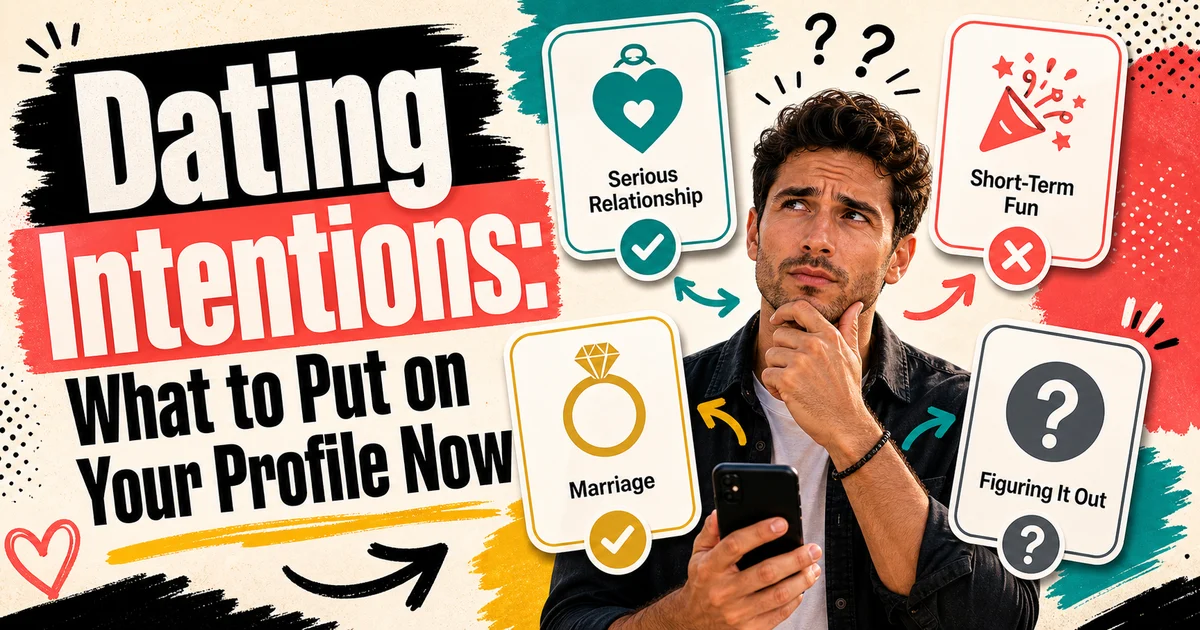
Dating Intentions: What to Put on Your Profile Now
Not sure which dating intention to choose? Learn what each option signals, how to write it without pressure, and how to align your photos.
In this article10 sections
- Why Dating Intentions Matter More Now
- The Best Dating Intention Is the One You Can Back Up
- What to Choose If You Want a Relationship
- What to Choose If You Are Open or Unsure
- What to Choose If You Want Something Casual
- The Photo Test: Do Your Images Match Your Intention?
- What Not to Write Under Dating Intentions
- A Simple Decision Framework
- FAQ
- References
The dating-intentions field looks simple until you have to choose one.
Long-term relationship can feel too serious. Something casual can feel too unserious. Figuring it out can sound honest, but also vague. Prefer not to say feels private, but on some apps it may quietly reduce how many compatible people see you.
That choice matters because it is no longer just a profile detail. Hinge says its recommendation system uses stated preferences, activity, and profile information to help people find each other as their needs, goals, intentions, and preferences change. Hinge also warns that selecting "prefer not to say" can exclude you from people who set dealbreakers around compatibility factors like dating intentions.
The point is not to pick the option that sounds most impressive. The point is to pick the option that your photos, bio, and messages can actually support.
Why Dating Intentions Matter More Now
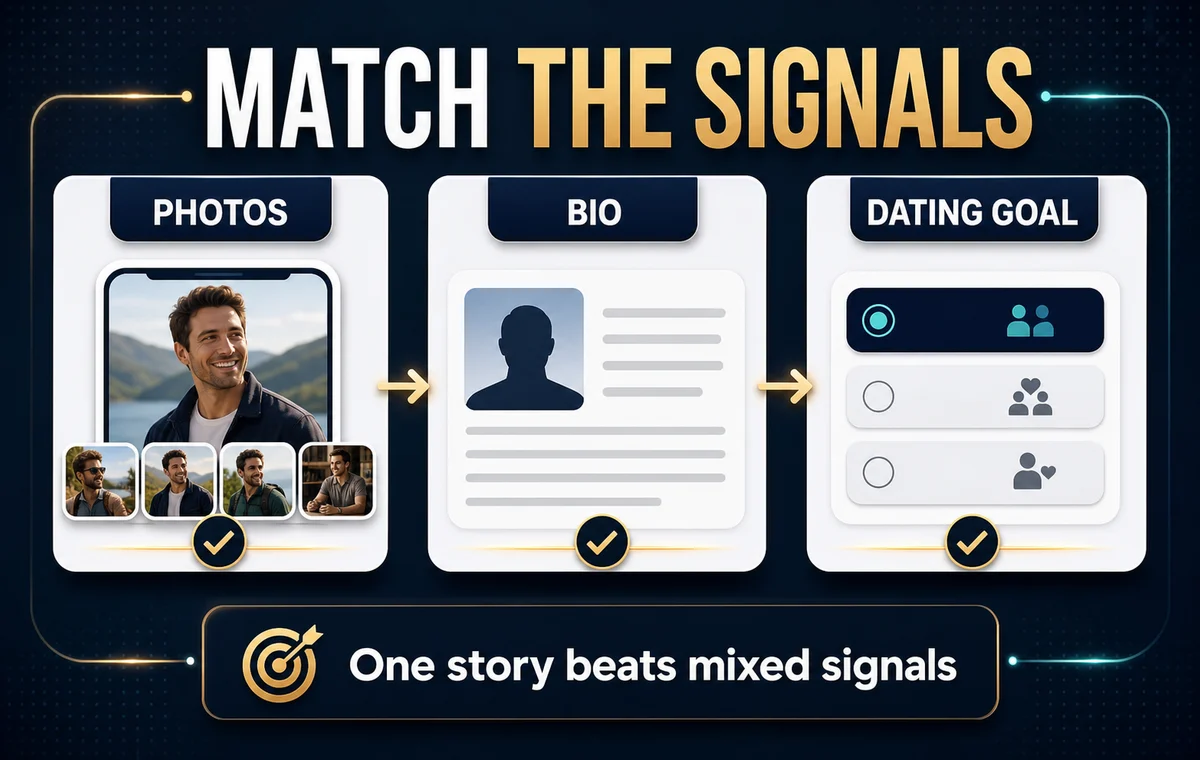
Modern dating profiles are judged as signal stacks.
Someone is not only asking:
- Are you attractive?
- Do you seem normal?
- Would I reply to this person?
They are also asking:
- Do your photos match what you say you want?
- Do you seem emotionally available or just polished?
- Are you direct without being intense?
- Would meeting you feel easy or complicated?
Tinder's 2026 "Speaking in Signals" report describes a culture where commitment is built through smaller signals: emotional competence, honest conversations, social context, and gradual clarity before formal labels. That lines up with what people already feel on apps. Mixed signals are tiring. Clear signals feel easier to trust.
Your dating intention is one of those signals.
See What Your Profile Is Signaling First
ProfileSharp analyzes your photos for trust, warmth, first-photo strength, and whether your profile supports the kind of dating you actually want.
The Best Dating Intention Is the One You Can Back Up
Before choosing a field, look at the whole profile.
If you choose long-term relationship but your profile is all nightlife, sunglasses, and vague jokes, the intention may feel disconnected.
If you choose something casual but your prompts read like a marriage interview, the profile feels tense.
If you choose figuring it out but give no personality, no date idea, and no clue what your life looks like, people may read that as low effort rather than openness.
The rule is simple:
| Your Intention | What It Should Signal | What Makes It Backfire |
|---|---|---|
| Long-term relationship | Clarity, consistency, emotional availability | Sounding like a contract |
| Life partner | Seriousness and values | Leading with pressure before chemistry |
| Short-term open to long | Flexibility with real openness | Looking like you are hiding casual intent |
| Something casual | Honesty and low pressure | Photos that feel careless or low trust |
| Figuring it out | Self-awareness and openness | No standards, no direction, no effort |
| Prefer not to say | Privacy | Appearing evasive or filtering yourself out |
Your profile has to make the selected option feel believable.
What to Choose If You Want a Relationship
Choose a relationship-oriented option if that is genuinely what you want.
Do not water it down just because you are afraid of scaring people away. The problem is usually not the intention itself. The problem is how heavy the rest of the profile feels around it.
Strong relationship-minded profile:
- Warm first photo
- One social or lifestyle photo
- Bio that is specific but relaxed
- Prompt that shows values through real details
- No bitter lines about being "done with games"
Weak relationship-minded profile:
- All serious photos
- Defensive bio
- Requirements list
- No humor or texture
- Date energy that feels like an interview
Better bio line:
"Open to something real if the chemistry is easy. Big fan of clear plans, good coffee, and people who say what they mean."
That says enough without turning the profile into a contract.
For more structure, use the examples in Dating Profile Bio: What to Write for More Matches.
What to Choose If You Are Open or Unsure
"Figuring it out" can work when the rest of your profile shows self-awareness.
It fails when it feels like:
- You do not know what you want
- You want maximum options with minimum honesty
- You will adapt your answer to whoever matches you
A better version of open intent is specific without pretending to know the ending.
Try:
"Open to seeing where things go, but I like direct plans and people who communicate clearly."
Or:
"Not rushing a label, but I am here to actually meet, not collect matches."
Those lines make openness feel intentional rather than avoidant.
What to Choose If You Want Something Casual
Casual does not mean careless.
If you are honest about wanting something casual, your profile still needs trust. In fact, it may need more trust, because people are scanning for respect, safety, and clarity.
Better casual profile signals:
- Recent, clear photos
- No misleading angles
- Warm expression
- Bio that is direct but not crude
- Low-pressure date idea
- No fake relationship language
Bad casual profile signals:
- Shirtless mirror photo as the main image
- Anonymous sunglasses photos
- "Just ask" bio
- Sexual jokes before any context
- Mixed signals that imply whatever gets the match
If you use a shirtless or gym photo, read Shirtless Photo on Dating Apps: Does It Help or Hurt? before making it part of your signal stack.
The Photo Test: Do Your Images Match Your Intention?
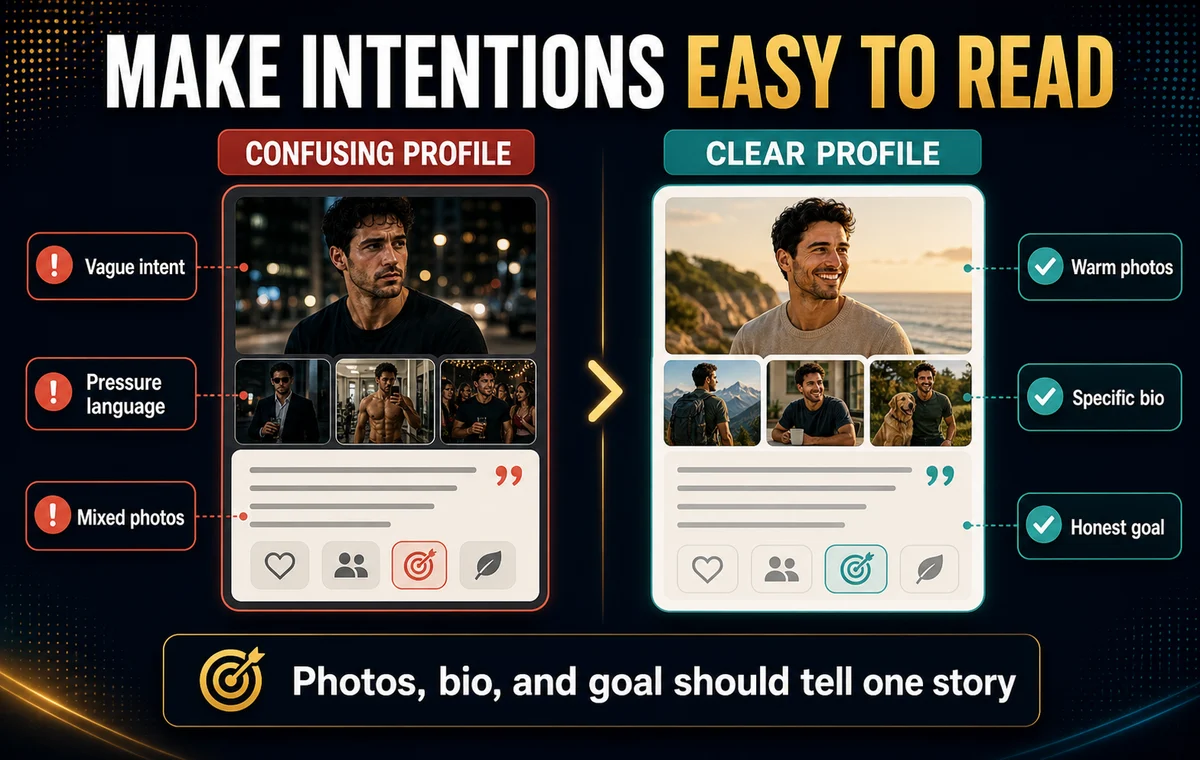
Your intention field is one line. Your photos are the proof.
Run this quick test:
- If you want a relationship, do your photos show warmth, consistency, and a real life?
- If you are open, do your photos make you seem easy to meet rather than impossible to read?
- If you want casual, do your photos still create trust?
- If you are unsure, does your profile still show standards and direction?
This is where many profiles fail. The words say one thing. The images say another.
Hinge's own guidance says profiles should reflect who you are now and that updating photos and prompt answers helps share your latest interests and stories. That is the standard to use: current, specific, aligned.
For a deeper photo audit, read How to Choose Dating App Photos That Get More Matches.
Check Whether Your Photos Match Your Intent
ProfileSharp helps you spot the photos that build trust, create confusion, or make your selected dating intention feel less believable.
What Not to Write Under Dating Intentions
Avoid turning clarity into pressure.
Do not write:
"Only serious people. I am not here to waste time."
Write:
"I like when plans are clear and the conversation feels easy."
Do not write:
"Looking for my future wife."
Write:
"Open to something serious if the connection feels natural."
Do not write:
"No hookups, no games, no drama."
Write:
"Good conversation, direct plans, and people who know how to communicate."
The second version still filters. It just does it without sounding exhausted.
A Simple Decision Framework
Use this:
- Choose the most honest option, not the safest-sounding one.
- Make your photos match that choice.
- Add one bio or prompt line that softens the intention into real-life dating energy.
- Remove defensive language.
- Update the field when your priorities actually change.
The goal is not to be universally appealing. It is to be legible to the right people.
FAQ
Should I put long-term relationship on my dating profile?
Yes, if that is what you want. Just make the rest of the profile feel warm, relaxed, and specific so it does not read like pressure before chemistry.
Is "figuring it out" a bad dating intention?
Not always. It works when your profile still shows effort, standards, and a real date style. It fails when the rest of the profile is vague.
Should I choose "prefer not to say"?
Use it only if privacy matters more than visibility and filtering. On Hinge, selecting "prefer not to say" can limit who sees you when others set dealbreakers around compatibility factors.
Do photos really affect how dating intentions are read?
Yes. People usually see your photos before they process your intention field. If the photos and words conflict, the photos win.
References
Disclaimer: This article is independent editorial guidance. ProfileSharp is not affiliated with or endorsed by Hinge, Tinder, Bumble, or any dating app mentioned.