 Getting More Matches
Dating Profile Score: What It Means and How to Improve It
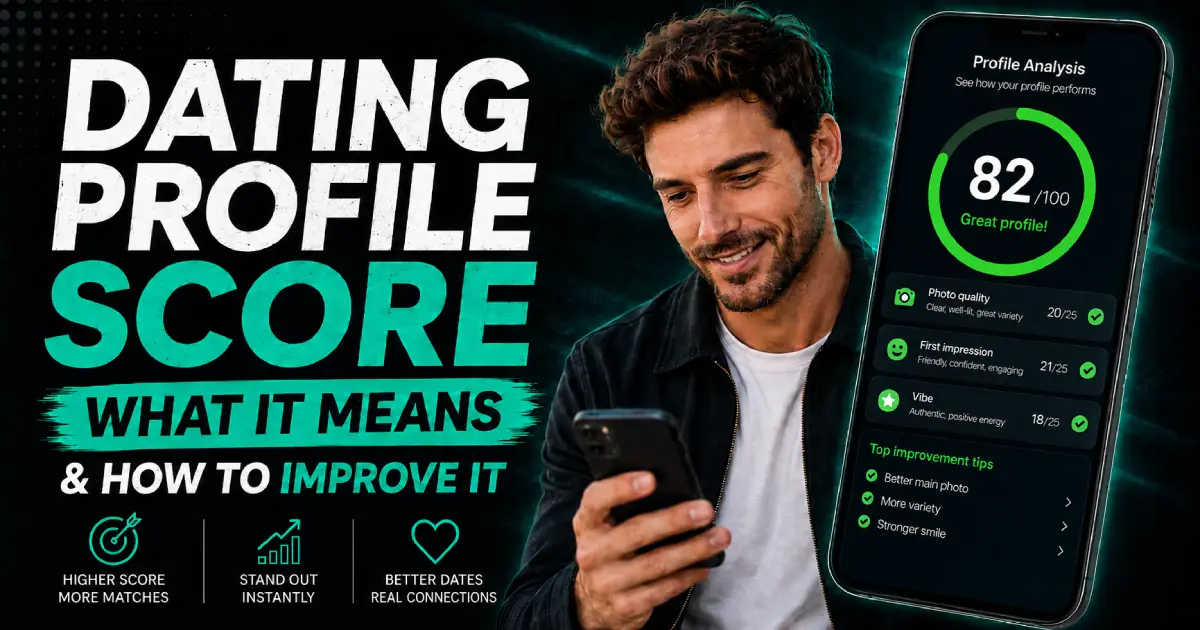
Your dating profile score tells you exactly why you're not getting matches. Learn what it measures, what a good score looks like, and how to raise yours fast.
In this article6 sections
Getting a number for your dating profile can feel almost comically blunt. But there's a reason a score works better than vague feedback: it forces you to confront a specific gap, not a general feeling. "Your photos could be better" tells you nothing. "Your profile scores 43/100, with lighting at 38 and authenticity at 61" tells you exactly where to start.
The dating profile score concept isn't new — apps like Tinder used versions of it internally (the old Elo-based desirability score) to decide whose profile got shown to whom. The difference now is that you can see the score before the algorithm punishes you for it.
📊 Dating Profile Score at a Glance
| Score Range | What It Means | Expected Match Rate |
|---|---|---|
| 80–100 | Top-tier profile — photos are strong across all dimensions | High match rate; you're being shown to good profiles |
| 60–79 | Solid but has gaps — one or two photos are dragging the average down | Average to above-average matches |
| 40–59 | Significant issues — at least one photo is actively hurting you | Below-average match rate |
| Below 40 | Profile is working against you — algorithm may be suppressing visibility | Low to minimal matches |
Each row maps to a specific range of interventions — some quick fixes, some requiring new photos.
📸 See Your Actual Score
SharpScan calculates your dating profile score across lighting, composition, authenticity, and first impression — for every photo you upload. Get your score in under 60 seconds. No credit card needed.
🤔 What Goes Into a Dating Profile Score?
A real profile score isn't a simple attractiveness rating. It's a weighted composite of the factors that actually drive swipe behavior. Here's what a well-built scoring system evaluates:
Lighting (high weight): Poor lighting is the single biggest correctable photo flaw. It tanks perceived attractiveness by making the subject look flat, tired, or sloppy — regardless of how you actually look. Golden hour natural light, for example, reliably scores higher than indoor artificial lighting.
Composition: Where are you in the frame? Is the background competing for attention? Is there something awkward being cut off? Composition determines whether the photo feels intentional or accidental.
Authenticity: Does the photo look like you, or like a version of you that you've heavily edited or staged? Heavy filters, old photos, or shots that look lifted from a modeling shoot can actually lower authenticity scores — matches feel the disconnect when they meet you.
First Impression: This is the catch-all dimension — the gut reaction a stranger would have within two seconds. It draws on all the above factors but also factors in whether your expression, body language, and vibe communicate approachability.
Wait, Really? Heavy photo editing can lower your profile score — not raise it. Authenticity signals that you'll look the same in person, which dramatically increases perceived trustworthiness and makes matches more likely to reply to your messages.
🎯 The Fastest Way to Improve Your Dating Profile Score
Most profiles have one or two photos that are significantly pulling down their average. The fastest improvement path is almost never "take all new photos" — it's cutting the weak ones and reordering the strong ones.
Here's the priority sequence for score improvement:
Step 1 — Identify your lowest-scoring photo. This is almost always the one you'd least want to lead with but included anyway because you don't have many. Cut it. A profile with 4 strong photos outperforms a profile with 6 mixed ones every time.
Step 2 — Fix your main photo first. Your first photo carries disproportionate weight in how your overall score is interpreted. If your best photo isn't first, that's the single highest-ROI change you can make today.
Step 3 — Replace indoor shots with outdoor ones. Natural light adds roughly 10–15% to perceived photo quality, all else equal. If you have any outdoor shots sitting in your camera roll, they're almost certainly scoring better than your indoor ones.
Step 4 — Add a genuine smile to at least one photo. Smiling in dating photos isn't optional — it's a trust signal. Profiles with no smiling photos consistently score lower on approachability, which drags the composite score.
For a complete breakdown of which types of photos consistently score highest, see best dating profile photos for men and how to choose photos for dating apps.
🚫 What Keeps Scores Stuck in the 40–60 Range
These are the most common patterns in underperforming profiles:
- All indoor photos — no natural light, no outdoor context shots
- Only selfies — no photos with depth, no other people, no world context
- Inconsistent quality — a few great shots mixed with clearly phone-front-camera photos
- Photos from different eras — a mix of how you looked two years ago and now
- No variety in expression — same slightly-serious look in every photo
- Cluttered or distracting backgrounds — bedroom, messy desk, generic white wall
The Harsh Truth: A 43/100 profile score is rarely about your looks. It's almost always about correctable, non-appearance factors like lighting, background, and photo selection. You may look significantly better in your best natural-light, genuine-smile photo than you do in your current profile.
📸 Why Tracking Your Score Over Time Matters
A profile score gives you something most dating advice never provides: a measurable feedback loop. You change one photo, run a new analysis, and see whether the score went up. You're no longer guessing at whether the change helped — you have data.
This matters because profile optimization is iterative. The people with the best match rates aren't the ones with the best raw photos — they're the ones who've tested and adjusted until every slot in their lineup is earning its position.
Think of your dating profile score as a baseline, not a verdict. A 43 today can be a 71 next week with the right three changes. For a concrete example of exactly what that improvement sequence looks like, see dating profile makeover: before-and-after results that work.
If you want the full diagnostic layer behind the score, read the AI dating profile review guide. It explains how photo-by-photo scoring turns into a keep, cut, reorder, and replace plan.
✅ Quick Self-Check
- I know which of my current photos is my lowest-quality one
- My strongest photo is in the first slot
- I have at least one outdoor, natural-light photo in my lineup
- At least one photo shows me genuinely smiling
- No photo is more than 18 months old
- I've cut any photo where I look significantly different from how I look now
- My photos show at least 2 different sides of my life or personality
Get your actual score at SharpScan — and find out which photo is the one dragging your average down.