 App Guides & Trends
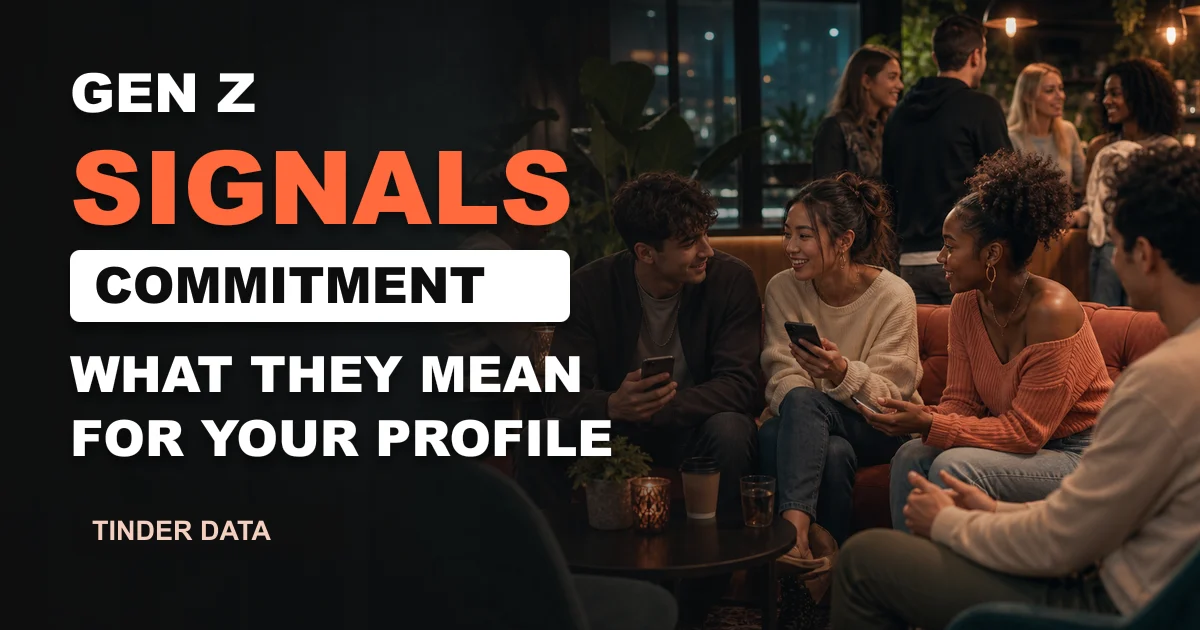
Gen Z Commitment Signals: What They Mean for Your Dating Profile
Tinder says Gen Z is creating new commitment rituals through soft launches, emotional signals, and community-first dating. Here is what that means for your photos, bio, and messages.
In this article11 sections
- The Big Shift: Vibes Before Vows
- What This Means for Your Profile
- Signal 1: Emotional Competence Is a Green Flag
- Signal 2: Social Context Matters More Than You Think
- Signal 3: Your Bio Should Show Emotional Availability
- Signal 4: Community Beats Broadcasting
- Signal 5: The Soft Launch Mindset Starts Before You Date
- Profile Checklist: Are You Sending the Right Signals?
- How to Message in a Signal-Based Dating Culture
- Bottom Line
- References
Gen Z did not kill romance. They made it harder to fake.
According to Tinder's February 25, 2026 report, Gen Z singles are unusually optimistic about love: 80% believe they will find true love and 74% believe they will get married. That is much higher than all singles overall, where Tinder reports 57% believe they will find true love and 43% believe they will get married.
The twist is that Gen Z is not rushing straight into formal milestones. They are building toward commitment through smaller signals: soft launches, friend-group approval, emotional competence, honest conversations, community overlap, and the way someone shows up online before the relationship is official.
That matters for your dating profile because your profile is no longer judged only on attractiveness. It is judged on what you signal.
Your Photos Are Signals Before They Are Photos
ProfileSharp scores what your dating photos communicate: trust, warmth, social ease, personality, and first-photo strength. If your profile looks good but gives no emotional or social signal, you may be losing serious matches.
The Big Shift: Vibes Before Vows
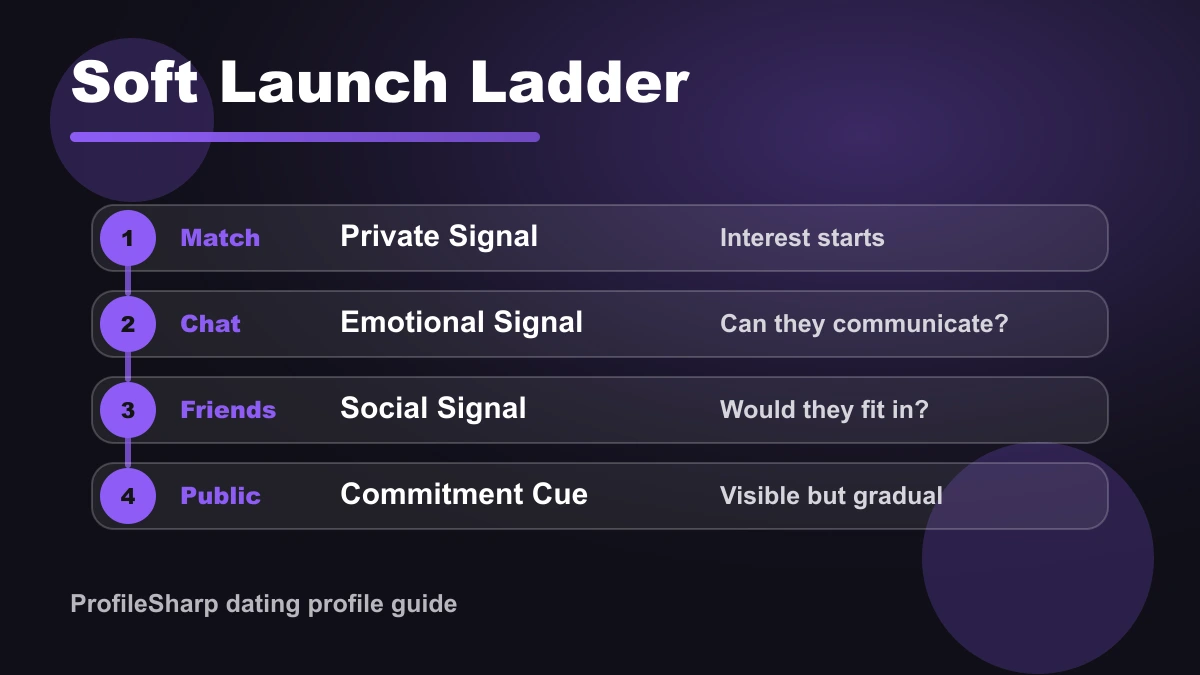
Tinder calls this shift "speaking in signals." Gen Z is still interested in love, marriage, and long-term commitment, but they are using intermediate rituals to test whether a connection is safe, clear, and emotionally real.
The most visible ritual is the social media soft launch.
Tinder reports that 46% of single Gen Z social media users soft launch relationships, compared with 12% of single social media users over 45. 37% of Gen Z hard launch relationships, compared with 10% over 45. And among Gen Z singles who have hard launched a relationship, 81% believe it is an important indicator of commitment.
In plain English: being seen together matters, but the way it happens is more gradual.
A soft launch does not say "we are married." It says, "this person is becoming part of my life." That is the point. Commitment is being tested through accumulated public and private signals before it becomes a formal label.
What This Means for Your Profile
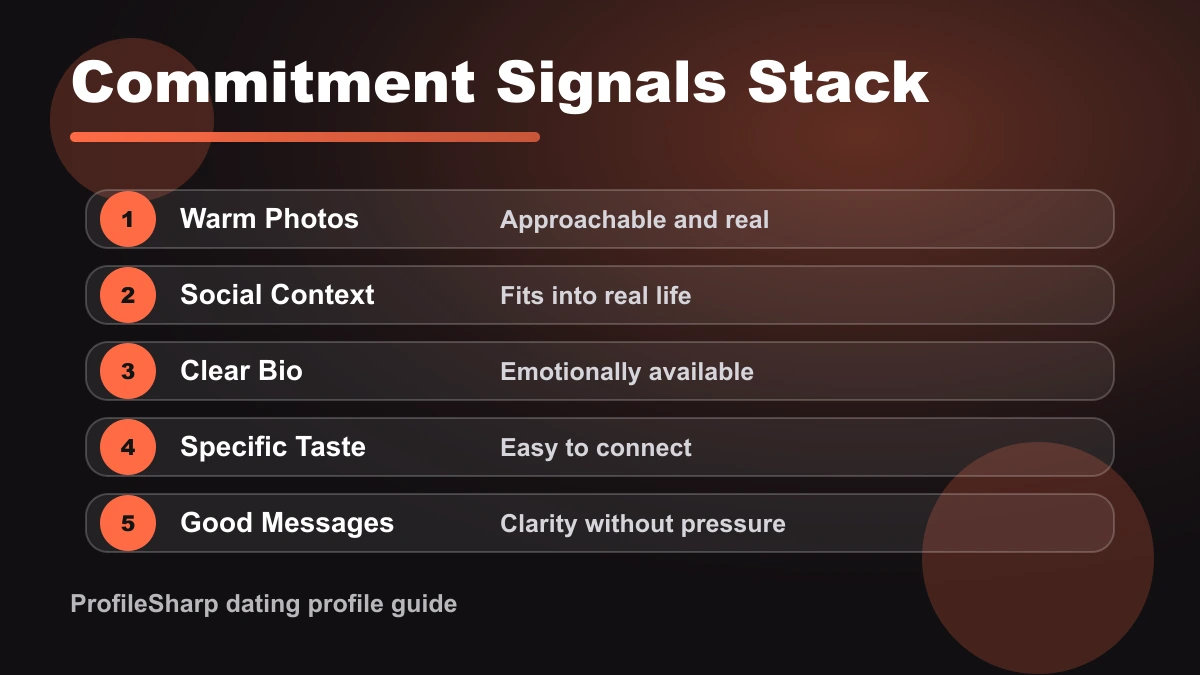
If Gen Z is reading signals, your profile needs to stop being a random collection of decent-looking photos.
It should answer:
- Do you seem emotionally normal?
- Do you seem easy to be around?
- Do you have real social context?
- Do you communicate clearly?
- Would someone feel comfortable letting their friends know about you?
- Does your life look like something another person could actually join?
Those are commitment signals. Your profile is already sending them, even if you did not choose them intentionally.
Signal 1: Emotional Competence Is a Green Flag
Tinder's report says 28% of Gen Z singles strongly agree that "the ick" comes from a lack of emotional competence or social skills, compared with 17% of older singles.
That is a major profile insight.
People are not only scanning for looks. They are asking: can this person read a room? Can they communicate? Do they seem respectful? Would they be embarrassing around friends? Would they handle a disagreement like an adult?
Your profile cannot prove all of that, but it can hint at it.
Bad signals:
- Aggressive bathroom mirror selfies.
- Bitter bio lines about "no drama."
- Photos where you look detached, angry, or too cool to try.
- Jokes that punch down.
- A profile that makes dating feel like a test she has to pass.
Better signals:
- Relaxed eye contact.
- Warm expression.
- Photos with real-life context.
- A bio that is specific without being defensive.
- Prompts that show self-awareness.
For example:
Bad bio:
"No drama. Don't waste my time."
Better bio:
"Best first meet: coffee walk, live music, or anything where we can talk without pretending the menu is fascinating."
The second one still filters for effort, but it does it without sounding guarded.
Signal 2: Social Context Matters More Than You Think
Gen Z's commitment rituals are social. Soft launching, community-building, friend-group overlap, and public signals all depend on one thing: whether someone fits into real life.
Tinder reports that Gen Z wants more than romance alone. In the data, Gen Z singles are open to:
- Friendships with romantic potential: 45%
- Shared community members: 37%
- Romantic relationships: 33%
- Mentors: 33%
- Work colleagues: 32%
- Volunteer group connections: 30%
Romance is part of a larger social web.
That means a profile with only solo photos can feel incomplete. It may show what you look like, but it does not show how you exist around other people.
You do not need to turn your profile into a group-photo slideshow. One good social photo is enough.
The best social proof photo:
- Shows you clearly.
- Includes two or three people, not a giant crowd.
- Feels natural, not staged.
- Shows warmth, context, and belonging.
- Does not make the viewer play "which one is he?"
For more on using social photos without hurting your match rate, read the group photo mistake that kills match rate.
Signal 3: Your Bio Should Show Emotional Availability
Tinder also points to a related survey where 56% of Gen Z daters say honest conversations matter. Emotional competence is the skill to communicate well. Emotional availability is the willingness to actually show up for the conversation.
Most dating bios do neither.
They either hide behind jokes:
"Fluent in sarcasm."
Or hide behind vagueness:
"Here for a good time."
Or hide behind requirements:
"Know what you want."
If you want to signal emotional availability, write a bio that gives her something real and low-pressure to respond to.
Better examples:
- "Slow mornings, live music, and people who can say what they mean without making it a whole courtroom case."
- "Currently trying to get better at cooking and worse at overthinking texts."
- "I like direct people, good coffee, and first dates that feel like two adults having an actual conversation."
- "Not rushing anything, but I do like when things are clear."
These are not dramatic. That is why they work. They signal clarity without neediness.
For more bio examples, see Tinder bio for guys.
Signal 4: Community Beats Broadcasting
Tinder says Gen Z leans heavily into newer social platforms: 54% of Gen Z singles report using Snapchat, compared with 30% across all generations, and 73% engage with TikTok, which Tinder says is 30% higher than the average across all ages.
The important takeaway is not "put TikTok in your profile." It is that Gen Z dating culture is more community-first and conversation-first than broadcast-first.
People want signs of shared language, shared taste, and shared worlds.
That means your profile should be specific enough to attract the right person.
Weak:
"Music, food, travel."
Stronger:
"Live music over clubs, spicy noodles over fancy tasting menus, and I will absolutely send you a TikTok that explains my entire mood."
Weak:
"I like fitness."
Stronger:
"Climbing gym twice a week, mostly for the illusion of control."
Specificity gives someone a signal to catch.
Signal 5: The Soft Launch Mindset Starts Before You Date
You do not need to be in a relationship to think about soft-launch logic. The same idea applies before the first date.
A strong dating profile should make someone feel like:
"I could imagine introducing this person to my world."
That is the deeper filter.
Your photos should not only say "I look good." They should say:
- I am socially safe.
- I have a real life.
- I can be around friends.
- I have interests beyond dating.
- I am clear enough to not create chaos.
This is why overly polished profiles can backfire. If every photo looks like a personal brand shoot, you may look attractive but hard to place in real life.
The best profile feels attractive and livable.
Profile Checklist: Are You Sending the Right Signals?
Run your current profile through this:
- Does your first photo feel warm and approachable?
- Do you have one real social-context photo?
- Does your bio say anything emotionally clear?
- Do your prompts show self-awareness instead of defensiveness?
- Is there at least one specific interest someone can respond to?
- Do your photos show real life, not only angles?
- Would someone feel comfortable telling a friend they matched with you?
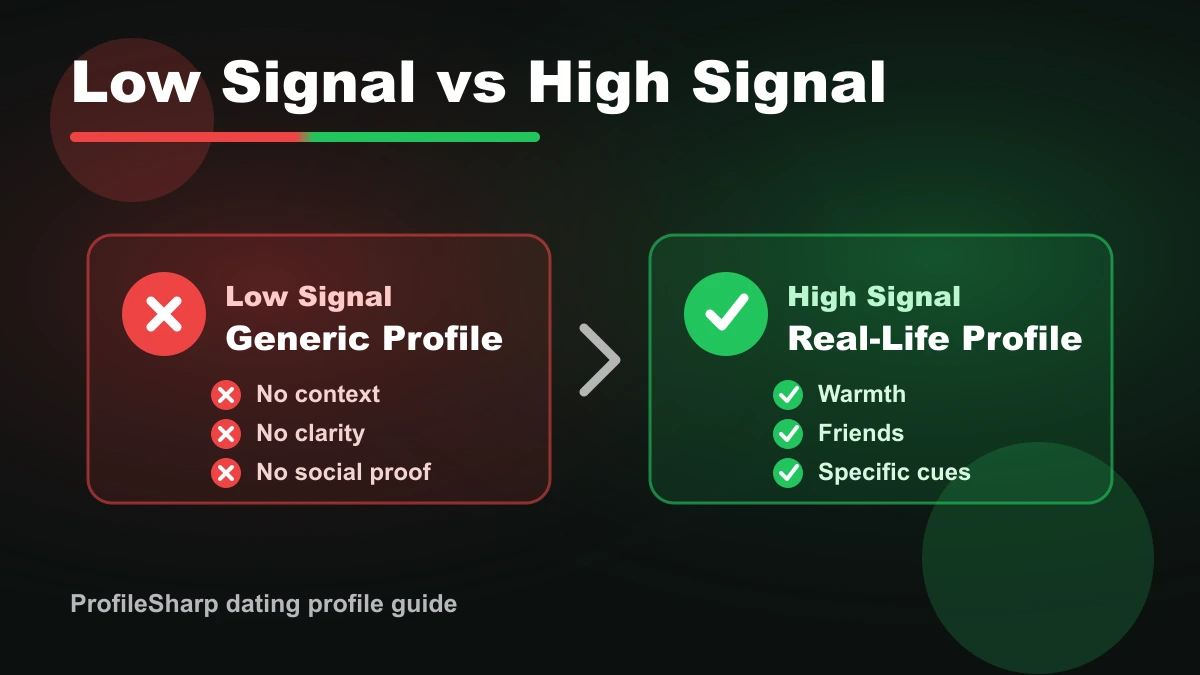
If you checked fewer than five, your profile may be attractive but low-signal.
That is the exact problem Gen Z dating culture exposes.
Need Help Reading the Signals in Your Own Profile?
ProfileSharp shows what your photos communicate before a match reads your bio. Keep the photos that build trust and personality. Fix the ones that make you look distant, generic, or hard to meet.
How to Message in a Signal-Based Dating Culture
The same rules apply after the match.
If commitment is built through micro-signals, then your early messages should communicate:
- You paid attention.
- You are not performing.
- You can hold a real conversation.
- You are comfortable with clarity.
- You can flirt without making everything intense.
Weak opener:
"Hey."
Better:
"Your coffee standards look dangerously specific. What is the order?"
Weak follow-up:
"So what are you looking for?"
Better:
"I am not trying to speedrun the app, but I do like knowing if someone is more 'see where it goes' or 'actually dating with intention.' Where are you at?"
That line works because it signals clarity without demanding a relationship immediately.
If you get stuck after the match, Wingman can help you write replies that fit the actual conversation.
Bottom Line
Gen Z is not anti-commitment. Tinder's own data suggests the opposite: Gen Z is highly romantic, but cautious about how commitment becomes real.
The path now runs through signals.
Soft launches. Friend-group comfort. Emotional competence. Honest conversations. Community overlap. Specific interests. Clear but low-pressure communication.
Your profile should reflect that shift. It should not only prove that you are attractive. It should prove that you are someone a real person could comfortably bring into their life.
Get your dating profile scored before your next match sees it ->
References
Disclaimer: This article is an independent analysis based on publicly available information. ProfileSharp is not affiliated with or endorsed by Tinder.
This article draws on Tinder's February 25, 2026 report and its cited survey methodology, including third-party research conducted by The Harris Poll for Match Group among 2,500 single adults ages 18-79 in the United States from September 26 to October 7, 2025, plus Tinder's additional Opinium survey of 4,000 actively dating 18-25 year olds in the US, UK, Canada, and Australia between October and November 2025.
Last updated: June 8, 2026