 Messaging & Conversations
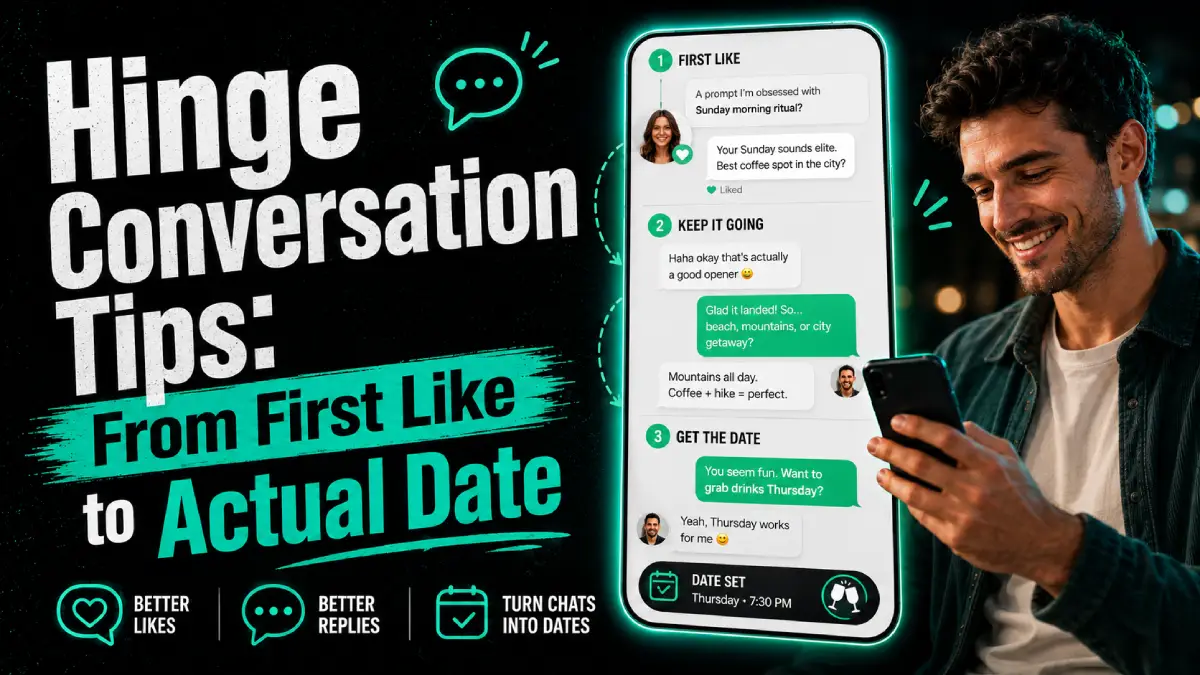
Hinge Conversation Tips: From First Like to Actual Date
Hinge conversations have a built-in advantage — the prompts. Here's how to use them, what to say after she likes you, and how to turn a Hinge match into a real date.
In this article10 sections
- ⚡ Hinge vs. Other Apps: What's Different
- What Hinge's Own Research Says About What Works
- 🎯 How to Like + Comment Effectively
- 📝 Responding to Her Like on Your Prompt
- 🔎 Using Prompts to Build Conversation Threads
- 🎤 Voice Notes: The Most Underused Hinge Tool
- 🚫 Hinge Conversation Mistakes
- 💬 Ask Better Questions — It Directly Affects Whether She Wants a Second Date
- 🎯 Moving From Conversation to Date
- ✅ Quick Self-Check
Hinge's design philosophy is intentional: prompts, voice notes, and photo captions are all conversation invitations. The problem is that most people ignore them. They match, send a generic opener, and then wonder why Hinge doesn't feel different from Tinder.
Used correctly, Hinge's format gives you more to work with than any other dating app. Here's how to actually use it.
⚡ Hinge vs. Other Apps: What's Different
| Feature | How Hinge Uses It | How to Leverage It |
|---|---|---|
| Prompts | Give you conversation hooks | Always reference or respond to them |
| Photo captions | Invite specific comments | Ask about the caption, not just the photo |
| Voice notes | Creates tone/personality read | Use voice notes yourself for differentiation |
| "Like" + comment | Forces specificity | Never like without a comment |
| Roses | Signals high interest | Use when you're genuinely more interested |
| Most Compatible algorithm | Shows high-match profiles first | Treat them as pre-qualified |
The key difference: Hinge is built for openers that are already half-written. The prompt is the conversation starter. Your job is to be the good first reply.
What Hinge's Own Research Says About What Works
Hinge's 10 Lessons in Love report (December 2025) surveyed daters across the platform and identified the communication behaviors that consistently lead to more dates. The data is specific enough to be actionable:
| Research Finding | The Number | What It Means for You |
|---|---|---|
| Profiles with Voice Prompts are more likely to lead to a date | 32% more likely | Add a Voice Prompt to your profile if you haven't |
| Gen Z daters who want more Voice Notes from matches | 35% | A voice note mid-conversation is a differentiator |
| People more likely to want a second date after being asked thoughtful questions | 85% | Curiosity isn't just charming — it's measurably effective |
| Women (across sexualities) who care more about effort than earnings | 72% | How you show up in messages signals more than what you say |
The throughline from Hinge's research: communication quality matters more than volume. Moe Ari Brown, Hinge's Love & Connection Expert (LMFT), puts it plainly: "The more intentionally we speak and listen, the more space we create for real understanding."
This maps directly to how Hinge is designed — prompts, voice notes, and photo captions are all built to make intentional communication easier. The question is whether you're actually using them.
💬 Get the Right Reply for Every Hinge Moment
Wingman reads your Hinge conversation and gives you reply options calibrated to her specific prompts, messages, and interest level. 3 free analyses per day.
🎯 How to Like + Comment Effectively
The "Like with a comment" feature is the most underused advantage on Hinge. Most men send a like without a comment, which is the Hinge equivalent of swiping right and saying nothing.
When you like her prompt: respond to the specific content of the prompt, not just acknowledge it.
🔴 "Haha that's funny 😂" (responding to a funny prompt)
🔴 "Same!" (responding to a shared interest prompt)
🟢 "Okay the [specific part of her answer] is genuinely surprising to me — how did that start?"
🟢 "I need the full story behind [specific detail] because that implies a lot."
The goal: your comment should be something only someone who actually read and thought about her prompt could write. If it could apply to any prompt or any person, it's not working.
For a full library of openers built on this same principle, best Hinge openers has specific examples sorted by prompt type.
📝 Responding to Her Like on Your Prompt
If she liked one of your prompts, she's given you signal. Your first message should:
- Acknowledge what she liked (briefly)
- Add something that extends the conversation
- Ask or invite a response
🔴 "Thanks for the like! How are you?"
🟢 "I see you liked the [prompt answer] one. Fair warning: I will absolutely defend that opinion if challenged."
🟢 "The [prompt] got you — that's the one I wasn't sure would land. What's your version of that answer?"
She engaged with your specific content. Mirror that specificity.
For the broader Hinge conversation strategy — from the very first message to building a thread — see how to start a conversation on Hinge.
🔎 Using Prompts to Build Conversation Threads
Each prompt answer she has is a potential thread. The mistake is treating them as separate one-off conversation topics. The better move is to follow threads wherever they go:
She says her most controversial opinion is [X]: Don't just ask "tell me more." React genuinely: "That's not controversial, that's correct. My controversial opinion is [Y] and I'll actually defend it."
She says she's always thinking about [topic]: "That's an interesting thing to always have on your mind — where does that come from for you? For me it's usually [thing you think about], which is either very similar or completely different."
She says she's looking for someone who [quality]: This is a signal about what she values. Respond to the quality, not just the prompt: "I've been told I'm [quality related to hers] — whether that's accurate is another question. Do you have a test for that?"
Wait, Really? Hinge's own data suggests that matches who receive a comment (versus a like only) are significantly more likely to have a conversation. And within those conversations, exchanges that reference the specific prompt content outperform generic first messages by a wide margin. The data isn't subtle: specificity converts.

🎤 Voice Notes: The Most Underused Hinge Tool
Most Hinge users never send a voice note. That's exactly why you should.
Hinge's research shows profiles with Voice Prompts are 32% more likely to lead to a date, and 35% of Gen Z daters say they want more voice notes from the people they're talking to. Voice carries tone, warmth, and humour that text can't replicate — it's the closest thing to an in-person conversation before you've actually met.
When to send a voice note:
- When a text reply would be long or nuanced (voice is faster and warmer)
- When you want to stand out — almost nobody does this
- When the conversation has momentum and you want to deepen it
- When humour is part of your personality (tone doesn't get lost)
How to do it well:
- Keep it under 30 seconds — this isn't a monologue
- Reference something specific from the conversation
- End with a question or something she can respond to
- Don't script it — a slightly imperfect, genuine delivery beats a polished read
The goal isn't to perform; it's to give her a real sense of who you are before you meet. That's what builds actual chemistry.
🚫 Hinge Conversation Mistakes
Ignoring the prompts. This is the most common mistake. She put time into writing them. Ignoring them in favor of "hey" signals that you didn't actually look at her profile — which is especially obvious on a platform designed around prompts.
Asking for her Instagram or number before any conversation. Hinge users tend to be more relationship-oriented. Moving to a different platform before a conversation has started reads as a skip-ahead move that most women don't respond well to.
Being too "clever." Hinge users tend to be more thoughtful. Overly performative wit or one-liner jokes sometimes land better on Tinder. On Hinge, genuine engagement often outperforms cleverness.
Treating it like a long-term pen-pal app. Great Hinge conversations should move toward a date. The format doesn't change the timing principle: after good back-and-forth, move toward meeting.
💬 Ask Better Questions — It Directly Affects Whether She Wants a Second Date
Hinge's research found that 85% of people are more likely to want a second date if they're asked thoughtful questions. This isn't about the date itself — it starts in the conversation before you've even met.
The pattern that works: ask questions that invite stories, not one-word answers.
🔴 "Do you like hiking?" → yes/no dead end
🟢 "What's the trip that made you actually understand why people love hiking?" → opens a thread
Hinge's own Love & Connection Expert frames it this way: when you invite someone to share a story, you discover not just their answer, but their world, their past, and their values. Stories create context and emotion — they move the conversation past small talk.
Practical upgrade for any conversation:
- Replace "what do you do?" with "what made you end up in [her field]?"
- Replace "do you like [activity]?" with "what's the best version of [activity] you've had?"
- Replace "where are you from?" with "do you still feel connected to where you grew up?"
None of these require more words. They just open more doors.
🎯 Moving From Conversation to Date
After 5–8 good exchanges on a Hinge thread, here's the move:
"This has been a good conversation — let's actually meet. Are you free [day] or [day] for [coffee / drinks / walk]?"
The specific suggestion matters. "We should hang out sometime" is not a date proposal — it's a vague gesture. A specific day, a specific activity. She can say yes, no, or suggest an alternative. Any of those is more useful than keeping it ambiguous.
Hinge's Follow-Through Formula
Hinge research identified exactly what daters want when it comes to post-conversation follow-through — and the numbers are precise enough to use directly:
- 75% of daters expect a message the same day or the next after a good conversation or first date
- 44% find genuine enthusiasm most attractive (not playing it cool)
- 47% want to see interest in meeting again — without overplanning it
Hinge calls this the Follow-Through Formula: Timing + Enthusiasm + Intent.
In practice: don't wait two days to message after a good exchange. Send the date ask while momentum is there. Be direct about wanting to meet — "I'd like to actually hang out" is more attractive than manufactured ambiguity. And keep the plan simple; the goal is the meeting, not an impressive itinerary.
Half of daters admit they've held back from sending a message after a great first date — worried it might seem too eager. Hinge's data says the opposite is true: clarity is more attractive than ambiguity.
For the cross-app framework on timing and framing the date ask, see when to ask for a date on dating apps.
✅ Quick Self-Check
- Every like I send includes a specific comment that references the actual prompt content
- When she liked my prompt, my first message acknowledges what she liked specifically
- I'm building on conversation threads, not treating each prompt as a separate topic
- I'm not ignoring prompts in favor of generic openers
- After 5–8 good exchanges, I'm suggesting an actual date with a day and activity
- I'm using Wingman to check her interest and get reply calibration when I'm not sure