 Profile Photos
Rate My Dating Profile: What Your Photos Actually Reveal
Wondering how your dating profile really looks? See what your photos actually signal to matches — and the exact fixes that get more right swipes.
In this article6 sections
You open your profile, stare at the photos, and think they look fine. Maybe even good. Then the match count stays exactly where it was. You refresh. Nothing. You start wondering if the algorithm is broken — or if something is quietly wrong with what you're putting out there.
The frustrating part isn't the low numbers. It's the uncertainty. When you don't know what your profile is actually communicating, you can't fix it. Most dating app problems aren't about your face — they're about what your photos signal in the first two seconds before a match makes a judgment call.
📊 What "Rating" a Dating Profile Actually Means
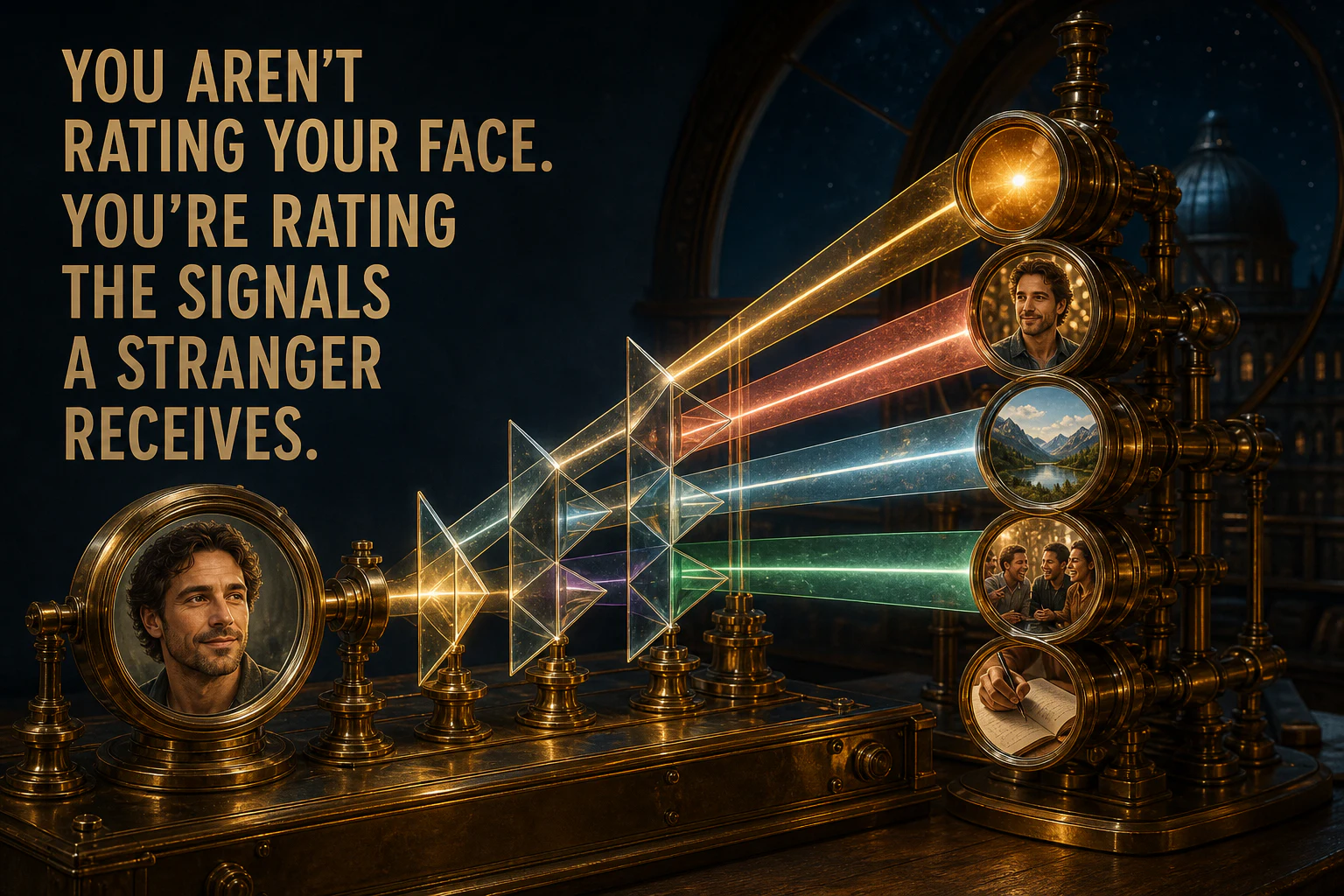
A lot of people think "rate my profile" means someone looks at your photos and scores your attractiveness. That's not what matters. What actually determines whether someone swipes right is a set of implicit signals your photos send about your lifestyle, social confidence, and effort.
Here's what any honest profile rater is actually evaluating:
| Signal | What it tells her | What hurts it |
|---|---|---|
| Lighting quality | Are you put-together or sloppy? | Dark, grainy, or bathroom-mirror shots |
| Body language | Are you confident or closed off? | Arms crossed, head down, forced smiles |
| Social context | Do you have a real life? | Only solo photos, no context shots |
| Background | What's your environment like? | Cluttered rooms, bland white walls |
| Authenticity | Does this look real? | Heavy filters, old photos, sunglasses in every shot |
| Photo variety | Are you interesting as a person? | Same pose, same location, same vibe across all photos |
Each row above maps to a real signal your profile is sending right now.
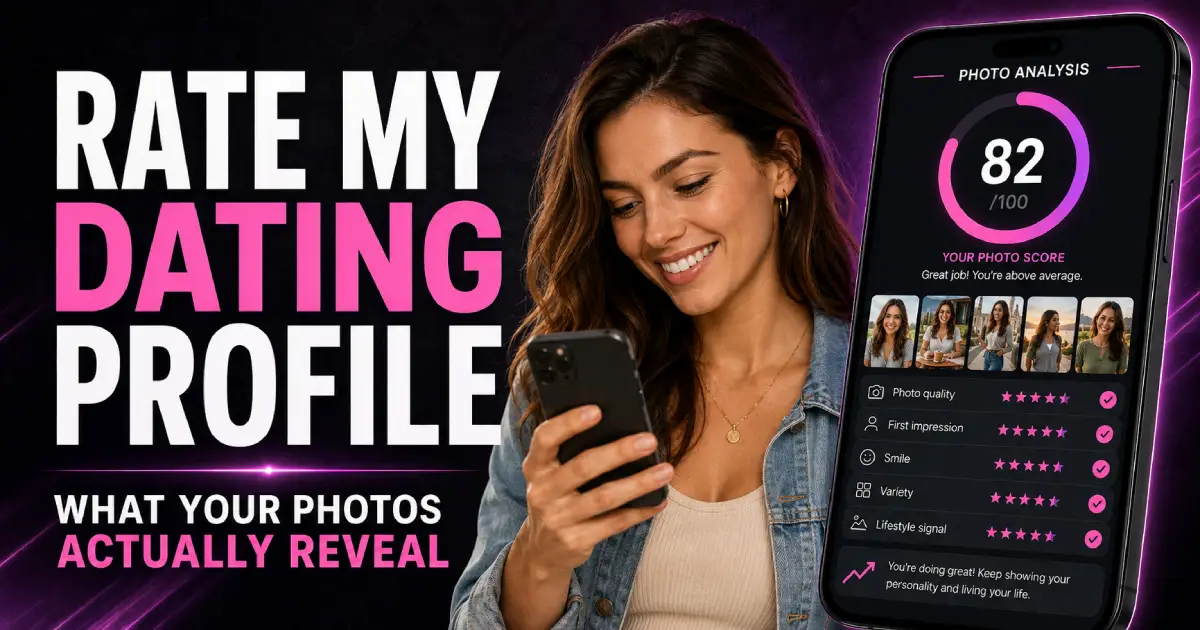
📸 Get Your Actual Profile Score
SharpScan analyzes every photo in your profile and scores each one across lighting, composition, authenticity, and first impression. Upload your photos and see exactly what's hurting your match rate — in under 60 seconds.
🔎 Why First Impressions Are Made Before She Even Reads Your Bio
The research on split-second social judgments is well-established. In dating app contexts, the swipe decision happens in under two seconds — before your bio is read, before your prompts register, before anything else. This is the photo psychology principle your profile lives and dies by.
In those two seconds, the halo effect kicks in hard. A strong first photo doesn't just make you look attractive — it primes the viewer to interpret your other photos more favorably. A weak first photo does the opposite: it creates a negative frame that makes everything after it look worse than it actually is.
This is why so many profiles underperform despite having a few decent photos. The lineup order and the first photo choice are often responsible for the gap between your actual attractiveness and what your match rate suggests.
🚫 The 5 Things That Tank a Profile Rating Instantly
When you mentally "rate" other people's profiles, these are the things that make you swipe left before you're even conscious of why:
- Low-resolution or blurry main photo — signals low effort immediately
- Sunglasses in the lead photo — hides the face, breaks trust, feels evasive
- Group photo as the first photo — forces her to figure out who you are, most won't bother
- No smiling in any photo — reads as unapproachable, cold, or uncomfortable
- Bathroom selfies or front-facing camera shots — screams no social life
- Only one type of photo (all gym, all nights out, all travel) — no depth, no story
The Harsh Truth: A profile with three great photos beats a profile with nine mediocre ones. More photos isn't better. Better photos is better.

🤔 Why You Can't Accurately Rate Your Own Profile
There's a well-documented bias in how we perceive our own photos: we consistently overestimate how others see our familiar images. You've looked at your photos so many times that you no longer register what a stranger sees in the first pass. You see context, memory, and personality. She sees composition, vibe, and signal.
This is the single biggest reason why asking friends "which photo is best?" rarely works either. Your friends have the same familiarity bias you do — they know you, so they evaluate based on likeness rather than stranger-first impression.
The only way to accurately rate a dating profile is through the lens of a cold, first-time viewer — which is exactly what AI photo analysis is designed to replicate. An AI dating profile review puts that objective lens on your photos specifically — something your own familiar eyes simply can't provide.
Wait, Really? Most people assume profile photos that "look fine" to them are good enough — but research on photo psychology shows familiar viewers and strangers evaluate the same image completely differently. The gap between your self-perception and first-impression reality is where match rate lives.
📸 What a High-Scoring Profile Actually Looks Like
If you were to build a profile that would rate extremely well across every dimension, it would follow this pattern:
Photo 1 (Main photo): Clear face, natural smile, good lighting, solo, outdoor or clean background. You look like a person other people want to be around. For the data behind why expression matters so much in this slot, see smiling vs. serious dating photos: which gets more matches.
Photo 2 (Social proof): You with friends or in a group setting. You exist in the world. You have a social life. Bonus if there's something interesting happening in the background.
Photo 3 (Activity/lifestyle): Doing something you love — travel, sport, cooking, music. Not posed for the camera. Tells a story without a caption.
Photo 4 (Full body): Shows your physique without being try-hard. Natural setting, clothed, preferably doing something rather than standing and posing.
Photo 5–6 (Depth shots): Close-up where your personality comes through, or a high-quality candid. Smiling naturally. The kind of photo that makes someone feel like they can imagine talking to you.
For a deeper breakdown of how to select each photo, how to choose photos for dating apps covers the full lineup strategy.
✅ Quick Self-Check
Run this against your current profile before you upload anything new:
- My main photo shows my face clearly with no sunglasses or hat
- At least one photo is outdoors in natural light
- I have at least one photo in a social context (not all solo)
- My photos span at least 2–3 different settings or activities
- I'm smiling (genuinely) in at least 2 photos
- None of my photos are blurry, dark, or filtered beyond recognition
- My most recent photo is from within the last 12 months
If you checked fewer than 5, your profile has clear fixable gaps. If you want the full breakdown by photo — scored across lighting, composition, authenticity, and first impression — upload to SharpScan and see the exact numbers.
The reality is simple: you can guess what's hurting your profile, or you can know. One approach gets you more of the same results.