 Messaging & Conversations
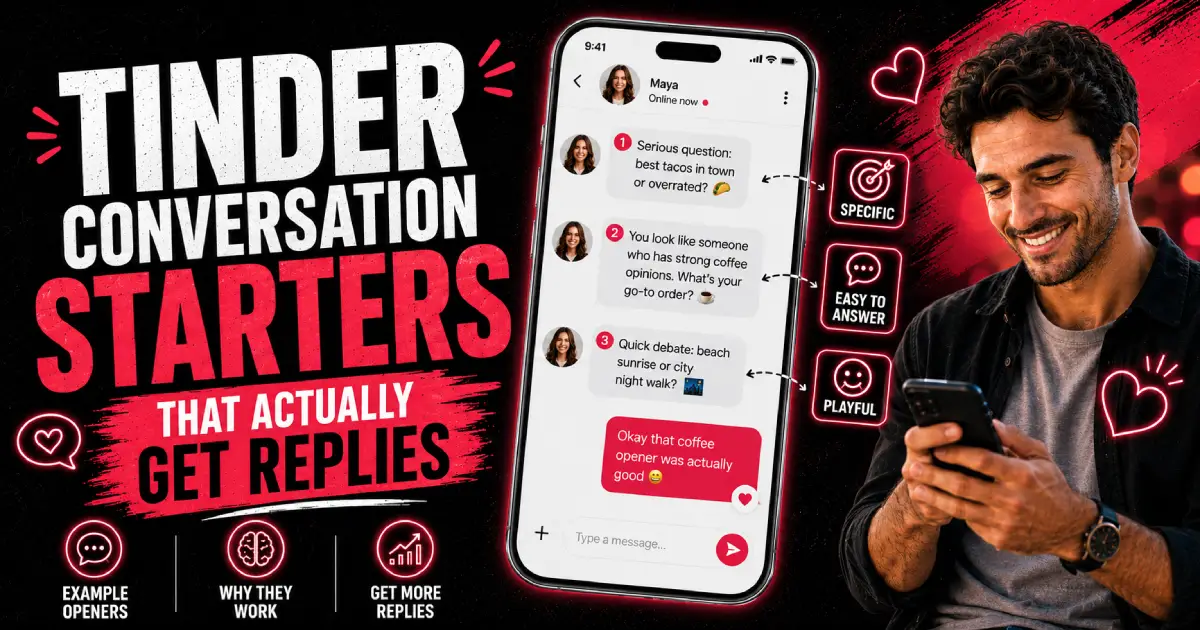
Tinder Conversation Starters That Actually Get Replies
Most Tinder openers get ignored. Here's why — and 12 specific conversation starters that actually get replies, with the psychology behind what makes them work.
In this article5 sections
The average Tinder opener gets ignored. Not because the person sending it is boring or unattractive — but because the opener itself gives the other person nothing to work with. "Hey," "You're gorgeous," and "How's your week going?" are not conversation starters. They're conversation requests. And nobody's obligated to do the work you didn't do.
A good opener requires just one thing: it has to be easier to respond to than to ignore. Here's how to build one.
⚡ Opener Types: What Works and What Doesn't
| Opener Type | Response Rate | Why |
|---|---|---|
| Profile-specific question | High | Shows effort, gives a real topic |
| Playful observation | High | Creates emotion, easy to engage |
| Specific compliment + question | Medium-high | Flattery + invitation |
| Opinion question | Medium-high | People love sharing opinions |
| Shared interest reference | High | Instant common ground |
| "Hey" / generic greeting | Very low | Nothing to respond to |
| Generic compliment ("you're cute") | Low | Feels transactional |
| Paragraph opening | Low | Too much, too soon |
| Copy-paste "witty" one-liners | Low | She's seen it before |
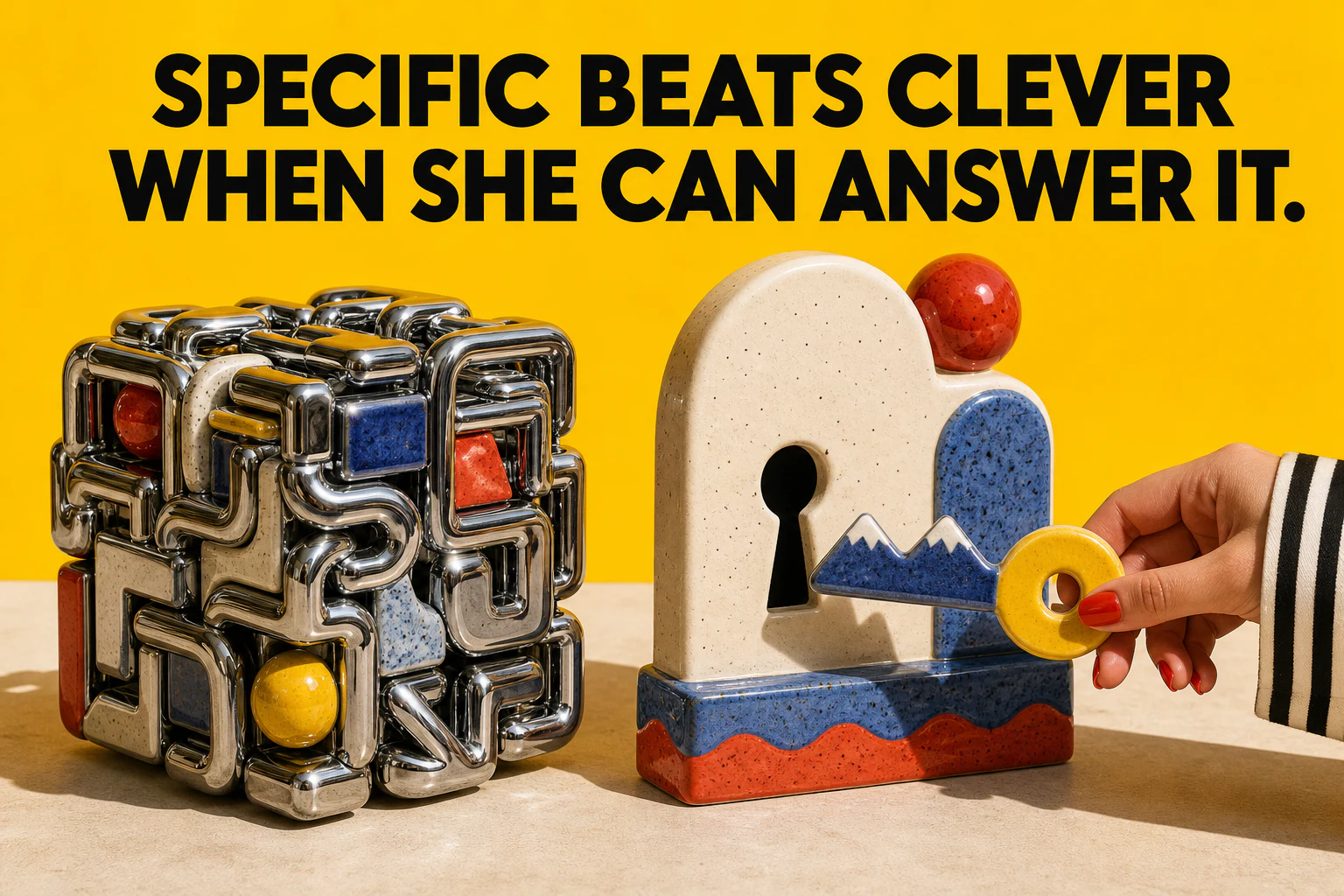
The principle: the best openers are specific, easy to respond to, and create a small emotional reaction (curiosity, amusement, or warmth). Profile-specific always outperforms generic.
💬 Never Run Out of Things to Say
Wingman analyzes your conversation in real time and gives you 4 reply styles — Flirty, Funny, Confident, and Chill — so you always have a direction when you're not sure what to send. 3 free analyses per day.
🎯 12 Openers That Actually Work (And Why)
1. The specific observation: "You look like someone who has a strong opinion about airport coffee. Tell me I'm wrong." Why it works: Creates a specific, funny frame that's easy to agree with or push back on.
2. The photo question: "The [specific location/thing in her photo] — is that [city]? Did you love it or was it one of those 'great for Instagram, exhausting to actually be there' situations?" Why it works: Profile-specific, shows you looked, and has a built-in opinion that invites her reaction.
3. The "I need your honest opinion": "Genuine question: is [mild controversial take about something in her profile] actually as good as everyone says?" Why it works: People love being asked for opinions, and it creates an immediate reason to engage.
4. The playful accusation: "Based on your profile I'm absolutely certain you're the person in your friend group who picks the restaurant and won't apologize for it." Why it works: About her specifically, slightly presumptuous, invites her to confirm or correct.
5. The "we'd disagree on": "We're probably going to argue about [thing in her profile] but I think we'd get along anyway." Why it works: Creates playful tension and implies connection despite differences.
6. The direct compliment with substance: "The photo at [specific place] — that's exactly the kind of trip I'd want to take. Where else have you been that surprised you?" Why it works: Not just "you're pretty" — it compliments something she did and opens a real conversation.
7. The hypothetical: "If you had to eat only the food from one country for the rest of your life, what are you going with?" Why it works: Easy to answer, reveals personality, no wrong answer.
8. The this-or-that: "Quick one: [Thing A in her profile] or [Thing B in her profile] — you can only keep one." Why it works: Fast, fun, requires minimal effort to answer, starts a back-and-forth.
9. The honest opener: "I don't have a clever line for this one. Your [specific thing] made me stop and actually read your whole profile. That doesn't happen often." Why it works: Sincerity stands out when everything else is trying too hard.
10. The shared interest hook: "You mentioned [specific interest]. I've been into that since [context]. Do you [specific question about the interest]?" Why it works: Instant common ground, shows you read the profile, and moves to a real conversation immediately.
11. The teasing challenge: "I'm not convinced your [claim in bio] is accurate. Prove it." Why it works: Playful, slightly challenging, invites engagement. Works best with confident bio claims.
12. The callback: "The [weird/funny/interesting thing in her profile] — okay I have questions." Why it works: Simple, creates curiosity, implies you want to hear more about her specifically.
🚫 Openers to Stop Using
"Hey 😊" — This is not an opener. It's a ping. She has 50 of these.
Compliment + nothing: "You're so pretty" with no question and no invitation. Even if she's flattered, there's nothing to respond to.
The resume opener: Three sentences about yourself with no question at the end. You've made her read an unprompted introduction. That's work she didn't ask to do.
The overly creative joke: Multi-part setups, jokes with specific punchlines. These require her to be in the right mood to appreciate them. The simpler the opening, the more accessible it is.
Anything she's obviously heard before: "I'm not good at this," "Tell me something interesting about yourself," "You seem different from other girls." These are immediately recognizable as templates.
If you sent one of these and got silence, how to recover from a bad opener has the exact second-message strategy.
The Harsh Truth: She knows when a message is copy-pasted. Not because she's suspicious — because it reads like copy-pasta. It has no specificity. It could have been sent to anyone. If your opener could be sent to literally any woman on the app, it communicates that she's not interesting enough to have written something specific for.
📝 The Profile-Mining Framework
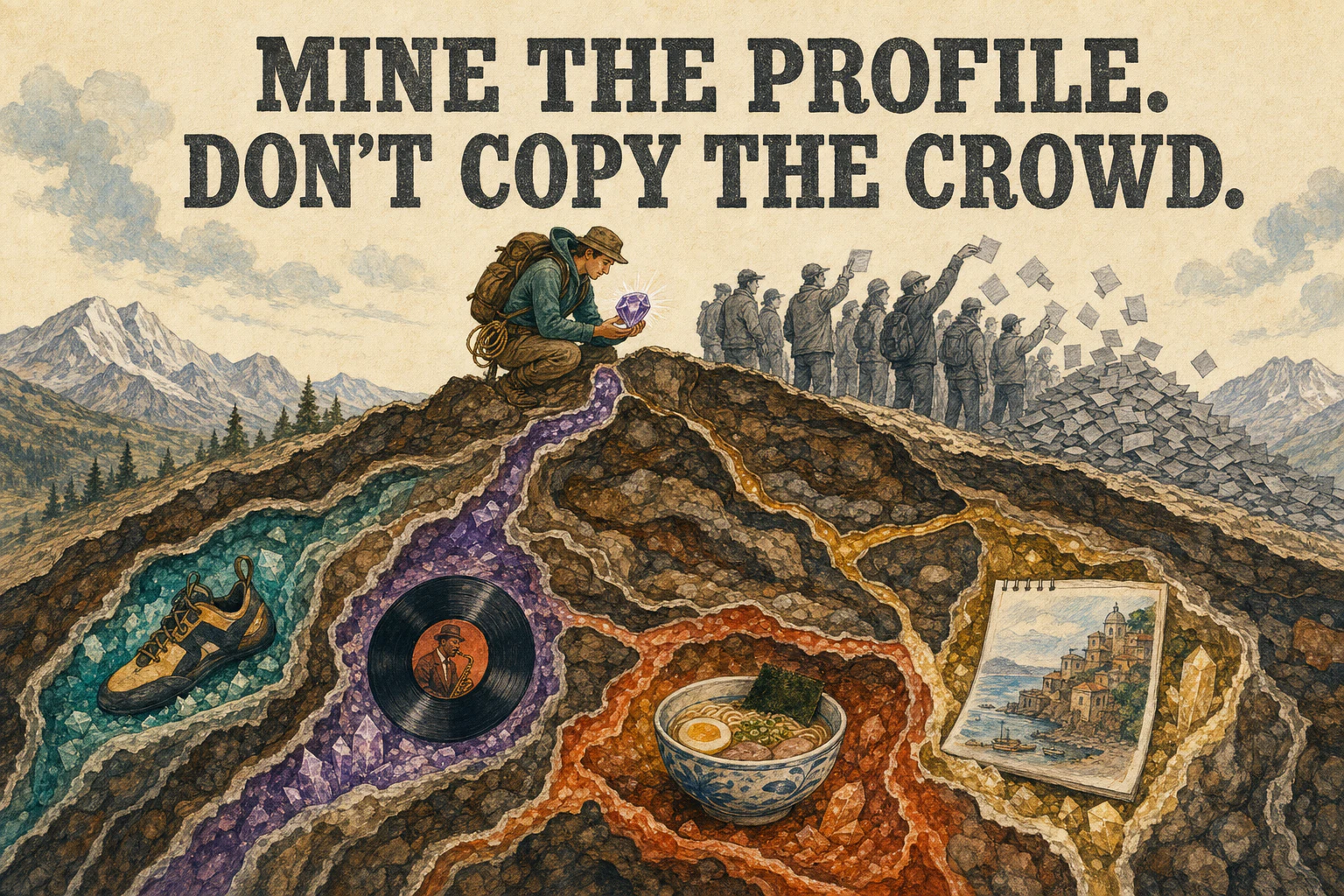
The best openers come from reading the profile. Here's a 60-second framework:
- Look at photos: Is there a location, activity, or detail that catches your eye?
- Read the bio: Is there an opinion, a claim, a quirk, or a question you can build on?
- Look at prompts (Hinge/Bumble): These are literally conversation invitations.
- Pick one thing and write a message specifically about that one thing.
- End with a question or an implicit invitation to respond.
That's it. One specific thing + question or reaction. It's more work than "Hey" — and it takes 90 seconds. The response rate difference is not small.
Once your opener lands a reply, the challenge shifts to keeping the conversation alive — see how to keep a conversation going on dating apps for what happens next.
For the broader collection of opener frameworks across all dating apps, dating app openers that actually work covers the underlying principles in more depth.
✅ Quick Self-Check
- My opener references something specific from her profile
- My message includes a question or a natural invitation to respond
- I'm not opening with a generic compliment only
- My message is 1–3 sentences, not a paragraph
- I could not have sent this exact message to someone else without changing it
- If the conversation stalls, I use Wingman to read her interest and get reply options