 Profile Photos
AI Dating Photos: Do They Actually Work in 2026?
AI dating photos can look impressive, but they can also quietly destroy trust. Learn when AI helps, when it hurts, and what to do instead.
In this article10 sections
AI-generated dating photos are tempting for one obvious reason: they promise to solve the hardest part of dating apps without making you take new photos.
No awkward photo shoot. No asking friends. No sorting through old pictures. Just upload a few selfies, get polished images back, and suddenly your profile looks like you have a personal photographer.
The problem is that dating apps are not only judging whether you look attractive. They are judging whether you look real, socially calibrated, trustworthy, and dateable. A photo can be technically impressive and still make women hesitate.
That is the part most AI photo advice misses.
That trust issue is not just theory. Tinder's Community Guidelines emphasize authentic profiles, while Match's Singles in America data, covered by Axios, shows AI is already influencing how people present themselves and communicate in dating.
The Short Answer
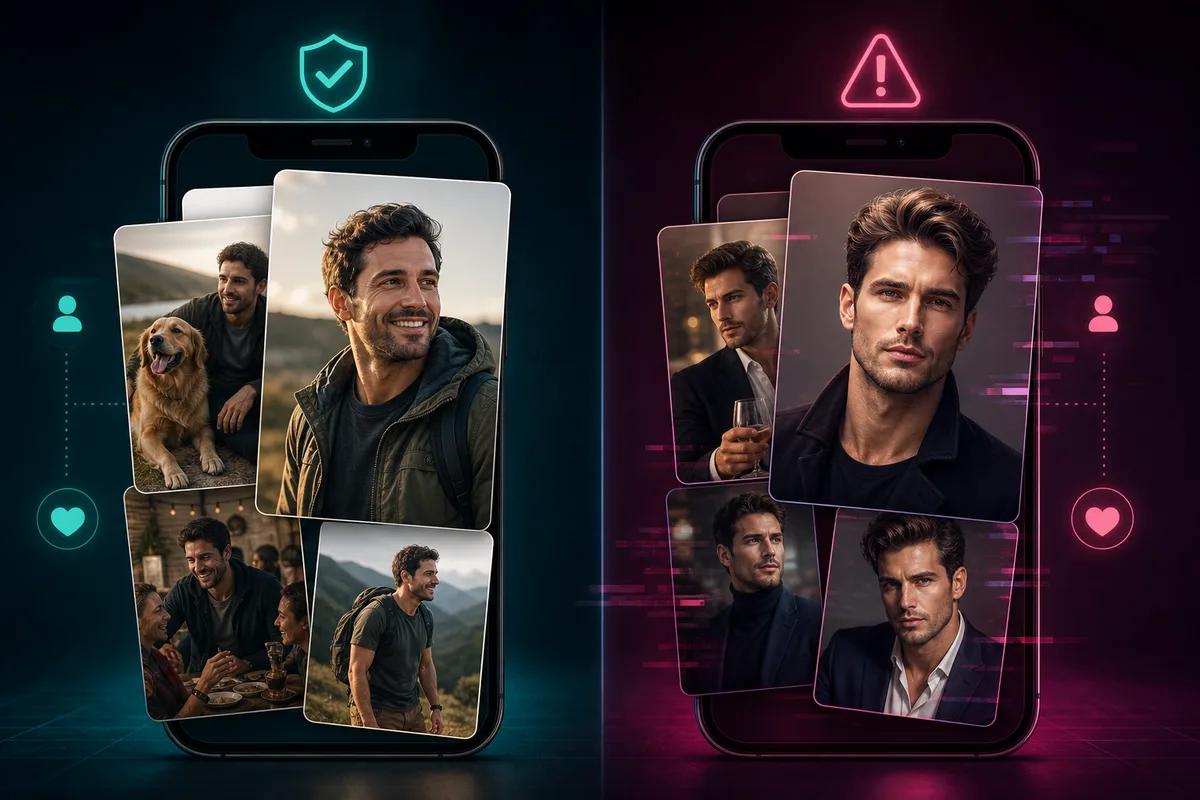
You should not build your dating profile around fully AI-generated photos.
Use AI to review, select, and improve your real photos. Do not use AI to invent a version of you that your date will not meet in person.
That difference matters.
AI can help you understand:
- Which photo should be first
- Which photos make you look less trustworthy
- Whether your lineup feels consistent
- If your lighting, expression, or background is hurting you
- What photo types are missing from your profile
AI becomes risky when it creates:
- A face that looks subtly different from yours
- A fake lifestyle you do not actually live
- Studio-perfect images that feel too polished for a dating app
- Generic "high value man" photos that look like everyone else's AI profile
- A first impression you cannot match in person
On dating apps, the goal is not to look artificially perfect. The goal is to make a stranger feel confident saying yes.
Get the Benefit of AI Without Looking Fake
ProfileSharp analyzes your real dating photos and tells you which ones help, which ones hurt, and what to change.
Why AI Dating Photos Are So Appealing
Most guys do not have many good photos of themselves. That is not a character flaw. It is just how male social life often works.
You might have:
- One decent wedding photo
- A gym mirror selfie
- A blurry group photo
- A vacation photo from three years ago
- A serious LinkedIn-style headshot
- A couple of random selfies
Then you open Tinder or Hinge and realize your profile is competing against people who look like they have a full content team.
AI photo tools step into that insecurity. They sell a simple promise: if your photos are the problem, generate better ones.
But the real issue is usually not that your photos are not cinematic enough. It is that your lineup is sending mixed or weak signals.
A dating profile needs to answer four questions fast:
- Do I know what he actually looks like?
- Does he seem safe and socially normal?
- Does his life look interesting enough to enter?
- Would meeting him feel natural, not awkward?
AI-generated photos often over-optimize the first question and damage the other three.
| Photo Approach | Short-Term Upside | Hidden Risk | Best Use |
|---|---|---|---|
| Fully AI-generated photos | Looks polished fast | Can feel fake or misleading | Avoid for main profile |
| Heavy AI edits | Can improve weak images | Changes your real-life expectation | Use rarely |
| Light editing | Fixes lighting and crop issues | Low risk if still realistic | Good support tool |
| AI photo review | Finds weak photos and best order | Requires real photo options | Best overall strategy |
The Trust Problem
Dating apps already have a trust problem. People worry about fake profiles, old photos, heavy filters, misleading angles, and now AI-generated images.
That means users are becoming more sensitive to anything that feels too smooth.
An AI-generated photo might trigger small doubts:
- Why does the skin look too perfect?
- Why does the background feel fake?
- Why does every photo look like a different person?
- Why does this look like an ad instead of a real life?
- Is he actually this put together, or is this all generated?
Those doubts do not need to be conscious. She does not need to think, "This is AI." She only needs to feel a little friction.
And friction kills swipes.
The First Date Problem
The biggest risk is not getting banned or reported. The bigger risk is disappointing someone who actually agreed to meet you.
If your profile creates an expectation that your real-life presence cannot match, the date starts with a silent penalty.
Maybe you still look good. Maybe the AI only improved lighting and styling. But if she feels even a small gap between the profile and the person across from her, trust drops.
That is why "better" photos are not always better dating photos.
A strong dating photo should make you look like the best real version of yourself. Not a fictional upgrade.
This is the same issue we covered in Are You Catfishing? 5 Signs Your Photos Look Misleading. You can mislead without intending to lie.
When AI Photos Hurt Your Match Rate
AI-generated dating photos usually hurt when they replace the basic proof points women look for.
1. They Remove Social Context
A perfectly generated portrait tells her what your face looks like. It does not show how you move through the world.
Real dating profiles need context:
- Friends
- Hobbies
- Travel
- Style
- Everyday environments
- A full-body view
- A candid moment
If every photo looks like a staged solo portrait, your profile can feel isolated.
2. They Make Your Life Look Generic
AI tools tend to produce the same visual tropes:
- Rooftop bar
- Expensive suit
- Beach sunset
- Coffee shop laptop
- Luxury car
- Mountain overlook
Those can look good, but they often do not say anything specific about you.
Specificity is what makes a profile memorable. A real climbing photo, a messy cooking photo, or a clear picture with friends usually does more than a fake "premium lifestyle" image.
3. They Create Face Drift
Even good AI tools can change your face slightly. Jawline, skin texture, eye spacing, hairline, body shape - small differences add up.
If each generated photo is based on a different prompt or model output, your profile may feel inconsistent. She may not know which version is the real you.
That uncertainty is a left swipe.
4. They Attract the Wrong Match
If your AI photos make you look more formal, wealthy, adventurous, or polished than you actually are, you may attract people responding to a persona you do not want to maintain.
More matches are not useful if they are matching with a character.
When AI Can Help
AI is not the enemy. Bad use of AI is the problem.
AI is genuinely useful for dating profiles when it helps you make better decisions about real photos.
Good AI feedback can tell you:
- Your first photo is too dark
- Your best smile photo is buried in slot five
- Your group photo is confusing
- Your photos all have the same expression
- Your profile lacks a full-body shot
- Your strongest photo is not the one you expected
- Your lineup feels too serious or too try-hard
That kind of AI does not replace your identity. It helps you see your profile the way a stranger sees it.
That is exactly what a good AI dating profile review should do.
See What Your Real Photos Are Signaling
Upload your dating photos and get clear feedback on what works, what hurts, and what to change first.
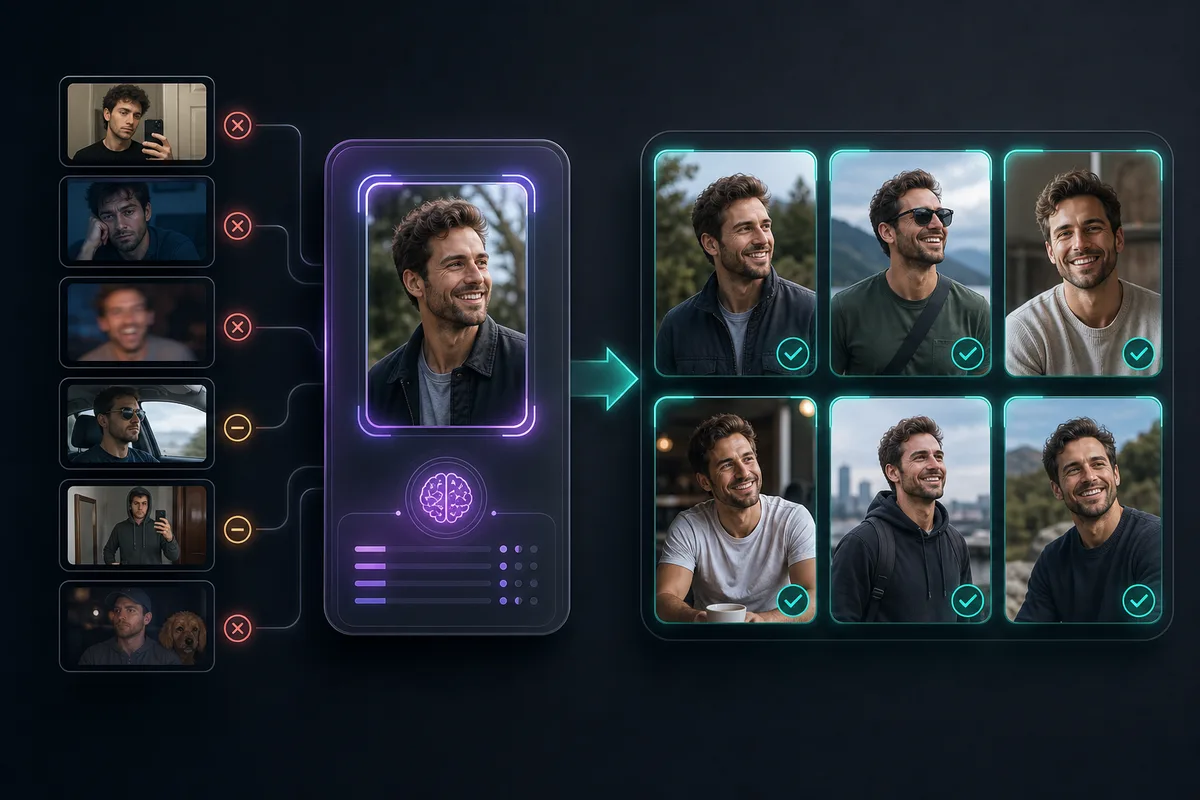
Better Than AI-Generated Photos: AI-Assisted Photo Selection
If you want better results, use this process instead:
Step 1: Gather 15-30 Real Photos
Include everything that might work:
- Clear face photos
- Smiling photos
- Outdoor photos
- Social photos
- Hobby photos
- Full-body photos
- Travel photos
- Candid photos
Do not judge too early. The photo you dislike may perform better than the one you think is "objectively best."
Step 2: Score Them Objectively
Look for the signals that actually matter:
- Face clarity
- Eye visibility
- Lighting
- Expression
- Background
- Social context
- Body language
- Authenticity
- Dateability
This is where ProfileSharp helps. It gives you structured feedback instead of vague friend advice.
Step 3: Build a Balanced Lineup
A good lineup usually has:
- Clear first photo with face, eyes, and approachable expression
- Full-body or style photo
- Social proof photo where you are easy to identify
- Hobby or lifestyle photo
- Another strong face photo or candid
- Optional conversation-starter photo
For a deeper breakdown, read How to Choose Photos for Dating Apps.
Step 4: Replace Weak Slots With New Real Photos
If AI review shows you are missing a photo type, take that photo in real life.
Need a better first photo? Ask a friend to take 30 shots outside in good light.
Need a hobby photo? Bring a phone tripod or ask someone while you are actually doing the activity.
Need a social photo? Use a real moment where you are clearly visible.
Real improvement beats fake perfection.
What About AI Photo Editing?
Light editing is usually fine.
Acceptable:
- Brightening a dark photo
- Cropping for better framing
- Reducing background distraction
- Improving sharpness
- Correcting color balance
Risky:
- Changing your face shape
- Adding muscle definition
- Replacing your outfit
- Changing your hairline
- Swapping the background into a fake luxury setting
- Making a selfie look like a professional shoot
The rule is simple: if she would feel tricked when she meets you, do not use it.
The Best 2026 Strategy
Dating in 2026 is moving toward clarity, trust, and authenticity. AI is everywhere, so real signals are becoming more valuable, not less.
Your profile should feel:
- Clear
- Specific
- Honest
- Attractive
- Easy to trust
- Real enough to meet
That is the sweet spot.
Use AI to understand your photos. Use real life to create better ones.
FAQ
Are AI-generated dating photos allowed on dating apps?
Rules vary by app and can change. Even when they are not explicitly banned, fake or misleading photos can be reported and can damage trust with matches.
Will AI-generated photos get me more matches?
They might create a short-term boost if your current photos are very weak, but they can also reduce trust, create inconsistent face signals, and disappoint matches in person.
Is it okay to use AI to edit dating photos?
Light editing is fine if the photo still looks like you. Avoid edits that change your face, body, lifestyle, or setting in a way that would feel misleading.
What should I do instead of generating fake photos?
Use AI to review your real photos, identify weak slots, and plan better real photos. That gives you the upside of AI without the trust penalty.