 Messaging & Conversations
Dry Texting Fix: 3 Ways to Stop Boring Conversations
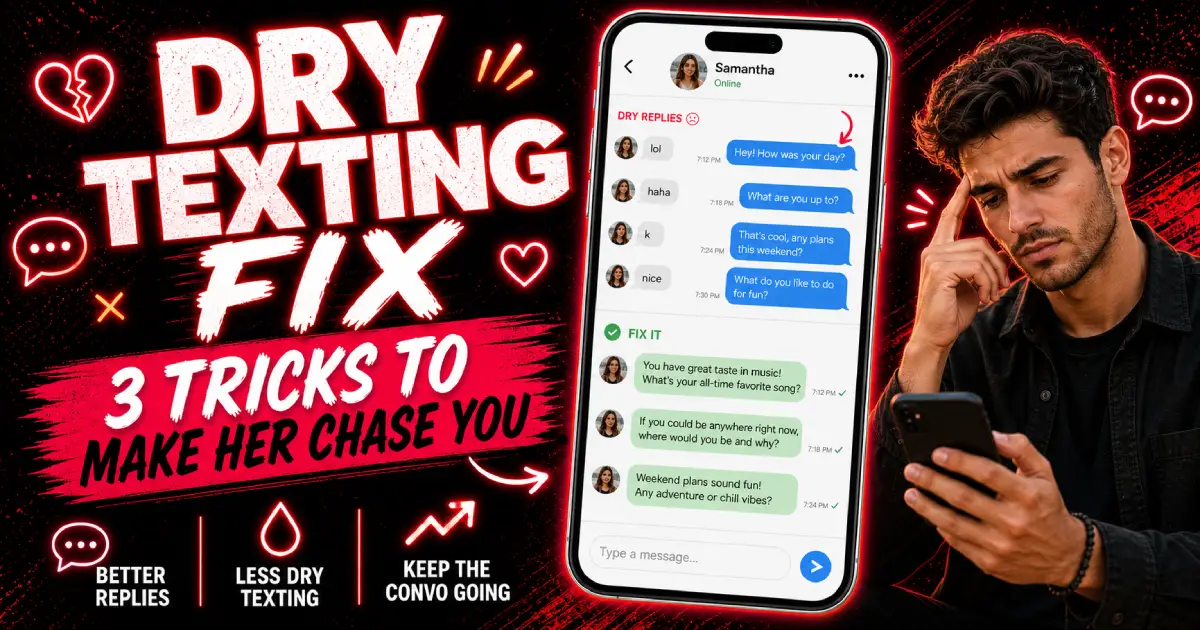
She's giving one-word answers and you're doing all the work. These 3 dry texting fixes flip the dynamic so she invests more in the conversation.
In this article4 sections
You send a message. She replies "haha." You send another one — something you actually thought about. She says "yeah." You start typing something clever, then delete it, then type it again. That creeping feeling that she's physically present in the conversation but mentally somewhere else entirely.
Here's what's actually happening: dry texting is usually a chemistry-gap problem, not a match-quality problem. She matched with you for a reason. But something in the conversation isn't creating enough pull — and there's a psychological mechanism at work: the more you invest while she doesn't, the more your perceived value drops in real time. You're not fixing a slow conversation by working harder. You're making it worse.

⚡ Dry Texter vs. Engaged Texter: The Pattern
Before trying any fix, recognize what you're actually dealing with:
| Dry texter signs | Engaged texter signs |
|---|---|
| One-word answers ("haha", "yeah", "lol") | Full sentences with her own questions back |
| Never asks anything — you drive everything | Volunteers information you didn't ask for |
| Hours between responses with no explanation | Responds with some energy, some texture |
| You've sent the last 3 messages in a row | Roughly equal back-and-forth |
| Doesn't expand on anything you say | Picks up threads and runs with them |
If you're checking three or more items on the left, the dry texter tricks below apply directly.
📸 Is Your Profile Part of the Problem?
Sometimes the dry texting starts because she matched on impulse — and your photos didn't build enough attraction to sustain it. SharpScan gives you a free AI analysis to see what your photos are actually communicating.
🎯 The 3 Tricks That Flip the Dynamic
Trick 1: The Exit Move
🔴 What most guys do when the conversation goes cold:
Keep sending messages, escalating length and effort trying to "warm her up."
🟢 The Exit Move:
"Hey — I'm about to head out. Let's continue this later when you're around."
Then stop. Don't text again. Let the silence sit.
Why it works: The Exit Move does something counterintuitive — it introduces scarcity. You're no longer waiting for her response; you're leaving. This triggers the psychological principle of loss aversion: people value things more when they sense they might lose access. If she was semi-interested but coasting, she'll suddenly notice your absence. If she was genuinely interested, she'll reach out.
The key is actually stopping. Sending the exit message and then following up an hour later destroys the effect entirely.
Trick 2: The Playful Call-Out
🔴 The passive approach:
Continue pretending the conversation is going fine while getting increasingly frustrated.
🟢 The Playful Call-Out:
"Okay, I'm getting dry texts. That's either a sign this topic isn't landing or you're texting with one thumb while watching TV. Which is it?"
Why it works: Naming the dynamic breaks the pattern. It's funny, it's low-pressure, and it gives her two easy ways to respond — either she's genuinely distracted (and she'll say so, giving you information) or she's been on autopilot and the call-out snaps her back into the conversation. Either outcome is better than pretending nothing's wrong.
The tone has to stay light. This is a playful nudge, not an accusation. If it sounds frustrated, it backfires.
Trick 3: The Curiosity Bomb
🔴 The low-leverage question:
"So what do you do for fun?" (She can answer in 2 words and be done.)
🟢 The Curiosity Bomb:
"Okay, real question — if you had to describe your personality using only three emojis, what are they? I'll go first: 🎯☕🌀. Now you."
Or: "Hot take contest — give me your most controversial opinion about something most people agree on. Mine: brunch is overrated and people only go for the aesthetic."
Why it works: Curiosity Bombs work because they're impossible to answer with one word and they invite self-expression rather than information retrieval. She can't just say "yeah" to "give me your most controversial opinion." The structure of the question forces engagement. And because you led first, it feels collaborative rather than interrogative.

🤔 The Psychology Behind Why Dry Texting Happens
Understanding the mechanism makes the fixes more intuitive. Dry texting usually isn't malice — it's effort calculation. If she perceives the conversation as not very interesting, not very safe to open up in, or not worth matching the energy level you're bringing, she'll give minimum viable responses until it fizzles.
What this means is that the fix isn't to bring more energy. It's to change what she's calculating. The Exit Move changes the availability variable. The Playful Call-Out changes the safety variable (suddenly it's funny and real, not a performance). The Curiosity Bomb changes the interest variable by making participation easy and fun.
Wait, Really? Most guys assume dry texting means she's not interested — but it often just means the conversation isn't creating enough friction to make replying feel worthwhile. The fix isn't effort. It's better structure.
For more on how to keep conversations alive, see our full guide on how to not get ghosted on dating apps. And if you're already past the dry texting stage and she's stopped responding entirely, what to do when left on read covers the next move.
💬 Stuck in a Dry Conversation Right Now?
Wingman reads your chat and gives you the right re-engage move — no guessing. Paste the thread and get a specific message that shifts the dynamic.
✅ Quick Self-Check When She Goes Dry
- Have you sent more than 2 messages in a row without a real response?
- Is every question you're asking answerable in 1–2 words?
- Are you matching or exceeding her message length every time?
- Have you used the Exit Move in the last 48 hours?
- Have you named the dynamic or are you still pretending it's fine?
- Does your last message contain a Curiosity Bomb she can't ignore?
If you're still doing all the heavy lifting, stop sending messages for now. Scarcity is the fastest reset button in a stalled conversation.