 From Match to Date
Ghosted After First Date? Here's Exactly What to Do
Getting ghosted after a first date stings — but it's rarely about you. Here's exactly what to do in the 48 hours after, and how to stop it happening again.
In this article7 sections
- ⚡ First Date Follow-Up: What Works vs. What Backfires
- 🤔 Why People Ghost After a Good First Date
- 🚫 What NOT to Do in the First 48 Hours
- 🎯 The 48-Hour Rule and the One Re-Engage
- ⚡ If They Still Don't Reply
- 🔎 How to Reduce First-Date Ghosting Going Forward
- ✅ Quick Self-Check: Did You Handle the Ghost Correctly?
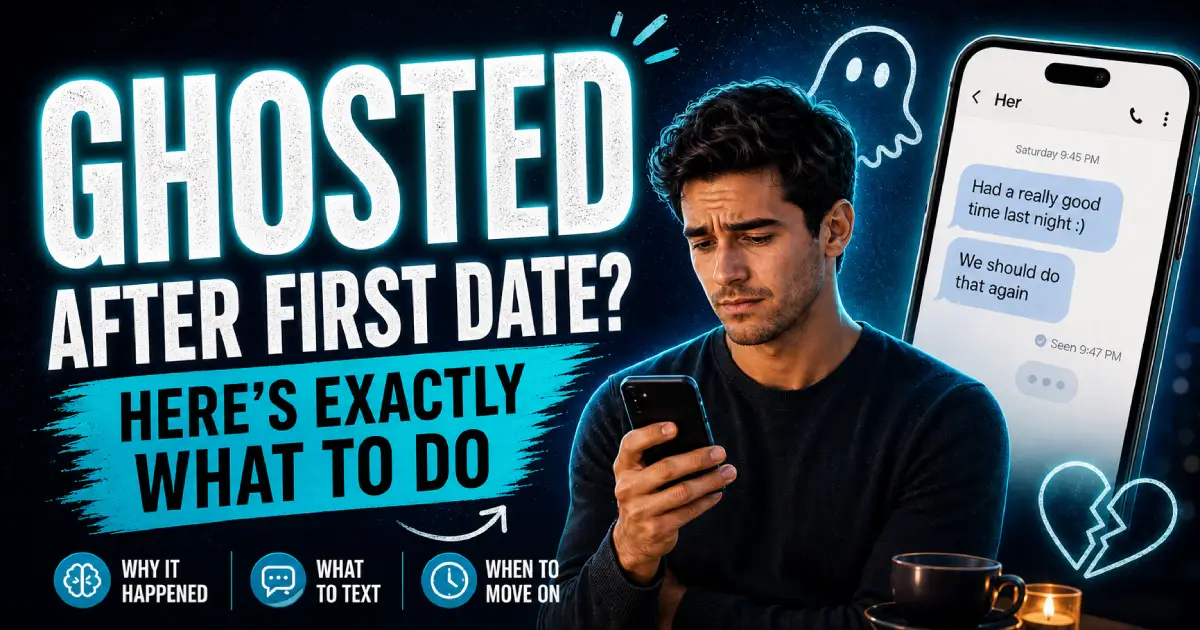
You had a great time. The conversation flowed, there was obvious chemistry, and you left thinking "that's definitely going somewhere." Then you sent a follow-up message. And nothing came back. You check again the next morning — still nothing. You're being ghosted after what felt like a completely solid first date.
This is one of the most disorienting forms of rejection because it lacks any of the closure that makes rejection processable. At least an explicit "I'm not interested" tells you something. Ghosting after a first date leaves you replaying the whole evening looking for the moment it went wrong — and often finding nothing, because the problem probably wasn't the date at all. Getting ghosted after a first date is almost never about one thing you said. It's usually about something happening on their end that has nothing to do with you. That said, there are concrete things you can do — and a few things you absolutely shouldn't.
⚡ First Date Follow-Up: What Works vs. What Backfires
| What most people do | What actually works |
|---|---|
| Double-text within 24 hours | Send one well-timed message, wait |
| Ask "did I do something wrong?" | Keep it casual and forward-looking |
| Long apology or explanation message | One short, low-pressure line |
| Go silent and never reach out again | One re-engage attempt after 3–5 days |
| Post-mortem spiral: replay every moment | Accept the ambiguity, focus forward |
The pattern: most post-ghost mistakes come from anxiety driving action when the right move is restraint.
💬 Not Sure What Your Profile is Signaling?
Before the date even happens, your profile sets expectations. SharpScan tells you exactly what your photos and profile are communicating.
🤔 Why People Ghost After a Good First Date
Understanding the actual psychology of ghosting after a first date short-circuits the self-blame spiral.
The most common reasons have nothing to do with you:
- They're emotionally unavailable right now — Many people use dating apps when they're not really ready. The date was good, which made the reality of actual connection more intimidating, not less.
- They're seeing someone else simultaneously — Most active app users have multiple conversations. Things progressed with someone else, and instead of telling you, they disappeared.
- Life got genuinely complicated — New job stress, family issue, mental health dip. Ghosting is often avoidance of effort, not a verdict on you specifically.
- They self-sabotage good things — A real psychological pattern. The date going well triggered anxiety.
- They misread their own feelings — They felt something in person, then second-guessed it back home.
The Harsh Truth: If they ghosted you after a good date, it says very little about your desirability and a lot about their avoidance patterns or life circumstances. The information content of post-date ghosting is close to zero.
What this means practically: the question "what did I do wrong?" is usually the wrong question. The more useful question is "what's my one shot at re-engaging well, and is it worth taking?"
🚫 What NOT to Do in the First 48 Hours
🔴 The Double-Text:
"Hey just checking you got my message? Hope everything is okay..."
🟢 Do nothing for at least 48 hours.
Why it works: Sending a follow-up to your follow-up signals anxiety and frames the situation as you chasing. It also removes the only leverage you have, which is their awareness that they haven't responded. Silence gives them room to come back voluntarily — double-texting takes that room away.
🔴 The Explanation Request:
"Did I say something wrong? I thought we had a good time — just want to understand."
🟢 Never ask for an explanation at this stage.
Why it works: Asking someone to justify their ghosting forces them to articulate a reason, which almost always makes them commit harder to disappearing. Even if they reply, it's usually a polite deflection. You don't want their explanation — you want re-engagement, and explanation requests kill it.
🔴 The Emotional Dump:
"I'm really confused because I thought things went really well, and the fact that you're not responding is genuinely hurtful and I just want to know..."
No version of this message has ever re-engaged a ghoster. It lands as pressure, regardless of how reasonable it actually is. Table it.
🎯 The 48-Hour Rule and the One Re-Engage
If you're going to attempt contact, there's one version of a follow-up message that consistently outperforms everything else. It follows three rules:
- Wait at least 48 hours from your last unanswered message
- Keep it short — two sentences maximum
- Make it forward-looking and low-pressure — no acknowledgment of the silence, no emotional weight
📝 The Re-Engage Template:
🟢 "The Soft Callback":
"Hey — [reference one specific thing from the date]. Reminded me of you. Hope the week's treating you well."
Example:
"Hey — saw that [restaurant/bar/thing you mentioned] is doing something this weekend. Reminded me of your take on it. Hope the week's been good."
Why it works: It signals you're fine (not anxious or waiting), references a real moment from the date (shows you were actually present), and leaves zero pressure to respond. It invites a reply without demanding one. This is the best version of a re-engage because it doesn't require them to respond to something emotionally heavy — just to a casual observation.
Send this once. Once only. If there's still no reply after another 3–5 days, it's over. Move on with your full attention — not 90% attention while the other 10% waits for a notification.
⚡ If They Still Don't Reply
One re-engage attempt with no response is the end of the line. Here's the mental shift that matters:
They opted out. That information is useful.
Someone who ghosts after a first date — even a good one — is demonstrating something real about how they handle uncomfortable situations. That's not the kind of communicator who makes a good partner. The ghosting is data, not a verdict on you. If they came back days later with an explanation, that's worth evaluating. But chasing silence beyond one low-key message is spending emotional energy on someone who isn't spending any on you.
Read our how to not get ghosted on dating apps guide and left on read — what to do next for a broader strategy around the patterns that lead here.
💬 Not Sure What to Text After the Date?
Wingman writes you the exact follow-up message for your situation — warm, confident, and not pushy. Paste how the date went and get a message that fits the vibe.
🔎 How to Reduce First-Date Ghosting Going Forward
Post-date ghosting often traces back to mismatched expectations set during the matching and pre-date phase. A few patterns that reduce it:
Move from app to real life faster. Extended pre-date texting creates a parasocial connection that in-person reality can't always match. Aim for a date within 5–7 days of matching. The longer the pre-date conversation, the harder it is for the real thing to live up to the mental image.
End the first date while energy is still high. Don't drag out a date trying to extend a good thing — leave on a high note before the conversation noticeably runs out of steam. This creates the right emotional residue: they remember the energy being good, not the awkward last 20 minutes.
Send a follow-up the same night, not the next day. A short, warm "had a really good time" message sent within an hour or two while the experience is still fresh lands completely differently than a "hey how are you" 18 hours later. The window when they're still warm from the date is short. Use it.
Your profile's quality filters for commitment. A profile that signals clearly who you are — and what kind of connection you're interested in — self-selects for people who are genuinely available, not just casually swiping. For a full breakdown, see our why conversations die on dating apps guide.
✅ Quick Self-Check: Did You Handle the Ghost Correctly?
- Waited at least 48 hours before any follow-up message?
- Sent only one follow-up — not a string of texts?
- Kept the re-engage short (2 sentences max) and pressure-free?
- Referenced something specific from the date — not a generic "hey"?
- Avoided asking for explanations or expressing hurt in the first message?
- Sent the re-engage once, then fully moved on without checking back?
- Treated their silence as information — not a problem to solve?
Being ghosted after a first date is frustrating. But it's also one of the lowest-information forms of rejection — it tells you almost nothing useful about your actual appeal or what you did wrong. One clean re-engage attempt, then full attention forward. That's it.