 Safety, Privacy & Wellbeing
Dating Profile After Divorce: Photos, Bio & Boundaries
Build a dating profile after divorce without oversharing. Learn which photos, bio lines, privacy rules, and boundaries create a grounded restart.
In this article13 sections
- Dating After Divorce Is Not an Unusual Edge Case
- Are You Ready to Make the Profile?
- The Past, Present, Future Profile Framework
- What to Say About the Divorce
- The Best Dating Profile Photos After Divorce
- How to Write a Dating Bio After Divorce
- Prompts That Look Forward Without Pretending
- Children, Co-Parenting, and the Disclosure Ladder
- Set Boundaries Without Sounding Unavailable
- Date Slowly Enough to Notice Quality
- The Ten-Minute Post-Divorce Profile Audit
- FAQ
- References
Opening a dating app after divorce can feel less like making a profile and more like explaining a whole life transition in six photos and three prompts.
You may be deciding whether to mention the divorce, how to describe shared custody, which old photos are still usable, and how much of your family life belongs on a public screen. At the same time, you do not want the profile to read like a legal statement or a recovery diary.
The answer is not to hide your history. It is to give that history the right amount of space.
A strong dating profile after divorce says: this happened, this is who I am now, and this is the kind of connection I am ready to build next.
Dating After Divorce Is Not an Unusual Edge Case
Pew Research Center found that 36% of U.S. adults who were divorced, separated, or widowed had used a dating site or app in its 2022 survey. You are not entering a space designed only for people who have never had a serious relationship.
In fact, a past marriage can communicate useful things when presented without bitterness: you understand commitment, you have learned what does not work for you, and you are making a more deliberate choice now.
The profile problem begins when the divorce becomes either a secret or the main character.
Hiding it can create a trust problem later. Leading with every detail can make a stranger feel as though they have joined a conflict already in progress.
Your job is to provide context, not a case file.
Are You Ready to Make the Profile?
There is no universal number of weeks or months that proves someone is ready to date after divorce. A better test is behavioral.
Ask yourself:
- Can I describe my current life without making my former partner the center of the story?
- Can I meet someone without using the date to process the divorce?
- Can I hear a reasonable question about my relationship status without becoming defensive?
- Do I know what pace and type of relationship I can genuinely offer?
- Can I protect my children, schedule, and co-parenting obligations without treating every boundary as a crisis?
- Would I still want to date if the first few matches went nowhere?
A study of 137 adults experiencing a recent marital separation found that less acceptance of the separation was associated with poorer psychological adjustment. That does not produce a universal readiness deadline. It does support a practical distinction: wanting connection is different from needing a new match to resolve the old relationship.
If the profile is mainly an attempt to prove something to your ex, numb the silence, or secure immediate reassurance, pause. If you can be curious about another person while remaining responsible for your own transition, you have a stronger foundation.
The Past, Present, Future Profile Framework
A post-divorce profile works best when the past is context, the present is visible, and the future is inviting.
| Layer | What it should communicate | What to avoid |
|---|---|---|
| Past | Accurate relationship status and one calm sentence if needed | Blame, legal details, timelines, or indirect messages to an ex |
| Present | Current appearance, interests, routines, friendships, and parenting reality | A profile built from wedding-era photos or a life that no longer exists |
| Future | The relationship pace, shared experiences, and values you can offer now | Demands, auditions, or promises you are not ready to keep |
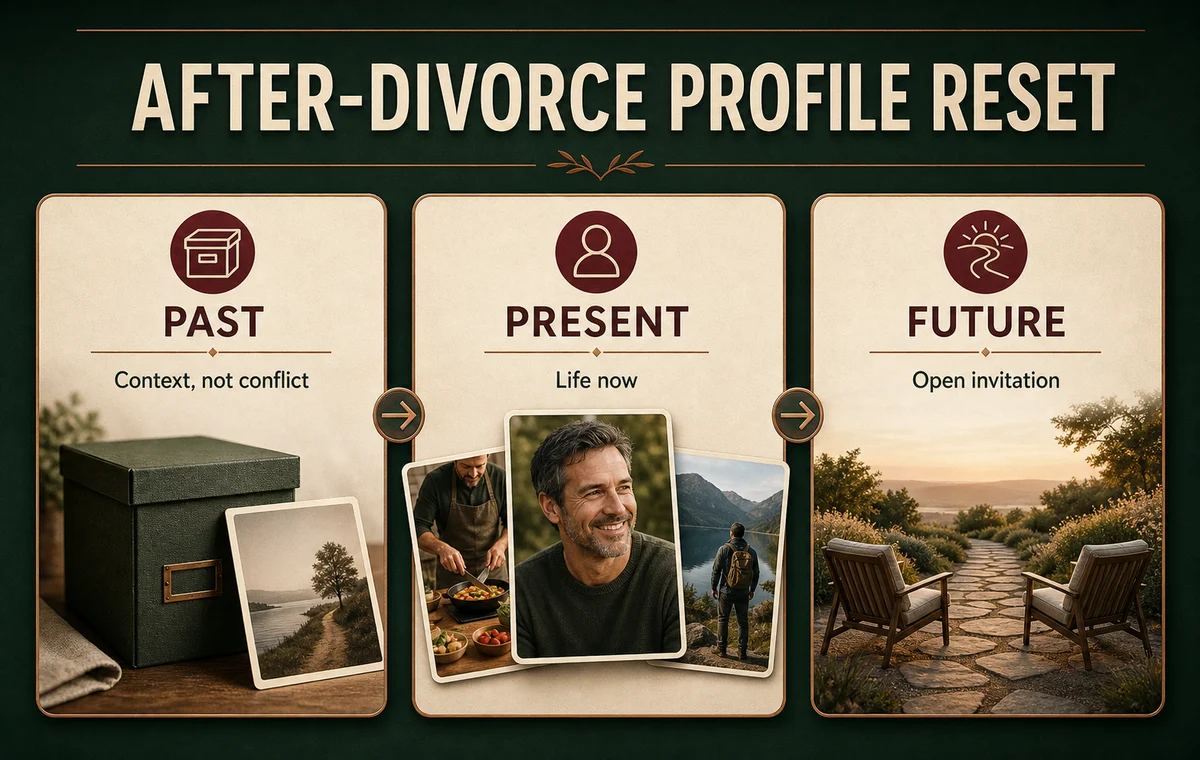
This framework prevents two common extremes. You do not erase the marriage, and you do not build the profile around it.
What to Say About the Divorce
Use the relationship-status field accurately. If an app offers “divorced” or “separated,” choose the option that reflects your actual situation. Do not call yourself divorced while proceedings are still active simply because the relationship feels finished.
Your bio usually needs no more than one neutral line, and often the status field is enough.
Good options include:
- “Divorced, settled, and building a good next chapter.”
- “Dad of two with a steady co-parenting schedule.”
- “Recently back to dating and taking it thoughtfully.”
- “Life is full, stable, and ready to make room for the right person.”
Avoid lines such as:
- “No drama. I have had enough.”
- “My ex was crazy, so honesty matters.”
- “Ask me about the divorce if you can handle the truth.”
- “Starting over because people cannot be trusted.”
Even when the pain behind those lines is understandable, a new match cannot tell whether the conflict is over. They only see that it has entered the profile.
If you are unsure which relationship label fits what you can offer, use the decision process in Dating Intentions: What to Put on Your Profile Now.
Make Your Current Life Visible
ProfileSharp can help you check whether your photos show the person and life a match would meet now—not the relationship chapter you have already left.
The Best Dating Profile Photos After Divorce
The right photo lineup does more than show that you look good. It proves that your life has shape, warmth, and momentum outside the former marriage.
1. Start With a Current, Uncomplicated Portrait
Use a recent image with a clear face, natural expression, and simple background. Your first photo should not require cropping another person out or explaining when it was taken.
If your strongest portrait is several years old, take a new one. Accuracy matters more than preserving a version of yourself from before the divorce.
2. Retire Wedding-Era and Couple-Crop Photos
A photo can still be technically current while emotionally belonging to the old relationship. Watch for wedding suits, anniversary trips, couple poses with one person removed, and images where an unexplained hand or shoulder remains in frame.
The issue is not that your past must disappear. The issue is that a new profile needs its own visual identity.
3. Show One Part of the Life You Rebuilt
Choose an activity that exists now: cooking in your current home, cycling, playing music, hiking, volunteering, woodworking, a sports league, or a regular weekend ritual.
This image is evidence of a present-tense life. It also gives a match something easier to ask about than the divorce.
4. Include One Clear Social Photo
One small-group image can show friendship and social range. Keep yourself easy to identify and avoid photos dominated by alcohol, a former partner, or a wedding party.
If the group is confusing, use the checks in Group Photo Mistake: Why It Hurts Your Match Rate.
5. Signal Parenthood Without Publishing Your Children
You can communicate that you are a parent without putting a child’s face, school, uniform, name, home, or daily routine on a public dating profile.
A bio line such as “Dad of two” is usually clearer than a family photo with children blurred or covered. If parenthood is central to your life, an adult-only activity photo can still show patience, steadiness, or a family-oriented lifestyle without turning a child into profile content.
6. Finish With Warmth and Availability
Your last image can be a relaxed candid, a full-body outdoor photo, or an approachable moment from a hobby. Avoid ending with another formal portrait or a photo that feels emotionally closed.
A practical six-photo order is:
- Current warm portrait
- Full-body everyday photo
- Interest in action
- Small social setting
- Current lifestyle or travel moment
- Relaxed candid with warmth
For a deeper selection process, use How to Choose Dating App Photos That Get More Matches.
How to Write a Dating Bio After Divorce
The best bio formula is simple:
Current life + useful context + shared plan
The current-life detail shows personality. Useful context prevents surprises. The shared plan makes conversation easy.
Example: Divorced With Children
“Dad of two, usually found testing a new pasta recipe or planning a Sunday trail. Divorced with a steady co-parenting rhythm. Looking for someone kind, curious, and up for coffee that can turn into a walk.”
Example: Divorced Without Children
“Architect, amateur guitarist, and recent convert to sunrise swimming. Divorced, grounded, and interested in building something real at a sane pace. Tell me the small place in town you would hate to see become popular.”
Example: Separated and Dating Carefully
“Separated, living independently, and taking dating slowly. My week is design work, long bike rides, and cooking for friends. Open to meeting someone thoughtful without rushing the outcome.”
Use “separated” only when it is accurate and be prepared to explain the practical reality before meeting. Some people will not want to date someone whose divorce is unfinished. That is compatibility information, not a profile failure.
For more structures and examples, see Dating Profile Bio: What to Write for More Matches.
Prompts That Look Forward Without Pretending
Good prompts after divorce should reveal what you enjoy now and what you want to share next.
Use a Present-Tense Pleasure
Prompt: “A small thing that makes my week better…”
Answer: “Cooking enough on Sunday that Tuesday dinner feels unusually competent.”
Show Your Real Schedule Positively
Prompt: “My ideal free evening…”
Answer: “A neighborhood restaurant, one excellent story, and no need to shout over the music.”
Offer a Low-Pressure Plan
Prompt: “Together we could…”
Answer: “Pick a direction for a Saturday walk and find the best bakery along the way.”
Do not use prompts to announce rules for your ex, complain about custody logistics, or test whether strangers can “handle your baggage.” A prompt should open a door, not guard a courtroom.
Children, Co-Parenting, and the Disclosure Ladder
Parenthood is relevant. Your children’s identifying information is not public-profile material.
A 2026 article in Pediatrics Open Science emphasizes children’s privacy and consent concerns when adults share their information and images online. A dating profile is an especially public and context-poor place to be conservative.
Use a disclosure ladder:
| Stage | Appropriate information |
|---|---|
| Public profile | That you are a parent, a broad sense of availability, and what kind of relationship you seek |
| After matching | General custody rhythm, realistic scheduling, and whether introductions are far in the future |
| After trust develops | Deeper family history, co-parenting challenges, and details that affect a serious relationship |
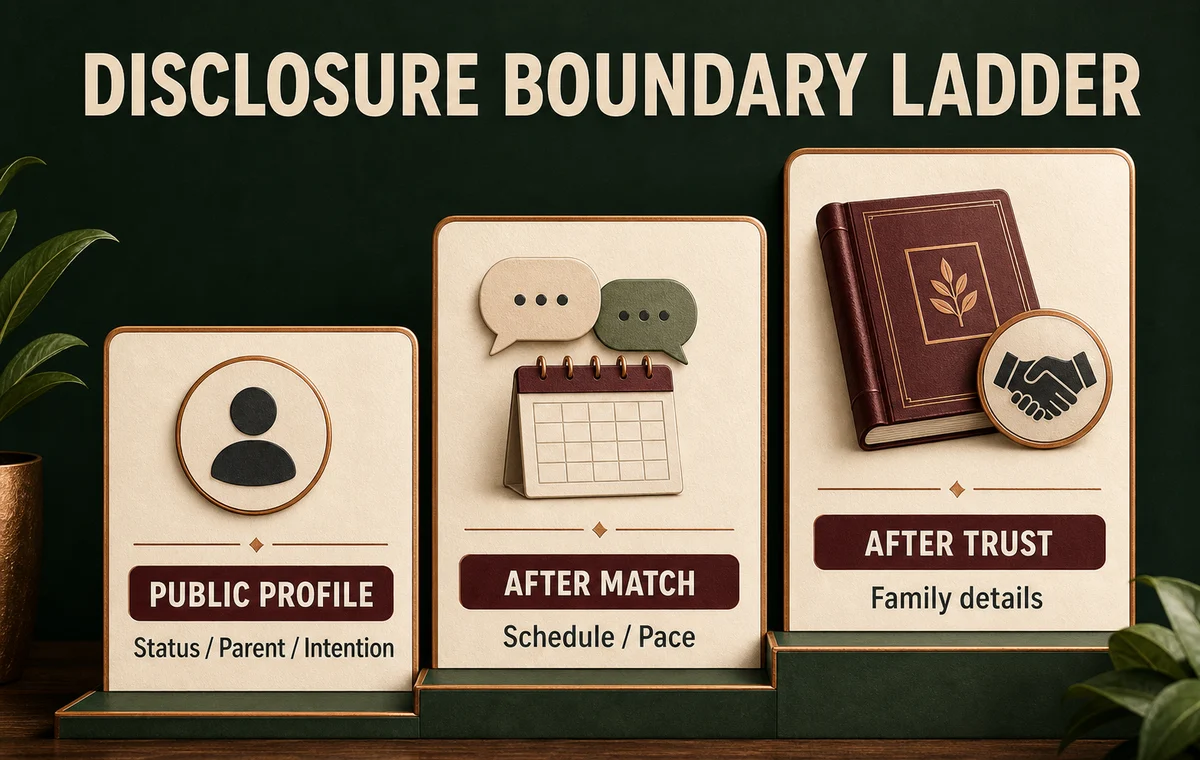
Keep children’s faces, names, schools, medical information, custody documents, and predictable locations off the profile. The same rule applies to screenshots from legal conversations or calendars containing family details.
For a complete public-profile check, read Dating App Privacy: 9 Things to Hide Before Matching.
Set Boundaries Without Sounding Unavailable
Boundaries are attractive when they explain how connection can work. They feel discouraging when they only list restrictions.
Compare:
| Closed wording | Grounded wording |
|---|---|
| “My kids always come first, so deal with it.” | “Parenting is a big part of my life, and I also make intentional time for dating.” |
| “I am too busy for games.” | “My schedule is structured, so I appreciate making real plans.” |
| “You will not meet my children anytime soon.” | “I keep dating and parenting separate until a relationship is established.” |
| “No one with ex drama.” | “I value respectful communication and clean boundaries.” |
The second version communicates the same limits while showing that another person could eventually have a place in your life.
Date Slowly Enough to Notice Quality
Research following mothers for two years after filing for divorce found that relationship quality mattered when examining dating and well-being. The study should not be generalized to everyone, but its practical lesson is useful: being in a new relationship is not automatically better than being single.
Do not let the profile’s success become the only test. Pay attention to consistency, respect, how someone responds to your schedule, and whether the connection makes your life clearer or more chaotic.
Newly returned daters should also keep ordinary online-dating safety habits. The Federal Trade Commission warns that romance scammers build trust through fake profiles and eventually ask for money; it advises never sending money or gifts to an online love interest you have not met in person.
Build for the Relationship You Can Offer Now
A good restart is not about appearing untouched by divorce. It is about making your current photos, bio, intentions, and boundaries tell one honest story.
The Ten-Minute Post-Divorce Profile Audit
Before publishing, check:
- Is every photo current enough to set accurate expectations?
- Have I removed couple crops and wedding-era context?
- Does the profile show a life that exists now?
- Is my relationship status accurate and calm?
- Have I mentioned children without exposing them?
- Does my bio include something easier to discuss than the divorce?
- Do my prompts look forward rather than litigate the past?
- Are my schedule and intentions compatible with what I claim to want?
- Have I kept legal, financial, custody, and identifying details private?
- Would a reasonable match understand both my availability and my warmth?
The strongest profile after divorce does not say, “My past no longer affects me.”
It says, “I understand my past, I live in the present, and I have room for a future.”
FAQ
Should I mention that I am divorced in my dating profile?
Yes, use the accurate relationship-status field. A calm bio line can help when the status affects your availability or expectations, but you do not need to explain the marriage or breakup publicly.
How soon after divorce should I join a dating app?
There is no universal deadline. Look for behavioral readiness: you can discuss your status calmly, show curiosity about another person, set realistic boundaries, and date without asking matches to resolve the previous relationship.
Should I include my children in dating profile photos?
It is safer to mention that you are a parent without posting identifiable photos of your children. Keep faces, names, schools, uniforms, routines, and locations off a public dating profile.
Can I use photos from before my divorce?
Only if they still represent your current appearance and contain no couple, wedding, or misleading context. A new portrait and several current-life photos usually create a cleaner restart.
What should a divorced dad or mom write in a bio?
Use one specific detail about life now, one neutral line about parenting or relationship status if useful, and one inviting idea for a date or shared activity.
Is it okay to date while separated?
That is a personal and sometimes legal decision. If you date, describe your status accurately, live independently where applicable, be clear about the practical situation, and accept that some matches will prefer a finalized divorce.