 Getting More Matches
How to A/B Test Your Dating Profile Without Guessing
Learn how to test one dating profile change at a time, track useful signals, avoid false conclusions, and improve photos and bio with confidence.
In this article11 sections
Most dating-profile advice creates the same problem: you change the first photo, rewrite the bio, replace two prompts, adjust your filters, and then have no idea which change mattered.
That is not a test. It is a makeover.
A makeover can still help, but it teaches you very little. A simple A/B testing process gives you a cleaner answer: did this specific change make the profile easier to understand and more likely to start the kind of conversation you want?
You do not need secret algorithm data. You need one clear hypothesis, one controlled change, and enough patience to avoid reading meaning into a quiet Tuesday.
What A/B Testing Means on a Dating App
In a classic A/B test, two versions run under comparable conditions. Most dating apps do not let an individual show two profile versions to randomly assigned groups, so your test will be sequential:
- Keep version A live and record a baseline.
- Change one element to create version B.
- Use the app in roughly the same way.
- Compare useful signals over a similar window.
This is not laboratory-grade experimentation. Seasonality, app activity, location, and who happens to see you can all change. The goal is not perfect certainty. The goal is a better decision than changing everything based on mood.
Research on mobile dating profiles shows that people make deliberate choices about how they present themselves within a highly compressed set of photos and text. A study of 524 profile pictures identified recurring visual presentation types rather than random image choices. That makes your photos testable communication: each one sends a different signal.
Start With a Question, Not a Replacement Photo
A useful test begins with a hypothesis you could prove wrong.
Weak hypothesis:
- "This photo is better."
Testable hypothesis:
- "A clear smiling portrait will make my first impression warmer than the distant travel photo currently in slot one."
- "A full-body everyday photo will set clearer expectations than a second close-up."
- "A specific cooking prompt will create more substantive openers than 'I love food.'"
- "Naming a relationship intention calmly will improve match quality, even if total likes do not rise."
The hypothesis tells you what to change and which signal to watch.
Change One Variable at a Time
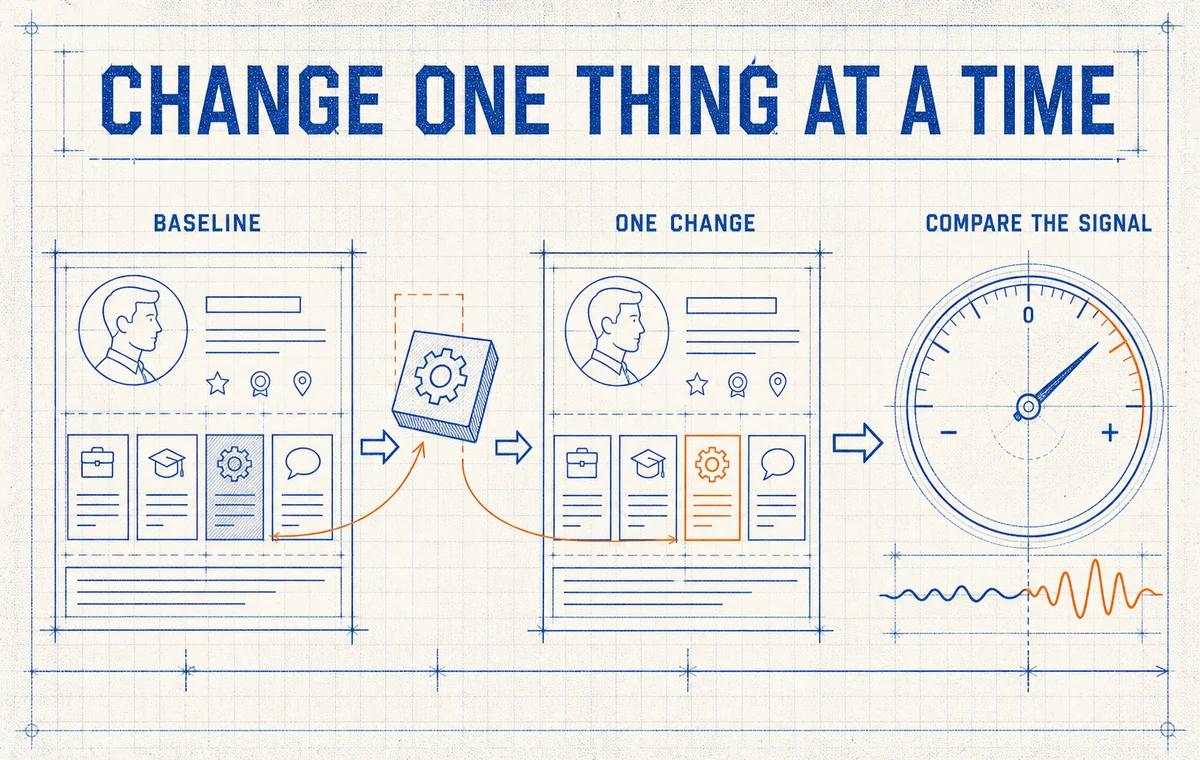
If you replace three photos and rewrite every answer, version B may perform differently, but you will not know why.
Choose one variable:
| Test | Keep constant | Change |
|---|---|---|
| First-photo test | Bio, prompts, remaining photos, app usage | Slot-one photo only |
| Photo-order test | The actual photos and all text | Position of two photos |
| Bio test | Photos, prompts, filters | Bio wording only |
| Prompt test | Photos, bio, other prompts | One prompt answer |
| Intention test | Photos and personality text | How you state your goal |
Test the biggest bottleneck first. If your first photo is dark and unclear, polishing the third prompt is unlikely to be the highest-value experiment. Use Dating App First Photo: The #1 Mistake Killing Your Matches to check that foundation.
Find the First Variable Worth Testing
ProfileSharp can help identify whether clarity, photo quality, variety, or overall lineup coherence is the most likely bottleneck before you spend weeks testing minor edits.
Build a Baseline Before Version B
Do not judge the new version against a vague memory of the old one. Record version A first.
Track only signals you can observe consistently:
- Likes or matches received
- Replies to your openers
- Conversations that become mutual rather than one-sided
- Matches aligned with your stated goal
- Dates agreed to
- Repeated comments or questions about a photo or prompt
Raw match count is not always the best outcome. A clearer intention line may reduce mismatched likes while improving the relevance of the people who engage. That can be a successful test.
Take screenshots of the profile before every change and note the date, app, location, and variable. Do not record other users' private conversations beyond what you need for your own pattern notes.
Keep the Test Conditions Reasonably Clean
Run both versions on the same app and in the same general location. Try to keep your usage pattern similar: comparable days, similar swipe selectivity, and no paid boost on only one version.
Avoid comparing a holiday weekend with an ordinary workweek. Do not move cities midway through a test and attribute the difference to a bio. If a major app feature or subscription changes, restart the baseline.
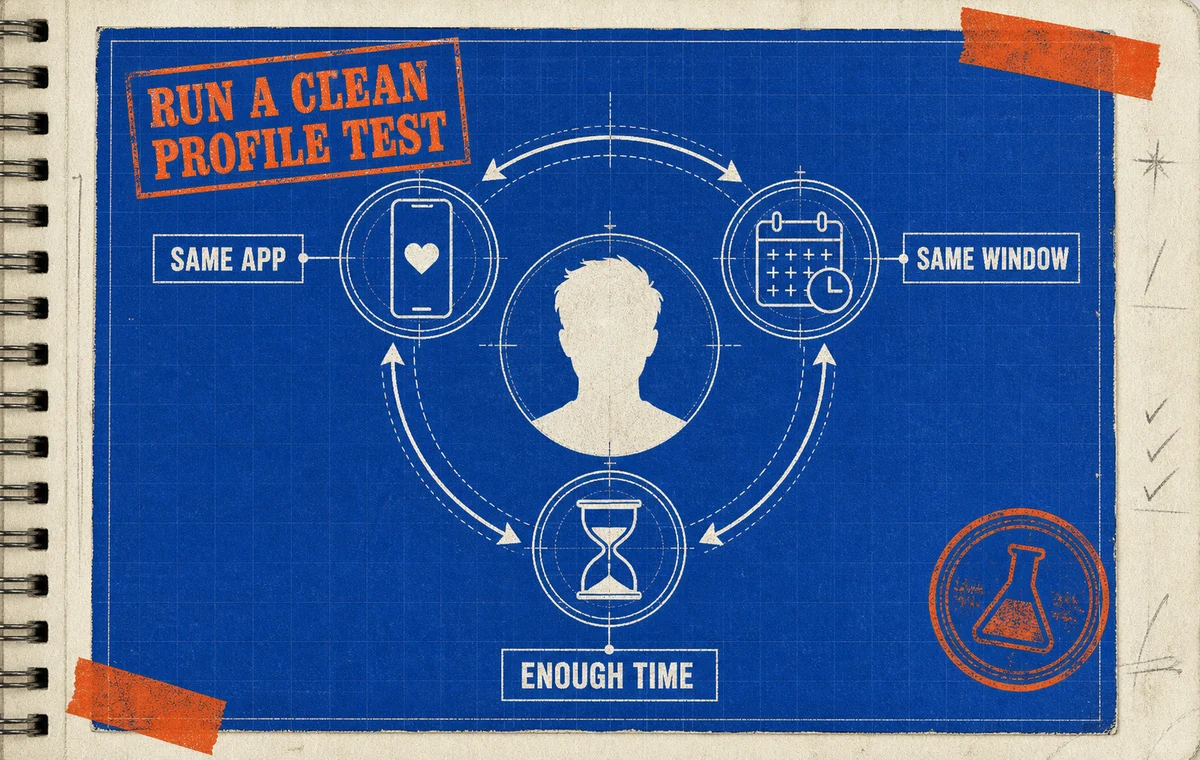
There is no universal test duration because profile traffic varies. Use enough time to collect a pattern, not one exciting match. If your account receives little exposure, extend the window rather than drawing a dramatic conclusion from two observations.
How to Read the Result
At the end of version B, choose one of four decisions:
Keep
The intended signal improved without a meaningful downside. Keep the change and make it the new baseline.
Revert
The version performed worse on the signal you chose, or it attracted a less suitable audience. Return to A.
Retest
The result is mixed or the conditions were messy. Run the comparison again before deciding.
Learn and Rewrite
The idea was right, but the execution was weak. For example, a specific bio produced better openers, but the tone felt too formal. Keep the specificity and rewrite the voice.
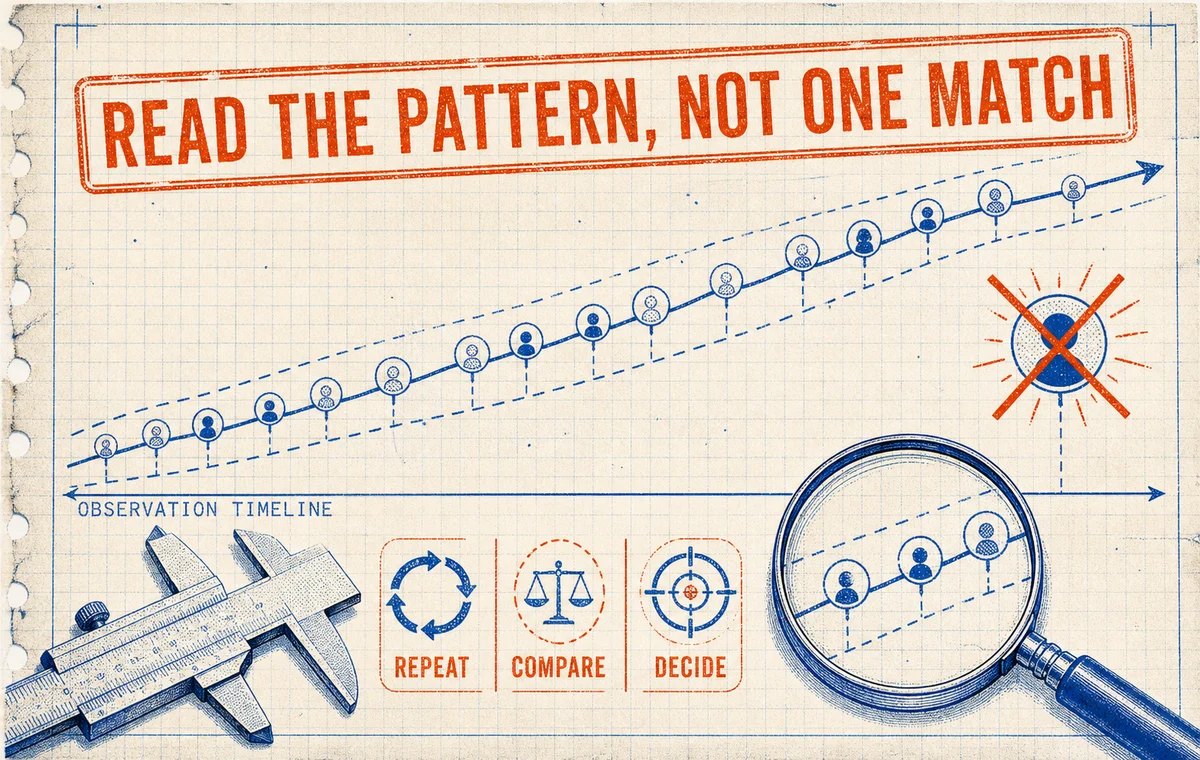
Do not declare a winner because one unusually attractive person matched. A test is about a repeated pattern, not the identity of one result.
The Best First Tests
1. Clear Portrait vs. Context-Heavy First Photo
Your first image has one job: make recognition and basic interest easy. Compare a current, well-lit portrait against a travel, group, sunglasses, or activity photo that requires more interpretation.
2. Warm Expression vs. Serious Expression
Keep framing and image quality as similar as possible. If the photos differ in lighting, clothing, location, and expression, you are testing a bundle. Read Smiling vs. Serious Dating Photos: Which Gets Matches? before choosing the pair.
3. Generic Bio vs. Concrete Bio
Research using authentic profile texts found that more original profiles tended to include concrete self-disclosure, and perceived originality was linked to stronger impressions through intelligence and humor. The study does not promise more matches, but it supports a sensible test: replace generic claims with specific evidence.
Instead of:
"I love travel, music, and good food."
Test:
"I plan trips around small music venues and will cross town for handmade noodles."
4. Closed Prompt vs. Reply-Friendly Prompt
Compare a statement that ends the thought with one that leaves a narrow opening.
- Closed: "Sunday is gym and relaxing."
- Reply-friendly: "Sunday is a long walk and one bakery worth the detour. Nominate the bakery."
5. More Matches vs. Better Matches
Test whether clearer values or intentions change who engages. Use the framework in How to Get Better Matches on Dating Apps, Not Just More to define quality before the test begins.
Common Testing Mistakes
- Changing several variables at once
- Testing a tiny detail before fixing an obvious weak first photo
- Comparing different apps as if their audiences were identical
- Using a paid boost for only one version
- Changing swipe behavior midway through the test
- Ending after one good or bad day
- Treating match count as the only outcome
- Copying a trend that makes the profile less accurate
- Running endless experiments until the profile no longer sounds like you
The point is to improve communication, not optimize yourself into a fictional character.
Turn the Winner Into a Coherent Lineup
A strong individual photo can still clash with the rest of the profile. Review the full set after each winning test so the photos, bio, and intentions continue to tell one story.
A Four-Week Testing Plan
| Week | Action |
|---|---|
| 1 | Record baseline and test a clearer first photo |
| 2 | Keep the winner and test one photo-order change |
| 3 | Keep the visual baseline and test one specific bio or prompt |
| 4 | Review match quality and stop changing what already works |
You do not need to test forever. Once the profile is clear, current, varied, and aligned with your goals, spend more energy on good conversations and actual dates.
FAQ
Can I really A/B test a dating profile?
You can run a practical sequential comparison, although it is not a true randomized experiment. Keep one version as a baseline, change one variable, use similar conditions, and interpret the result as directional evidence.
How long should a dating profile test run?
Long enough to observe a pattern under comparable conditions. Low-traffic profiles need a longer window. Avoid deciding from one day, one match, or a holiday spike.
What should I test first?
Test the largest visible bottleneck. For many profiles that is the first photo, followed by photo variety, then bio or prompt specificity.
Should I track likes or matches?
Track both if the app exposes them, but also watch replies, mutual conversations, match fit, and dates. The metric should match the hypothesis.
Can changing my profile hurt visibility?
Apps do not provide enough individual-level data to promise how a particular edit affects distribution. Test communication quality rather than relying on algorithm myths.
When should I stop testing?
Stop when the profile is accurate, coherent, and producing suitable opportunities. Constant editing can create noise and take attention away from conversations.