 Getting More Matches
How to Get Better Matches on Dating Apps, Not Just More
Getting matches that go nowhere? Learn how to attract better-fit people by aligning your app, photos, bio, filters, and dating intentions.
In this article11 sections
- What a Better Match Actually Means
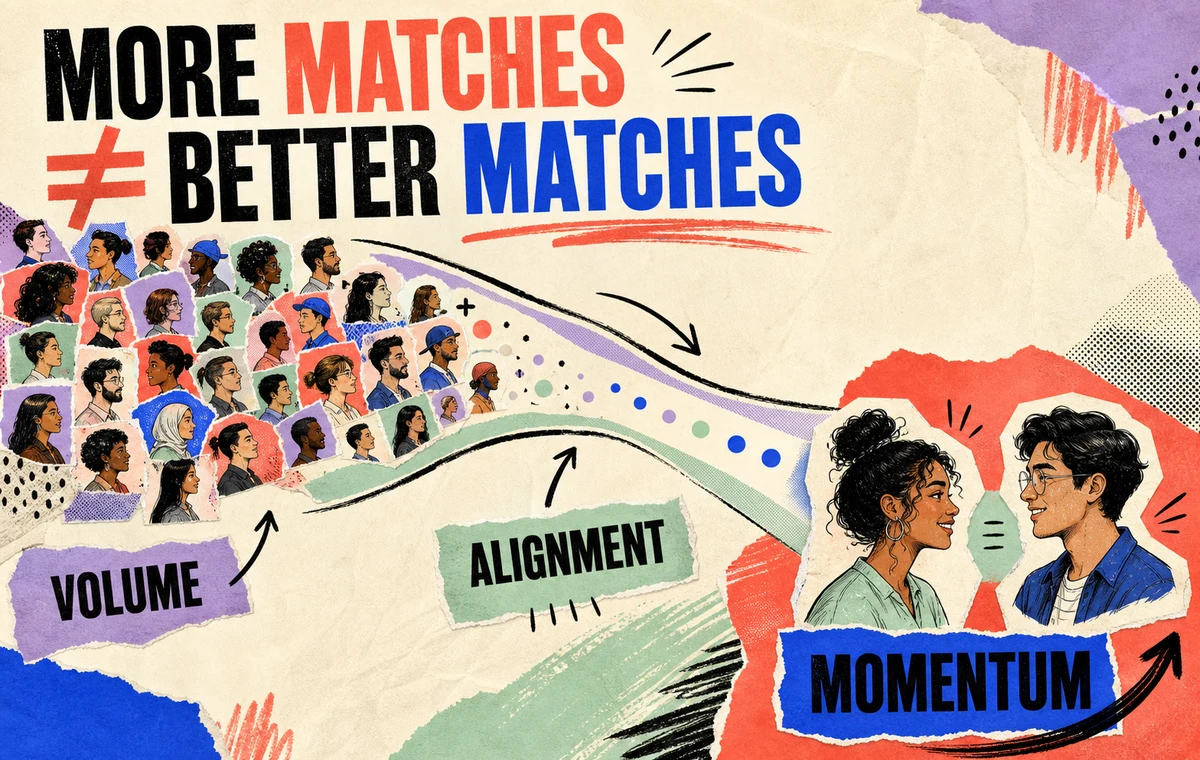
- Why More Swiping Can Make Matching Worse
- Diagnose Where Your Match Quality Breaks
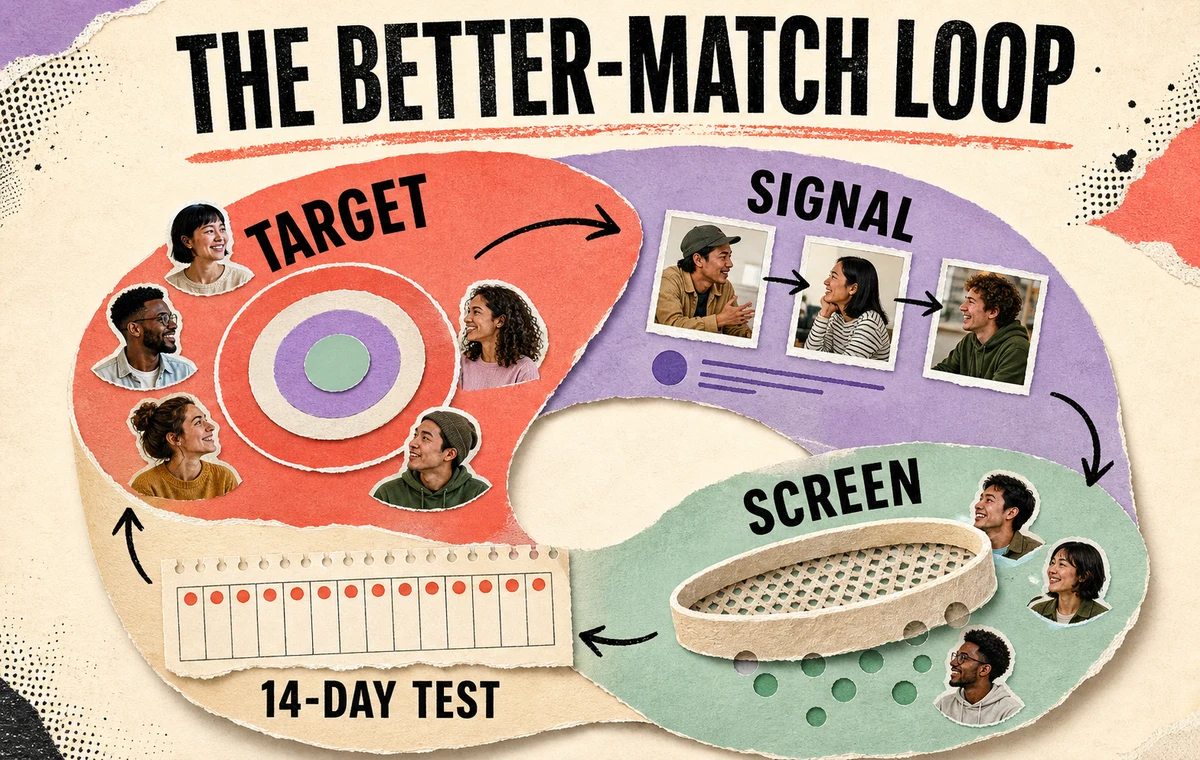
- The Better-Match Loop: Target, Signal, Screen
- Align Each Photo With the People You Want to Meet
- Make Your Bio a Compatibility Hook
- Swipe for Fit, Not for the Possibility of Attention
- Run a 14-Day Better-Match Test
- The Bottom Line
- FAQ
- References
Getting ten matches that never become a real conversation is not better than getting three matches you genuinely want to meet.
That sounds obvious, but most dating app advice still treats match count like a scoreboard. Change the first photo. Rewrite the bio. Buy a boost. Get more likes. None of that answers the more useful question: are you attracting people who fit your intentions, lifestyle, attraction, and willingness to meet?
A better dating profile does not appeal to everyone. It gives the right people clearer reasons to choose you and the wrong people enough information to move on.
This guide shows you how to stop optimizing for volume and build a profile that creates more mutual, usable interest.
What a Better Match Actually Means
A quality match is not simply someone you find attractive. It has four parts:
- Mutual attraction: You are both interested enough to engage.
- Compatible intention: You want roughly the same kind of connection.
- Practical fit: Distance, schedule, age range, and lifestyle make meeting realistic.
- Conversation momentum: The profile gives both people something specific to respond to.
If one part is missing, the match often stalls. Attractive but incompatible becomes a short chat. Compatible but impractical becomes a pen-pal situation. Mutual interest without conversational material becomes another silent match.
This is why raw match count is a weak success metric. Track what happens after the match.
| Metric | What it tells you |
|---|---|
| Matches | Your profile can generate initial interest |
| Conversations | The interest is strong enough to act on |
| Meaningful exchanges | Your profile and messages create connection |
| Dates arranged | Attraction, intention, and logistics align |
| Dates you want to repeat | The profile represented both people accurately |
Why More Swiping Can Make Matching Worse
An endless feed can make selectivity less thoughtful, not more precise.
In three studies of online dating decisions, researchers found that people became increasingly likely to reject potential partners as they moved through more profiles. The study also found a negative relationship between overall rejection behavior and satisfaction with the options participants did accept. The authors describe this as a rejection mindset created by choice abundance.
That does not mean you should accept people you do not want. It means mindless volume can make every profile feel disposable. A smaller, intentional session gives you a better chance of judging fit rather than reacting to fatigue.
Pew Research Center found that majorities of online daters said it was at least somewhat easy to find people they considered attractive, people who shared their interests, and people they wanted to meet. Yet recent users were more likely to say online dating left them frustrated than hopeful. That gap suggests the problem is not always a total lack of options; it is often turning options into worthwhile connections.
Diagnose Where Your Match Quality Breaks
Before changing your profile, identify the stage that is failing.
You get likes, but rarely like them back
Your profile may be attracting too broad an audience or signaling a lifestyle you do not actually want. It can also mean the app or location settings are wrong for your goal.
You match, but conversations do not start
There is enough visual interest to swipe, but not enough specificity to make the next step easy. Your bio and prompts may be generic, empty, or disconnected from your photos.
Conversations start, but the goals do not align
Your dating intention may be hidden, vague, or contradicted by the rest of the profile. Read our guide to showing dating intentions without making the profile feel heavy.
Conversations are good, but dates never happen
The issue may be distance, availability, slow pacing, or spending too long chatting. Use the practical steps in how to move from a dating app match to an actual date.
Do not rebuild everything at once. Find the first weak stage and fix that stage first.
See What Your Profile Is Really Signaling
ProfileSharp analyzes your dating photos and shows which ones build attraction, trust, and a clear sense of who you are.
The Better-Match Loop: Target, Signal, Screen
Better match quality comes from repeating one simple loop.
1. Target: Decide who the profile is for
Do not begin with “How do I appeal to more people?” Begin with:
- What kind of connection am I available for now?
- What kind of person fits my real weekly life?
- Which shared values or habits actually affect compatibility?
- Which preferences are flexible, and which are genuine dealbreakers?
You do not need a fantasy checklist. You need a useful target. “Someone active, curious, and looking for a relationship within 30 minutes” is more actionable than “my perfect person.”
App choice matters here. A polished profile shown to the wrong audience still produces poor-fit attention. If you are unsure where your goal fits best, compare the options in our dating app guide by relationship goal.
2. Signal: Make the target recognize themselves
Your photos and words should tell one coherent story.
If you want a relationship but every photo shows nightlife, luxury settings, or solo posing, viewers have to guess where partnership fits. If you want something casual but your bio sounds like a marriage interview, the same problem appears in reverse.
A coherent lineup usually includes:
- A clear, current first photo with an approachable expression
- One full-body image that shows your normal style
- Two or three lifestyle photos connected to things you still do
- One social or environmental image that adds context without creating confusion
- A bio or prompt with a specific invitation to respond
Specific does not mean impressive. “Saturday market, an overambitious pasta recipe, then a terrible movie” creates more usable connection than “food, travel, and fun.” For the full selection process, see how to choose dating app photos that work together and what to write in a dating profile bio.
3. Screen: Use preferences without building a cage
Filters should remove genuine incompatibilities, not every person who differs from an imagined ideal.
Hinge’s current preferences illustrate the distinction. When a preference is not marked as a dealbreaker, the app says it may still show other people while prioritizing those who align. When it is marked as a dealbreaker, only matching profiles are shown. Hinge also says preferences are private. In other words, a preference and a hard exclusion are different tools.
Use a hard filter when the answer would realistically stop you from dating someone. Keep it flexible when it is merely a nice-to-have. If your pool suddenly feels empty, audit the combination of dealbreakers rather than blaming a single setting. Our Hinge dealbreakers guide explains how stacked filters can shrink the pool.
Align Each Photo With the People You Want to Meet
Every photo attracts some interpretations and discourages others. That is not a flaw; it is how communication works.
Ask these questions for each image:
- What is the first impression? Warm, intense, polished, playful, reserved, social?
- What lifestyle does it imply? Outdoors every weekend, quiet homebody, frequent traveler, nightlife regular?
- Is that implication accurate now? A great photo from an old phase can attract someone who expects a life you no longer live.
- Does another photo add range? Six near-identical portraits provide proof of appearance but little evidence of personality.
- Would the person I want understand why this matters? A hobby photo is stronger when the hobby is part of your current life.
The aim is not to manufacture a persona. It is to reduce the distance between the profile version of you and the person who arrives on the date.
Make Your Bio a Compatibility Hook
A strong bio helps the right person imagine interaction with you.
Use this compact structure:
Current life + specific texture + easy invitation
For example: Product designer, usually outside before the city wakes up. I make excellent shakshuka and questionable road-trip playlists. Tell me the one song you never skip.
The job of that bio is not to summarize an entire personality. It gives three useful signals: daily rhythm, a concrete social detail, and an easy opening.
Avoid copying broad claims such as “fluent in sarcasm,” “partner in crime,” or “love to laugh.” They may be true, but they do not help a compatible person recognize a shared life.
Swipe for Fit, Not for the Possibility of Attention
Do not like someone merely because you would accept being liked by them. Before swiping, ask:
- Am I attracted to this person?
- Is there at least one real point of connection?
- Do their stated intentions fit mine?
- Would I realistically make time to meet them?
This takes longer per profile and usually produces fewer likes. That is the point. You are moving the decision before the match instead of postponing it until after someone engages.
When a match happens, refer to something specific and make the response easy. If you need examples, use our guide to keeping a dating app conversation moving.
Turn Clearer Signals Into Better Matches
Get focused feedback on your photo lineup and see how well it communicates attraction, personality, and intent.
Run a 14-Day Better-Match Test
Random edits make it impossible to know what worked. Test one coherent version for two weeks.
Before day one
- Write one sentence describing the person and connection you want.
- Save screenshots of your current profile.
- Record your last 14 days: matches, conversations, meaningful exchanges, and dates arranged.
Change only the alignment variables
- Replace one photo that attracts the wrong interpretation.
- Add one specific bio hook connected to your real life.
- Make your dating intention clear.
- Adjust one app, distance, age, or dealbreaker setting if it conflicts with your target.
- Limit swiping to short, intentional sessions.
Review on day 14
Do not ask only whether matches increased. Compare:
- What percentage of matches did you genuinely want?
- How many became two-sided conversations?
- How many felt easy to continue?
- How many could realistically become dates?
If total matches fall but useful conversations rise, the new profile is working. If both fall, your signals may be too narrow or the profile may need a stronger first photo. If matches rise but fit does not, the profile became more attractive without becoming more specific.
The Bottom Line
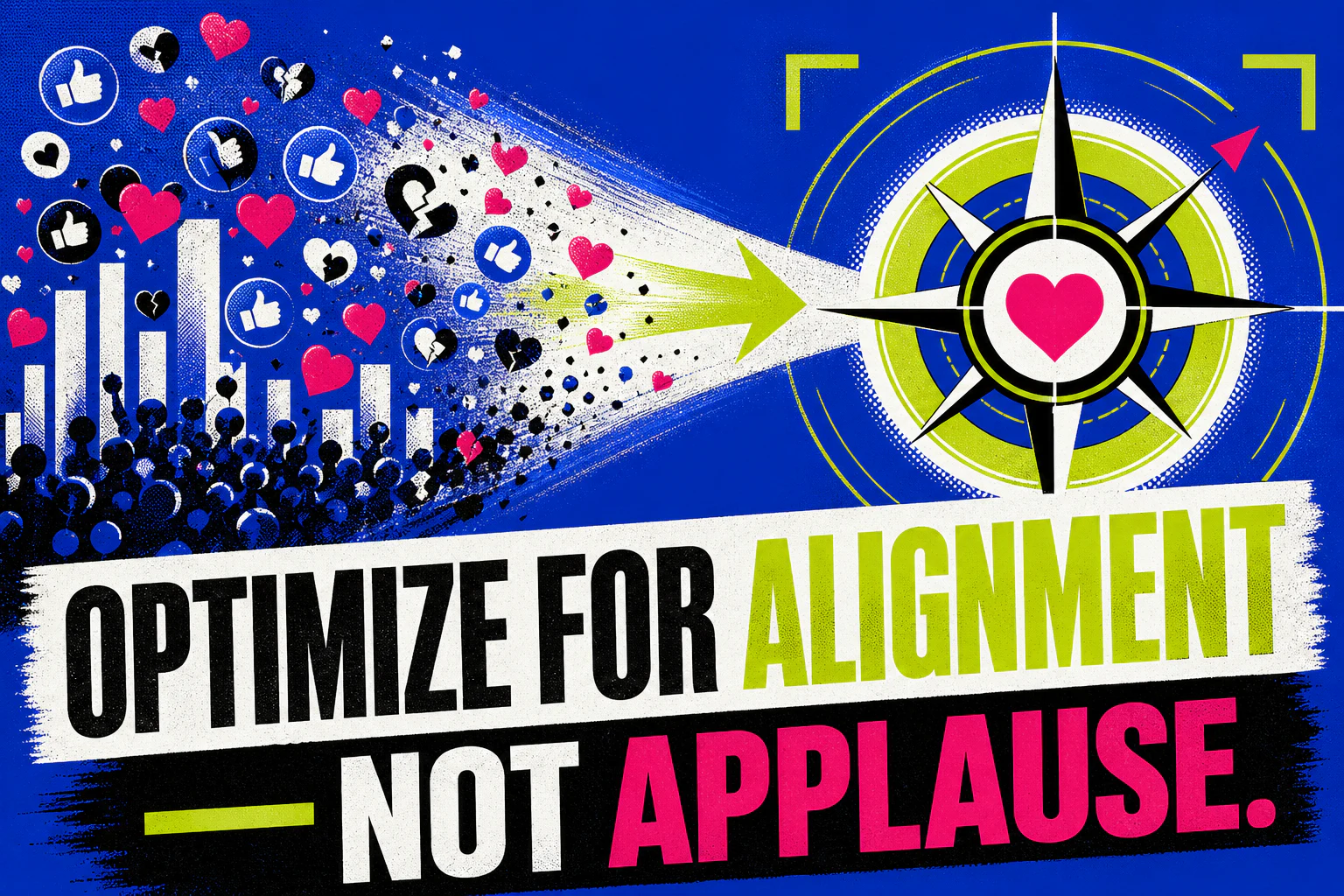
Better matches come from alignment, not maximum reach.
Choose a realistic target. Make your photos, bio, and intention tell the same story. Use filters for true incompatibilities. Swipe on people you would actually meet. Then measure conversations and dates rather than treating every match as a win.
Your profile does not need to persuade everyone. It needs to make the right next step obvious to the right person.
FAQ
Is it better to get fewer matches on dating apps?
It can be. Fewer matches are an improvement when a larger share are mutually attractive, compatible, conversational, and realistic to meet. A lower number caused by weak photos is not the same as a lower number caused by clearer targeting.
How do I stop attracting the wrong people?
Audit the signals repeated across your photos, bio, intention field, app choice, and filters. Remove contradictions, replace outdated lifestyle images, and add specific details that the people you want can recognize.
Should I use more dating app filters?
Use hard filters only for real incompatibilities. Too many stacked dealbreakers can make the pool unnecessarily small, while no filtering can waste attention on people you would never meet.
How long should I test profile changes?
Two weeks is a useful minimum for a directional test, though results depend on location, app activity, and audience size. Change a small set of related variables, keep your behavior reasonably consistent, and compare post-match outcomes.
What should I measure besides match count?
Track the percentage of matches you wanted, two-sided conversations, meaningful exchanges, dates arranged, and dates you would repeat. These measures are closer to your actual goal than raw likes.