 Bios & Prompts
Should You Put Your Height on Dating Apps? Pros & Cons
Should you list your height on dating apps? Learn when it helps, when it hurts, and how to show confidence without making it your whole profile.
In this article10 sections
A tiny height field can create a ridiculous amount of anxiety.
Should you fill it in? Leave it blank? Round up? Add a joke to your bio before anyone can judge you?
Here is the short answer: if the app gives you a dedicated height field, list your real height and move on. Do not repeat it in your bio, defend it, or turn it into the main story of your profile.
Height can matter to some people. It can also be used as a filter. But it is still only one part of a much larger decision that includes your photos, bio, lifestyle, expression, and overall credibility.
The goal is not to convince everyone that height is irrelevant. The goal is to give compatible people accurate information without making one measurement feel bigger than your personality.
The Quick Decision Guide
| Situation | Best move | Why |
|---|---|---|
| The app has a height field | Fill it in accurately | It answers the question without using bio space |
| The app has no height field | Usually leave it out | Your bio should show personality, not read like a form |
| Someone asks in chat | Answer directly | Calm honesty builds more trust than evasion |
| You feel insecure about your height | Do not make a defensive joke | The joke often communicates the insecurity you hoped to hide |
| You are tempted to round up | Use your actual height | A small mismatch can become a large trust problem in person |
| Height is genuinely important to you in a partner | Use filters where available | A list of demands in your bio can sound hostile or transactional |
That is the practical answer. The rest of this guide explains why it works.
Why Height Matters Less—and More—Than You Think
Height is not imaginary in online dating. On Hinge, for example, height is currently among the additional filters available to subscribers. If someone marks a height preference as a dealbreaker, leaving your field blank does not necessarily help you reach them.
At the same time, height is not the whole profile.
A 2025 open-access study observed 5,340 selection decisions from 445 online daters while varying profile photos, height, occupation, intelligence, and bio. Height had an effect, but visual attractiveness was overwhelmingly more influential, and bio quality also had a larger effect.
That distinction matters. You cannot edit your height, but you can improve the way the rest of your profile presents you.
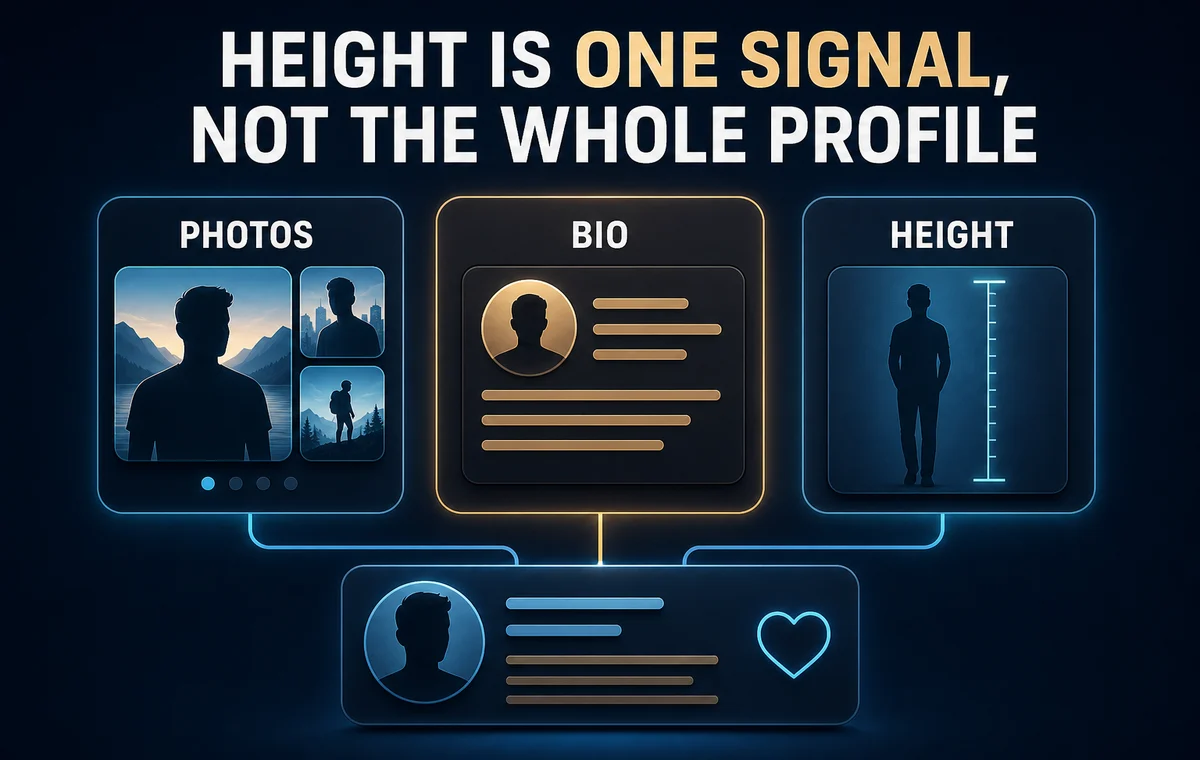
A person may have a preference and still respond to the complete impression of a profile. Your first photo sets the tone. Your other photos show context. Your bio gives them something to connect with. Your height field answers one factual question.
Treat those elements in proportion.
Find the Part of Your Profile You Can Actually Improve
If you are blaming your height for weak results, check the variables you can change before accepting that conclusion.
ProfileSharp reviews your photo lineup and shows where clarity, expression, variety, or photo order may be holding the profile back.
The Pros of Listing Your Height
1. It Sets Accurate Expectations
A profile is a preview of meeting you. Accurate basics reduce avoidable surprises and let both people decide with the same information.
This is especially useful when the app already provides a standard field. The information sits beside other basics instead of taking over your bio.
2. It Signals That You Are Comfortable With Yourself
Confidence is not writing, “I know I am short, but give me a chance.” Confidence is entering the accurate number and continuing with the interesting parts of your life.
The same principle applies if you are tall. You do not need to build a sales pitch around it. Let the field communicate the fact.
3. It Prevents Wasted Matches
If height is a strict preference for someone, hiding yours may delay the same decision until later. That does not create a better match; it creates more time invested before discovering an incompatibility.
Being filtered out is not always a loss. Sometimes it is the app doing exactly what a filter is meant to do.
4. It Keeps Your Bio Available for Better Material
Your bio should reveal taste, energy, humor, or a concrete part of your life. “Six feet because apparently that matters” does none of those things.
Use the structured field for structured information. Then use the bio to give someone an easy opening. If that part feels harder, see what to write in a dating profile bio.
The Cons—and What Actually Causes Them
Listing your height rarely hurts because the number exists. Problems usually come from how you frame it.
Inaccuracy Creates a Trust Problem
Rounding up by an inch may feel harmless on a screen. In person, it can make a date wonder what else was edited.
That risk is larger than the potential benefit. Pew Research Center found that most online daters believe people commonly lie to appear more desirable. You do not want a small measurement discrepancy to place your whole profile inside that suspicion.
This is the same reason old or misleading photos backfire. Our guide to accidental catfishing explains how small presentation gaps can create a bigger first-date trust problem.
Repeating It Makes Height Look Central
If the number already appears in a profile field, do not also put it in your bio, prompt, caption, and opening message. Repetition tells people that you think about it constantly.
One accurate field feels neutral. Four references feel like a campaign.
Defensive Humor Can Read as Bitterness
Avoid lines like:
- “Short king, since everyone here only wants six feet.”
- “Six feet in shoes.”
- “Apparently height matters more than personality.”
- “Do not match if you wear heels.”
Even if the joke is understandable, it introduces conflict before a conversation begins. A profile is stronger when it shows what being around you feels like—not what you resent about dating apps.
A Number Without Context Can Feel Bigger Than It Is
Dating apps compress people into cards. That makes every visible field feel unusually important.
The fix is not to manipulate the number. The fix is to build a fuller profile around it: a clear face photo, a natural full-body photo, social or activity context, and a specific bio. The best dating profile photos for men can help you create that broader impression.
How to List Height Without Making It a Big Deal
Use this three-step rule:
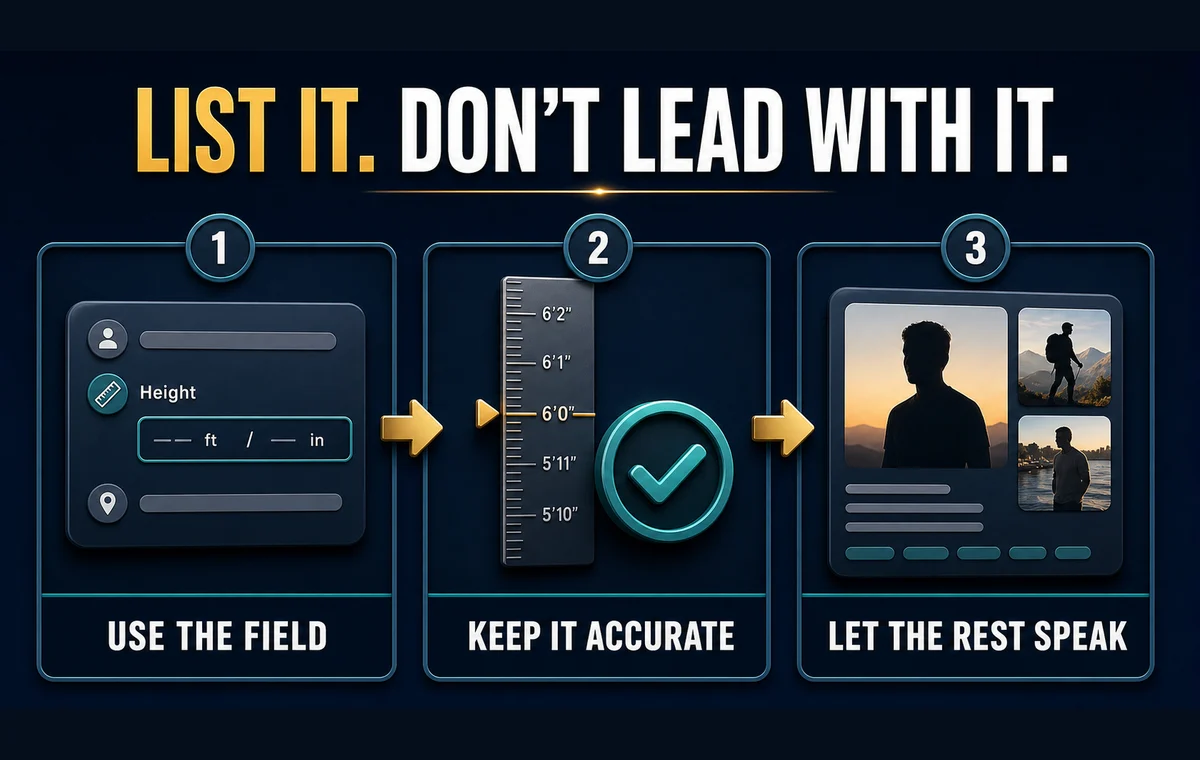
1. Use the Dedicated Field
If the app provides a height field, put the number there. Do not spend valuable bio or prompt space repeating information the interface already displays.
2. Keep It Accurate
Use the height you would give at a doctor's office, without shoes. If the app uses a different unit system, convert carefully instead of estimating.
Do not add one or two inches because “everyone does it.” Accuracy is simpler, calmer, and easier to carry into a first date.
3. Let the Rest of the Profile Speak
Once the field is complete, stop optimizing around it.
Use your first photo to show your face clearly. Include a natural full-body image rather than a low-angle trick designed to make you look taller. Add lifestyle context. Write a bio that gives someone a reason to message you.
If you are unsure which expression creates the best first impression, compare smiling and serious dating photos. The right choice is the one that looks confident and natural, not the one that tries hardest to compensate.
What If You Are Shorter Than Average?
List your real height if the field exists. Then build a profile around qualities that can be seen and felt:
- Clear, current photos with good light
- Clothes that fit well
- Upright, relaxed posture
- A genuine expression
- Activities and settings that show a real life
- A bio with specific interests and an easy conversation hook
Avoid camera tricks that collapse at the first meeting. Extreme low angles, cropped group photos, or never showing your full body can create uncertainty rather than attraction.
Also avoid making height your identity. You are not required to write a manifesto, apologize, or challenge strangers to prove they are not shallow.
Your profile only needs to make a credible introduction to the people who could genuinely like you.
Stop Guessing What Is Holding Your Profile Back
Height is easy to blame because it is visible and fixed. Your actual bottleneck may be a first photo, weak variety, low-quality lighting, or a lineup that sends mixed signals.
ProfileSharp gives you a structured review of the parts you can change.
What If You Are Taller Than Average?
Use the field, but resist the urge to make height the headline.
Leading with “6'3” as your main selling point can make the profile feel one-dimensional. It may also attract attention without creating compatibility.
Tall is a trait. It is not a personality, a conversation hook, or evidence that someone will enjoy a date with you.
The same rule applies: list it once, accurately, and give the rest of the profile more substance.
The Bottom Line
Should you put your height on dating apps?
Yes, when the app provides a height field. Enter it accurately and leave it there. If there is no field, you usually do not need to add the number to your bio unless it is genuinely relevant to the way you want to present yourself.
Do not round up. Do not apologize. Do not turn it into a joke about other people's preferences.
Height may affect who sees or chooses your profile, but it does not replace the rest of the profile. Strong photos, a specific bio, honest information, and a relaxed tone give people a much better picture of who they would actually meet.
FAQ
Should men put their height on dating apps?
Yes, if the app includes a height field. Use your actual height and do not repeat it in the bio. The advice is the same for anyone: accurate structured information is better than defensive explanation.
Should I put my height in my dating bio?
Usually not if the app already displays it elsewhere. Use your limited bio space for personality, interests, and conversation hooks.
Is it okay to round up my height on a dating profile?
No. A small numerical advantage is not worth creating doubt when you meet. Use the number you would give without shoes.
Will leaving my height blank get me around filters?
Do not count on it. Apps handle missing fields differently, and people can still ask later. Omitting accurate information is not a reliable matching strategy.
What should I say if someone asks about my height in chat?
Answer simply and move on: “I'm 5'8.” You do not need to defend the number or ask why it matters before you have even met.
How can I improve my profile if I cannot change my height?
Focus on clear photos, expression, lighting, posture, photo order, lifestyle context, and a specific bio. Those elements create the complete impression and are all adjustable.